
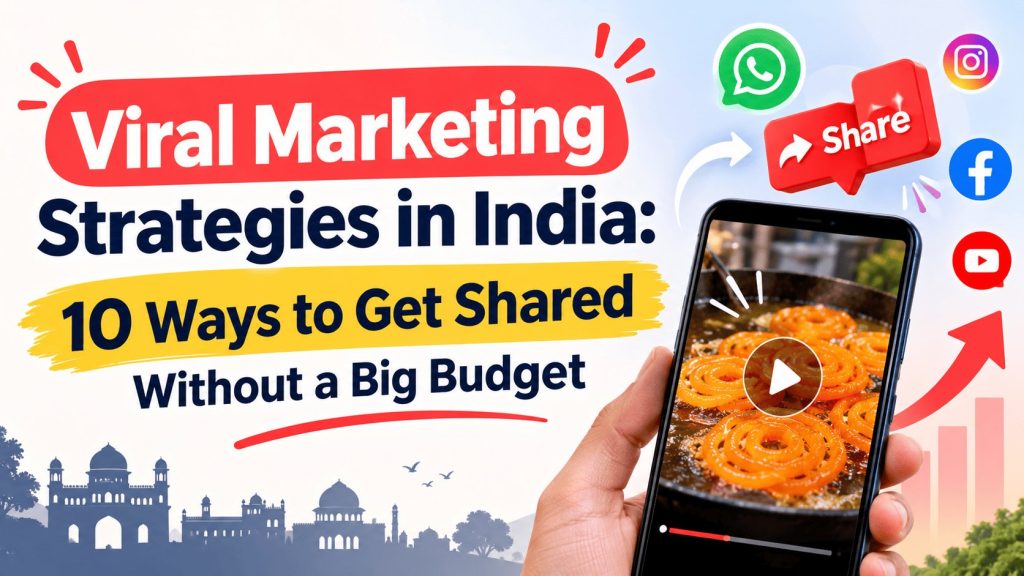
Last checked: 18 November 2026. Social apps change their rules often, so we update this guide when they do.
Picture a small sweets shop in Indore. The owner posts a 20-second video of fresh jalebis dropping into hot oil, with a plain caption and no budget behind it. By night, the clip has been sent to family WhatsApp groups, a few college friends have tagged each other, and strangers from other parts of the city are asking if he delivers. Nobody planned it, and he could not repeat it on demand.
That is the honest picture of viral marketing. It looks like magic, but most of it comes from a few simple habits, plus a lot of timing and luck.
This guide covers the viral marketing strategies in India that give a small business the best chance of getting shared. We will also tell you plainly what you can plan and what you can’t. You will find ten strategies, real Indian examples, a simple 30-day plan, the mistakes that backfire, and how to tell whether any of it worked.
What is viral marketing?
Viral marketing means creating something so useful, funny or moving that people share it on their own. The brand makes it once, and the audience spreads it. You pay little or nothing for each extra person who sees it.
Here is the part most guides skip: nobody can promise a post will go viral. Not us, not a big agency, not a famous creator. Sharing depends on mood, timing, and what else is happening that day. Anyone who guarantees a viral campaign is selling something.
What you can do is raise your chances. Some things are in your hands, and some are not.
You can control:
- How strong the first few seconds of your video are
- Whether the idea is easy to understand and easy to send
- Whether it fits your audience, language and city
- How often you try
- Whether you are ready to handle the attention when it comes
You can’t control:
- The exact moment people are in the mood to share
- What the platform decides to show
- Whether a bigger event pushes your post out of sight
A good strategy is mostly about trying more often, with better ideas, and learning from each try.
Why India is a good place for sharing
Indians share a lot, and much of it happens in private chats. Estimates differ by source, but India has more than 500 million WhatsApp users, roughly 480 million Instagram users, and about 500 million YouTube users. India is the biggest market for all three.
That matters because the most powerful sharing here is not a public post. It is a forward in a family group, a reel sent to a friend, or a link dropped in a college chat. A good idea can spread through those small circles faster than you would expect.
Viral marketing in India: the numbers
India has about 1.03 billion internet users and 500 million social media user identities, which gives a good idea can reach a huge crowd. These figures come from DataReportal’s Digital 2026: India report, which covers data up to October 2025.
| Platform | Users in India (late 2025) | How sharing happens | Where it works best (our view) | |
|---|---|---|---|---|
| YouTube | About 500 million | Search, suggested videos, links sent in chats | How-to videos and longer stories | |
| About 481 million | Reels and posts sent by DM, Stories, tags | Short video and product visuals | ||
| About 403 million | Shares to groups and pages | Local and community audiences | ||
| 500 million+ (estimates vary) | Forwards in chats and groups | Referrals, offers and enquiries |
A few more numbers worth knowing:
- Instagram’s reach in India grew by about 90 million people (22.9%) in the year to October 2025, according to Meta’s ad tools.
- Instagram reaches roughly 47% of India’s internet users.
- About 70% of Instagram’s adult audience in India is male. If your customers are mostly women, check who your posts actually reach before you assume a viral post will help.
Two cautions. These are ad reach figures from each platform, which are not the same as monthly active users. And WhatsApp has no public ad figure like the others, so its number is a third-party estimate.
Why people share things
Before the strategies, one simple idea. People share content for a few reasons:
- It made them laugh or feel something strongly
- It helped them, and they want to help a friend
- It says something about who they are, such as their city, their taste or their values
- It gave them a reason to join in
- It was easy to send
Every strategy below leans on one or more of these. If your post gives people none of them, it will not spread, however big the budget.
10 viral marketing strategies that work in India
1. Make content people want to send to a friend
This is the base for everything else. Instagram’s head, Adam Mosseri, has said the three signals that matter most for ranking are watch time, likes and sends. Sends are the times someone shares your post with a friend through a message. Several guides report that sends count most when Instagram decides whether to show your post to people who don’t follow you yet. Instagram has not published exact weights, so treat any claim like “a send is worth five likes” with caution.
So ask one question before you post: who would send this to whom, and why?
Posts that people send tend to be:
- Relatable, like “every Indore person knows this feeling”
- Useful, like a checklist, a price guide or a quick tip they can pass to a friend
- Funny or surprising in a way that fits your brand
If you can’t name a person who would send it, rework the idea.
2. Win the first three seconds
Watch time is the other big signal. If people swipe away at once, the platform stops showing your video. If they watch to the end, it shows it to more people.
A few habits help:
- Start with the most interesting moment, not a logo or a long hello
- Put the main idea in words on the screen, since many people watch with the sound off
- Keep the video as short as the idea allows
- End on something that makes people want to watch again or send it
Our sweets shop example works because the hot oil and the first jalebi swirl appear in the first second. Compare that with a clip that opens on a shop signboard for five seconds.
3. Use your city, your language and your festivals
Generic content gets a shrug. Local content gets a “this is so true.” Talk the way your customers talk. Use Hindi, Hinglish or a regional language if that is how your audience speaks. Make jokes about the things only your city understands, such as the traffic, the rain, the poha at breakfast or the wedding season rush.
Reports on Indian brand campaigns often point to Zomato’s city-specific meme posts as an example. People share them because they feel written for their own town. You do not need that scale. A local shop can do the same with its own neighbourhood.
Festivals work well too, since people are already in a sharing mood. Plan ahead for Diwali, Holi, Eid, Raksha Bandhan, Navratri and the wedding season, and avoid starting your idea the day before.
4. Join the conversation fast, in your own voice
Some of the best-known Indian brand content comes from reacting quickly to what everyone is already talking about. Amul has done this with its topical ads since the 1960s, turning news, cricket and film moments into one-line cartoons. Blinkit and Tinder ran cheeky billboards together for Valentine’s Day 2024, one asking “You up?” and the other replying “See you in 10.”
You can borrow the idea without the big budget:
- Watch what is trending in your city and your industry each morning
- Pick only the topics that fit your brand
- Make a simple post in a few hours, while the topic is still fresh
- Keep your usual voice, so people still know it is you
One rule matters more than all the others. Skip anything that touches tragedy, disasters or sensitive news. A joke that lands badly can hurt a brand far more than a viral post can help it.
5. Invite people to join in
A post people only watch can spread. A post people can copy, answer or remix spreads further. In 2019, Swiggy ran its #VoiceOfHunger campaign, which asked people to use Instagram’s voice note feature to make shapes of food from their own voices. People became the content, so they shared it with friends.
Small businesses can use the same idea in simpler ways:
- A “show us how you use it” challenge, with a small prize
- A caption contest
- A “tag the friend who always does this” post
- A simple template people can fill in with their own details
Keep the rules short and the entry easy. If joining takes more than a minute, most people won’t.
6. Build a referral loop into your business
Some of the strongest sharing is not a post at all. It is a friend telling a friend. You can make that easier with a simple referral offer.
For example, a coaching centre could give both the current student and the friend they bring a small discount. A salon could give a free add-on to anyone who brings someone new. The key is that both sides benefit, and sharing takes one tap on WhatsApp.
A few tips:
- Give people a ready-made message and link they can forward
- Keep the reward simple, and say it clearly
- Thank people quickly when a referral works
- Track who brought whom, even if it is only in a notebook or a spreadsheet
If you want to handle many enquiries from WhatsApp, our guide to WhatsApp Business automation for Indian SMEs shows how to reply without losing leads.
7. Give away something genuinely useful
People love to share things that save them time or money. A free checklist, calculator, template or guide can travel far, because it is useful to the person who sends it as well as the person who receives it.
We use this idea ourselves. Tools like our Google Business Profile Health Score Checker and our Instagram Engagement Rate Calculator give people a quick answer for free, and they pass it on.
Think about what your customers keep asking you. A caterer could share a party quantity chart. A tutor could share an exam revision plan. A mechanic could share a simple service schedule. If you answer the same question ten times a week, turn it into something shareable.
8. Tell real human stories
People share what makes them feel something. Founder stories, behind-the-scenes clips, customer journeys and honest mistakes often do better than polished ads, because they feel real.
Ideas to try:
- The story of why you started the business
- A day in the life of your team
- A customer who got a great result, with their permission
- The time something went wrong and how you fixed it
Do not invent a story. If it is not true, people can often tell, and the damage to trust lasts longer than the post does.
9. Work with small creators and your own customers
You don’t need a celebrity. Local and small creators often have followers who trust them more, and they cost much less. Your own happy customers can also be your best voice. Ask them to share a photo or video, and repost it with their permission.
A few practical points:
- Pick creators whose audience matches your customers, not just those with the biggest numbers
- Agree on what you want, and let the creator keep their own style
- Make sure paid partnerships are marked clearly. India’s advertising rules for influencers ask for disclosure, so check the latest guidelines from the Advertising Standards Council of India before you start
10. Give your best post a small paid push
Here is something free guides rarely say: viral marketing is not always free. Many posts that seem to spread on their own got a small paid boost at the start.
If one of your posts is doing well, you can put a small budget behind it so more of the right people see it early. This helps the post reach the point where people start sharing it themselves. It works best when you pick a post that is already getting real reactions, and it is a good use of a small Meta Ads budget. If you would like help with this, see our Meta Ads services.
Whatever the budget, be ready for the attention. If a post takes off and your website is slow, your WhatsApp is unanswered or your stock is out, you waste the best moment you will get.
Which strategy fits your business? A quick comparison
Not every strategy suits every business. Use this table to pick two or three to start with.
| Strategy | Cost | Effort | Time to see results | Risk | Best for |
|---|---|---|---|---|---|
| 1. Shareable content | Low | Medium | Weeks | Low | Every business |
| 2. Strong first seconds | Low | Medium | Days to weeks | Low | Anyone posting video |
| 3. Local language and festivals | Low | Low | Days | Low | Local and regional brands |
| 4. Trend and news posts | Low | High | Hours to days | High | Brands with a clear voice and a quick approval process |
| 5. Challenges and join-in posts | Low to medium | Medium | Weeks | Medium | Consumer brands with a visual product |
| 6. Referral loop | Medium | Medium | Weeks to months | Low | Services and repeat-purchase businesses |
| 7. Useful free tool or guide | Medium | High at the start | Months | Low | Businesses with expertise to share |
| 8. Real human stories | Low | Medium | Weeks | Low | Founders and small teams |
| 9. Small creators and customers | Medium | Medium | Weeks | Medium | Products people like to show off |
| 10. Small paid push | Medium | Low | Days | Low | Any post that is already doing well |
These ratings are our own view, based on typical small business projects. They are not measured data, so adjust them for your own situation.
What you can plan and what is luck
Here is a quick way to keep your expectations honest.
Plan it:
- The hook, the format and the length
- The language and the local detail
- A reason to share, such as a laugh, a tip or a reward
- The calendar, including festivals and events
- A small test budget
- Your reply system for comments, messages and orders
Leave it to luck:
- Which post takes off
- When it takes off
- How far it travels
So plan for many small chances, not one big hit. A business that posts good ideas every week and learns from each one will usually beat a business waiting for one perfect idea.
A simple 30-day plan for a small business
Week 1: Get ready. Pick your main platform, probably Instagram or YouTube Shorts. Write down five questions your customers ask most. Check that your profile, website and WhatsApp number work and are easy to find.
Week 2: Test ideas. Post four to six short videos. Try different hooks and different formats, such as a tip, a behind-the-scenes clip, a local joke and a customer story.
Week 3: Look at the results. Open your Insights. Note which posts got the most sends, saves and full views. Make three more videos in the style of the best one.
Week 4: Push and add a loop. Put a small budget behind your best post. Add a simple referral offer or a free useful item. Reply to every comment and message quickly.
Then repeat the month with what you learned. If you want ideas on tracking your numbers, our Instagram Engagement Rate Calculator is a good start.
Mistakes that backfire
- Chasing every trend. If it doesn’t fit your brand, skip it. A forced trend looks desperate
- Making jokes about sensitive events. The risk is far bigger than the reward
- Buying followers or views. Fake numbers don’t spread posts or bring customers, and they can hurt your reach
- Running a giveaway with no clear rules. Unclear contests lose trust fast
- Copying another brand’s idea. Use it for inspiration, then make it your own
- Having no plan for attention. Viral reach with no way to respond is wasted
- Judging success only by views. A post with millions of views and no sales may not help your business
- Giving up after two posts. Most posts will not spread. That is normal
How to know if it worked
Views are exciting, but they are not the goal. Look at the numbers that connect to your business:
- Sends and saves. These show people found it worth passing on or keeping
- Average watch time. This shows whether your hook and story work
- New followers from the post. This shows whether it brought in the right people
- Profile visits and website clicks. These show interest beyond the video
- WhatsApp enquiries, calls and orders. These show whether attention turned into business
Compare these numbers across posts. Over a few weeks, you will see what your audience likes, which is more valuable than any single viral hit.
Final thoughts
You cannot force a post to go viral, but you can give it a fair chance. Make content people want to send, hook them quickly, speak like your customers, and join in when something relevant happens. Add a referral loop and a useful free item, and use a small budget to push your best work. Then measure what matters, which is sales and enquiries, not only views.
Start small. Post often, learn from each result, and keep what works. The sweets shop owner in Indore did not plan his viral video, but he made a good one, and he kept making more.
If you would like a hand with your social media, short videos, ads or WhatsApp marketing, talk to the Digital Dawn team. You can also look at our social media marketing services, video production services and WhatsApp marketing services.
