
Last Updated: June 2026
Most businesses are not failing at digital marketing because they are lazy. They are failing because they are doing a lot of things without a clear plan behind any of them.
They post on Instagram for a few weeks, run a Google Ad or two, write a few blog posts, and then wonder why none of it is bringing in results. The problem is not the tactics. It is the lack of a strategy connecting them.
This guide walks you through how to build a digital marketing strategy from scratch — one that is realistic, focused, and designed to get you results.
What Is a Digital Marketing Strategy?
A digital marketing strategy is your game plan for getting in front of the right people online, convincing them you are worth their time, and converting them into paying customers.
It is not a list of things to post on social media. It is a clear answer to three questions:
- Who are you trying to reach?
- What do you want them to do?
- Which digital channels and methods will get you there?
Without that clarity, you are just throwing content at the wall and hoping something sticks.
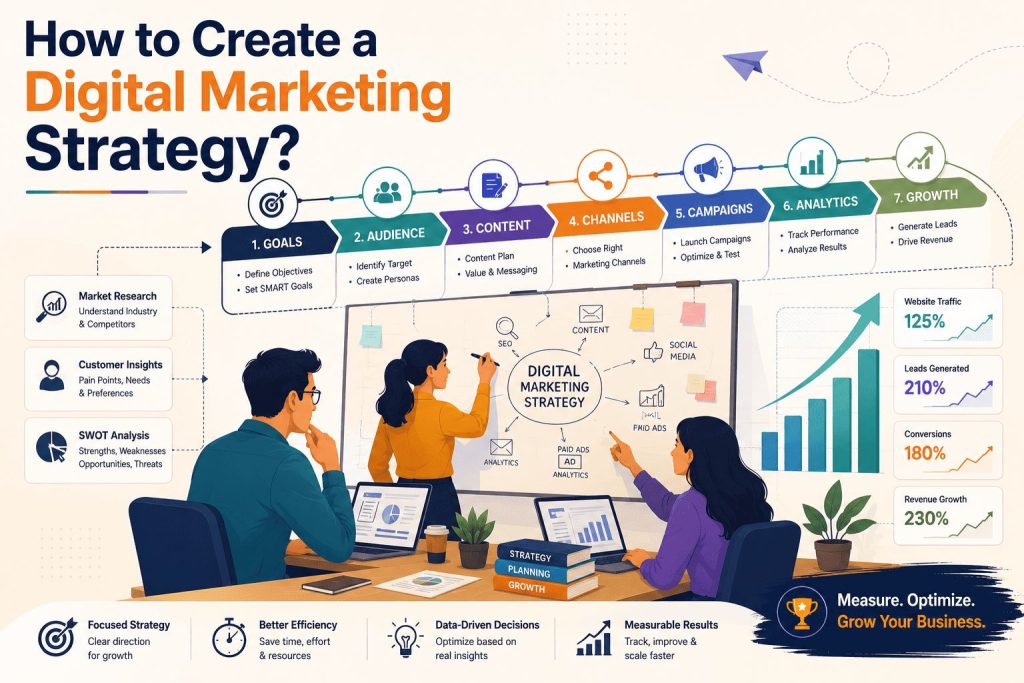
Step 1: Set Goals You Can Actually Measure
Before you do anything else, decide what success looks like.
Vague goals like “increase brand awareness” or “get more customers” do not work. You cannot measure them, which means you cannot tell if your strategy is working or not.
Instead, set specific targets or SMART Goals. For example:
- Generate 100 leads per month from Google Ads by September 2026
- Increase organic website traffic by 30% in 6 months
- Get 10 new client inquiries per month from Instagram
These are goals you can track weekly. You will know if you are on track or if something needs to change.
A good rule of thumb: if you cannot put a number to your goal, make it more specific until you can.
Step 2: Get Clear on Who You Are Talking To
This is where most businesses rush, and it costs them later.
Your target audience is not “everyone who might need my product.” That thinking leads to generic content that resonates with nobody. You need to get specific about who your ideal customer is.
Ask yourself:
- What does my ideal customer do for a living?
- What problem are they trying to solve?
- Where do they spend time online?
- What do they read, watch, or listen to?
- What makes them choose one business over another?
If you have existing customers, talk to them. Ask them why they chose you, what almost stopped them, and what they were searching for before they found you. That conversation will give you more useful information than any demographic report.
The clearer you are on your audience, the better every piece of your strategy becomes — your messaging, your content, your ad targeting, everything.
Step 3: Audit What You Already Have
Before building something new, take stock of what you already have.
Look at your website, your social media profiles, any existing content, and your past ad campaigns. Ask:
- Which pages on your website get traffic and which do not?
- Which social posts performed well and why?
- If you have run ads before, what worked and what did not?
- Are you ranking on Google for any keywords?
This audit helps you avoid rebuilding things that already work and fixes you identify things that are quietly holding you back. A slow website, a confusing homepage, or a social media page with no real content — these issues will kill your results even if everything else in your strategy is right.
Use Google Analytics and Google Search Console for your website data. Both are free and give you more insight than most paid tools.
Step 4: Choose the Right Channels
You do not need to be on every platform. You need to be on the right ones.
Here is a simple way to think about it:
SEO and content marketing work best if you want long-term, compounding traffic. It takes time — usually 6 to 12 months to see real results — but once it works, it keeps working without you spending money on ads every month.
Google Ads work best when people are already searching for what you sell. If someone types “digital marketing agency in Indore” into Google, they are ready to buy. A well-run Google Ads campaign can put you in front of them immediately.
Meta Ads (Facebook and Instagram) work best for reaching people who do not know they need you yet. Good for building awareness, promoting offers, and retargeting people who visited your website.
Social media marketing works best for building trust and staying top of mind. It is rarely the first place someone decides to buy from you, but it is often the place they go to check if you are legitimate before they do.
Email marketing works best for nurturing people who already know you. If you have a list, it is one of the most cost-effective channels available.
Pick two or three channels to start. Do them properly before adding more. Spreading yourself thin across six channels is how businesses end up with mediocre results everywhere.
Step 5: Build a Content Plan
Content is what powers most of your digital marketing. Blog posts drive SEO. Social posts build trust. Ad creatives get clicks. Email newsletters keep your audience warm.
But content without a plan becomes a chore that produces inconsistent results.
Here is what a basic content plan should include:
👉 What you will create: Blog posts, short videos, social media posts, email newsletters — decide which formats make sense for your business and audience.
👉 How often you will publish: Be realistic. Publishing one good blog post a week is better than burning out trying to post three times a day on five platforms.
👉 What topics you will cover: Focus on questions your customers are already asking. What are they searching for? What problems do they need help with? Answer those questions better than anyone else.
👉 Who will create it: If you are a one-person business, this might be you. If you have a team, decide who owns content so it does not fall through the cracks.
👉 One practical tip: start with SEO-focused blog posts. They take time to rank, but they bring in traffic for months or years after you publish them. That is a much better return than a social media post that disappears in 48 hours.
Step 6: Set Your Budget
Digital marketing does not have to be expensive, but you do need to be intentional about where your money goes.
A common mistake is splitting a small budget across too many channels. If you have Rs 20,000 a month to spend on paid ads, concentrating all of it on one well-targeted Google Ads campaign will almost always outperform splitting it between Google, Facebook, and Instagram.
Think about your budget in two buckets:
Paid channels — Google Ads, Meta Ads, LinkedIn Ads. These get you results faster but stop the moment you stop spending.
Organic channels — SEO, content, social media. These take longer but build lasting assets that work for you over time.
A good strategy usually has both. Use paid channels for quick wins while you build organic assets that compound over time.
Step 7: Track, Measure, and Improve
A digital marketing strategy is not something you set once and forget. It needs to be reviewed regularly.
Set up tracking from day one. At minimum, you need:
- Google Analytics on your website to track traffic and conversions
- Google Search Console to track your SEO performance
- Conversion tracking in your ad accounts to know which campaigns are generating leads or sales
Every month, review the numbers. What is working? What is not? Where are you spending money or time without seeing results?
Then make changes. Cut what is not working. Double down on what is.
This is how good digital marketing strategies actually get better over time — not by adding more channels or more content, but by paying close attention to what the data is telling you and acting on it.
Common Mistakes to Avoid
❌ Trying to do everything at once. Pick a few channels and do them well. You can expand later.
❌ Ignoring your website. Your ads and social posts send people to your website. If the website is slow, confusing, or unconvincing, no amount of marketing spend will save it.
❌ Creating content without thinking about SEO. If your blog posts are not optimized for the keywords your audience is actually searching, they will not get found.
❌ Not tracking results. If you are not measuring what is working, you are flying blind. Even a basic monthly review of your analytics will help you make better decisions.
❌ Expecting overnight results. SEO takes months. Brand building takes longer. Be patient with the slow-burn channels while using paid ads for quicker feedback.
Putting It All Together
Here is the simple version of everything above:
- Set specific, measurable goals
- Get really clear on who you are talking to
- Audit what you already have
- Pick two or three channels and commit to them
- Build a realistic content plan
- Set a focused budget
- Track your results and keep improving
A digital marketing strategy does not need to be a 50-page document. It needs to be clear enough that you know exactly what to do every week and why you are doing it.
Want help building a digital marketing strategy for your business? At Digital Dawn, we work with businesses in Indore and across India to create marketing plans that drive real results. See what we do and get a free audit.