
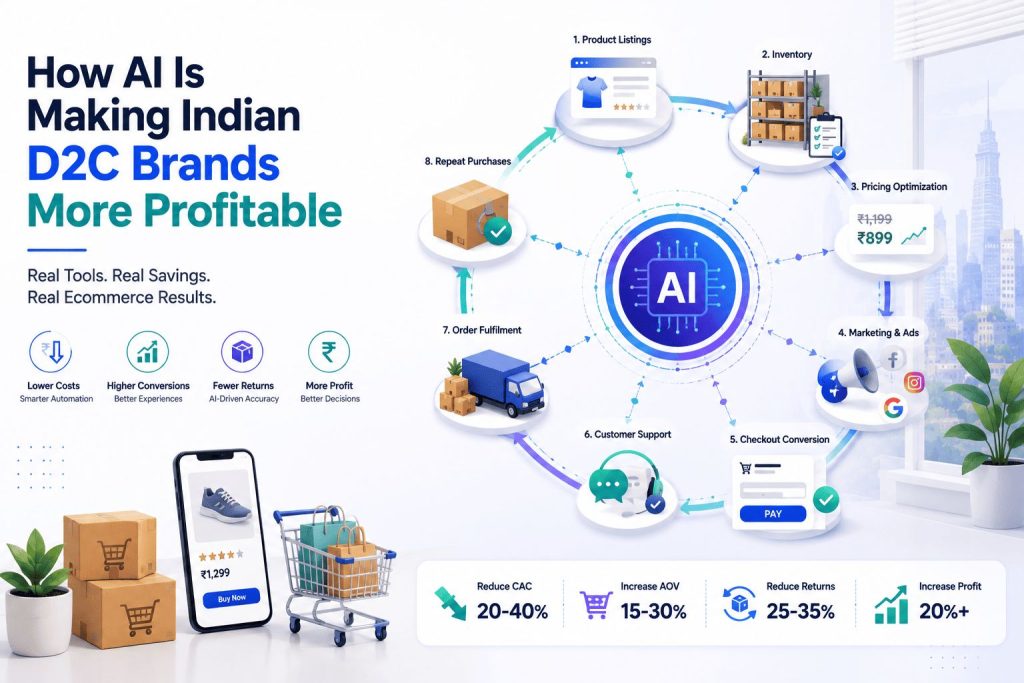
A D2C apparel brand in Tirupur was losing ₹3 lakh a month to COD returns. One AI-powered checkout change cut that in half. This is what AI in Indian ecommerce actually looks like in 2026 — not the hype, the practical shifts already changing who wins.
Every ecommerce conference in India this year has had at least one session titled something like “The Future of AI in Ecommerce.” Most of them talk about the future. What we want to talk about is the present — because AI has already moved from a nice-to-have feature to something that is directly changing which Indian ecommerce brands make money and which ones don’t.
We work with ecommerce and D2C clients across categories — fashion, home goods, wellness, electronics accessories. What we are seeing on the ground is different from what most “AI ecommerce trends” articles describe. It is less flashy and more operational. It shows up in return rates, checkout completion, customer support costs, and how fast a seller can list a hundred products on Meesho without losing their mind.
This article walks through where AI is genuinely changing outcomes for Indian ecommerce businesses right now, with real numbers and specific tools — not a generic list of “10 AI trends to watch.”
18–32%
Average RTO rate for Indian D2C brands in 2026, depending on category and COD share
Source: HillTeck, May 2026
28%
Indian shoppers who say AI shopping assistants and chatbots are genuinely valuable
Source: Industry survey, 2026
14 Bn
UPI transactions per month in 2026, continuing to squeeze out cash-on-delivery
Source: ROI Hunt, April 2026
The single biggest AI win in Indian ecommerce: fixing returns
If you sell online in India, you already know the pain of cash-on-delivery returns. A customer orders, the courier reaches their doorstep, and they simply refuse to accept it. The product travels back, shipping gets paid both ways, and sometimes the item arrives damaged and cannot even be resold. This single problem — called RTO, or Return to Origin — quietly eats more margin than almost anything else in Indian ecommerce.
In 2026, the average RTO rate across Indian D2C brands sits between 18 and 32%, depending on the product category, how much of your sales are cash-on-delivery, and which regions you serve. That range is enormous, and the difference between the low end and the high end usually comes down to one thing: whether the brand is using AI to predict and prevent bad orders before they ship, or just accepting whatever comes in.
REAL EXAMPLE
A D2C apparel brand based in Tirupur was losing roughly ₹3 lakh a month to COD returns. Products would go out, come back unaccepted, and the brand paid shipping both ways — sometimes on a product that arrived damaged and could not be sold again. They implemented an AI tool that identifies high-risk COD customers at the moment of checkout and offers them a small discount — around ₹50 — to switch to prepaid instead.
The result: their COD return rate dropped from 38% to 19% within three months.
₹1.5 lakh saved every month, from one checkout change
How does this actually work? The AI looks at dozens of signals the moment someone places an order — has this phone number or email placed and cancelled orders before, is this pincode known for high delivery failure rates, does the order pattern match known risky behaviour. Based on that risk score, the checkout either nudges the customer toward prepaid with a small incentive, asks for order confirmation through a WhatsApp message, or in some cases blocks a clearly fraudulent order before it ever gets shipped.
Brands that have adopted these AI risk-scoring and WhatsApp confirmation tools have brought their RTO rates down to 8 to 14%, roughly half of what brands without any verification system experience.
| Approach | Typical RTO Rate | What it means for a ₹10L/month brand |
|---|---|---|
| No verification system | 28–40% | ₹2.8L–4L in lost shipping and unsold returns |
| Basic manual calling team | 18–25% | Reliable but expensive to scale past 200 orders/day |
| AI risk scoring + WhatsApp confirmation | 8–14% | ₹80K–1.4L in losses, less than half the unmanaged rate |
For any Indian brand processing more than 200 cash-on-delivery orders a day, keeping a manual calling team to confirm every order is expensive and does not scale reliably. Voice AI that calls to confirm orders automatically has moved from an experimental idea to something widely used across leading Indian D2C brands in 2026 — it solves the scalability problem permanently.
Which tool should you actually use?
Three names come up consistently when Indian D2C brands talk about fixing RTO with AI, and they take slightly different approaches.
The most established name in this category, built specifically around AI-driven checkout optimisation and RTO reduction. It profiles buyers using 200+ signals and offers a guarantee model on approved orders — meaning GoKwik itself absorbs some of the RTO risk on orders it greenlights. Reports around an 18% reduction in COD-based RTOs on average, with over ₹130 crore saved across its brand network through these interventions. Pricing is a flat 2.5% on prepaid transactions, with the first 1,000 COD orders free every month — best suited to fashion, beauty, wellness, and lifestyle brands where COD and return rates run highest.
The natural choice if you are already using Shiprocket for logistics, since the checkout and RTO tools sit inside the same platform as your shipping and fulfilment. It completes checkout in under 40 seconds, prefills addresses automatically from its logistics network, and uses COD fees plus prepaid nudges to shift customers toward safer payment modes. Shiprocket claims RTO loss reductions of up to 45% with its tools, and COD charges typically run 1 to 2% depending on your plan.
The lighter, more transparent option — a good fit for early-stage brands, especially ones already using Razorpay for payments. It combines risk scoring with automated RTO reimbursement protection rather than GoKwik’s full conversion-optimisation suite. Less feature-heavy than GoKwik, but simpler to set up and priced more predictably, which matters for a brand just starting to tackle its RTO problem.
If you are doing under 200 COD orders a day and just want to stop the bleeding, start with Razorpay Magic or Shiprocket Checkout if you are already on either platform — the setup is simpler and there is no new vendor relationship to manage. If RTO is a serious, ongoing drain on a fashion, beauty, or lifestyle brand doing meaningful volume, GoKwik’s dedicated focus on this exact problem and its guarantee model make it worth the flat 2.5% fee.
Listing products across marketplaces: from a full day to a few minutes
If you sell on Meesho, Amazon, or Flipkart — or all three, which is increasingly the norm for Indian sellers — you know how much time product listing eats up. Writing titles within character limits, crafting bullet points, finding the right HSN code, resizing images to each platform’s exact requirements, and doing all of this again for every single SKU.
This is one of the clearest places where AI has changed daily operations for Indian sellers, not in some abstract future sense but right now, this month. Tools built specifically for the Indian marketplace ecosystem take a single product photo and generate a complete, ready-to-publish listing — SEO-friendly title, description, bullet features, keyword tags, suggested pricing, and even the HSN code — formatted correctly for Meesho, Amazon, or Flipkart’s specific requirements.
AI image and listing generators for Indian marketplaces
Tools built specifically for Meesho, Amazon, and Flipkart sellers can now take one product photo and generate a complete listing — background removed, resized correctly, with an SEO title, description, and keyword tags — in seconds rather than the 15 to 20 minutes it used to take per product. Sellers using optimised, AI-generated images report significantly faster listing approval on Meesho, since the images meet platform requirements on the first attempt rather than getting rejected and resubmitted.
Bulk cataloguing for high-volume sellers
For sellers managing hundreds or thousands of SKUs, newer AI cataloguing tools built on computer vision and large language models can process an entire spreadsheet of products and generate full marketplace-ready listings in bulk — turning what used to be days of manual work into an afternoon. This matters enormously for the Surat, Tirupur, and Delhi-based sellers who are the backbone of Meesho’s supplier base and often run lean teams with no dedicated cataloguing staff.
Specific tools worth trying
A handful of tools built specifically for Indian marketplace sellers stand out from the generic global options:
A free-to-start toolkit built around a Meesho Image Optimizer — background removal, resizing to the exact 1080×1080 format Meesho requires, and shipping cost reduction — bundled with a profit calculator, GST report generator, and invoice maker. Sellers using its optimised images report 60% faster listing approval. Paid image credits start from ₹49 a month, which makes it accessible even for a seller just starting out with a handful of SKUs.
Focused purely on generating SEO-optimised listings — titles, bullet points, and backend keywords — formatted correctly for Amazon, Flipkart, Myntra, and Meesho in one go. Useful if your main bottleneck is writing rather than images, since it adapts automatically to each platform’s character limits and listing structure.
Built for sellers operating at real scale — it can process up to 50,000 SKUs a month using Google’s Vertex AI and Gemini models for both image generation and listing text. Overkill for a seller with 50 products, but a genuine fit for an established Meesho or Amazon seller managing a large and constantly changing catalogue across multiple marketplaces.
For a seller just starting to explore AI-assisted listings, SellerShip’s free tier is the easiest place to begin — it solves the two most time-consuming parts (images and basic listing data) at effectively zero cost for low volumes. Move to Sellermitra or ListIQ once your catalogue grows large enough that writing quality and scale become the bigger constraint.
💡 Worth knowing before you rely on these tools:
AI-generated listings are a strong starting point, not a finished product. Always review the generated title and description for accuracy — AI occasionally invents product specifications that are not true, which creates real problems with returns and platform penalties if a customer receives something different from what was described. Treat the AI output as a fast first draft that you check, not a fully automated pipeline you never look at.
Customer support: the shift to AI-first, human-backup
Indian shoppers are increasingly comfortable with AI-powered customer interactions — and this is changing how ecommerce businesses need to think about support. Roughly 28% of Indian shoppers now say AI-powered shopping assistants and chatbots are genuinely valuable, and 17% report having already made a purchase based on an AI recommendation. Those are not small numbers for a market that was largely skeptical of chatbots just a couple of years ago.
What has changed is the quality of these interactions. Older ecommerce chatbots were rigid decision trees that frustrated customers and got escalated to a human within two messages. The current generation, especially on WhatsApp — where the vast majority of this activity in India actually happens — can hold a genuine conversation, answer specific product questions, help with sizing or compatibility, and only hand off to a human when the conversation genuinely needs one.
Meesho, which serves over 400,000 sellers, has built AI-supported automation into its customer care operations at scale, with the majority of routine issues resolved without a human ever getting involved. For individual sellers and D2C brands, replicating even a simplified version of this on WhatsApp — automated responses to common questions like sizing, delivery timelines, and return policy — removes a meaningful chunk of daily support workload.
The pattern across every category we have looked at is the same: AI is not replacing the checkout, the catalogue, or the support team. It is replacing the slow, repetitive parts of running each of those — and giving that time back to the parts of the business that actually need human judgment.
Product discovery is shifting — and search visibility rules are changing with it
This is the part of the AI ecommerce shift that most Indian sellers have not caught up to yet, and it is worth paying close attention to. Increasingly, product discovery does not start with a Google search that lands on a website. It starts with a question typed into ChatGPT, Perplexity, or a Google AI Overview — “best budget wireless earbuds under 2000,” “which sunscreen is good for oily skin in India” — and the AI tool recommends specific products and brands directly in its answer.
This has created a new discipline that is being called Generative Engine Optimization, or GEO — essentially making sure your brand and products are structured, described, and reviewed in a way that AI tools are likely to reference and recommend when someone asks a relevant question. It sits alongside traditional SEO rather than replacing it, but the skills required are slightly different — clear, factual product information, genuine customer reviews, and content that directly answers specific buyer questions tend to get cited more often by AI tools than generic marketing copy.
🇮🇳 The India-Specific Reality
AI-led product discovery is currently favouring brands that already have an established digital footprint over brand-new entrants. Advisory data from a January 2026 commerce audit found that while branded digital sales were softer across several categories, new D2C brand formation was still happening — but the brands succeeding were the ones with clear, well-documented product information and existing customer reviews that AI tools could confidently reference. If you are a newer brand, prioritise getting genuine reviews and clear product documentation early — it directly affects whether AI shopping tools recommend you.
Quick commerce has permanently reshaped categories like FMCG, beauty, and wellness in urban India. Platforms like Blinkit, Zepto, and Instamart are not just a delivery channel anymore — they are where a growing share of urban Indian shoppers now expect to find and buy these categories within minutes. If your brand sells in these categories and is not present on quick commerce platforms, you are increasingly invisible to a meaningful part of your potential audience.
Meesho has become the dominant platform for tier 2 and tier 3 India. Its dropshipping-native, zero-commission model powered by AI-assisted seller tools has made it the default starting point for a huge number of new Indian sellers, particularly outside the major metros. If your ecommerce strategy only considers Amazon and Flipkart, you are likely missing where a large and fast-growing segment of Indian buyers actually shop.
Personalization and advertising: smaller budgets working harder
For Indian D2C brands running paid advertising, AI has changed the economics of who can compete. A small brand with a modest monthly ad budget can now use AI-powered campaign tools that identify the best-performing customer segments, recommend which products to advertise first, and manage bid optimization automatically — work that previously required a dedicated performance marketing team or a much larger budget to do manually.
This matters enormously for the Indian ecommerce landscape specifically, where a huge share of sellers and D2C founders are running lean operations without a large marketing department. AI tools that used to be the domain of enterprise brands with big budgets are now accessible to a seller running a single Shopify store from a two-person team.
On the personalisation side, product recommendation engines and AI-driven onsite personalisation are becoming table stakes rather than a differentiator. Brands offering hyper-personalised shopping experiences — recommendations based on actual browsing and purchase behaviour rather than generic best-sellers — are seeing measurably better conversion and repeat purchase rates. For brands still showing every visitor the same homepage and the same product recommendations, this is a genuine competitive disadvantage in 2026.
What Indian ecommerce brands should actually do about this
Reading about AI trends is one thing. Deciding what to prioritise with a limited budget and team is another. Here is a practical order of operations based on what we have seen deliver the clearest returns for Indian ecommerce and D2C brands.
👉 If cash-on-delivery is a significant part of your sales
Fixing RTO should be your first priority, not your fifth. The math is simple — a brand doing ₹10 lakh a month with a 30% RTO rate is losing a genuinely large chunk of revenue to shipping costs and unsellable returns. AI-based risk scoring and WhatsApp order confirmation tools typically pay for themselves within the first month through reduced shipping losses alone.
👉 If you sell across multiple marketplaces
Look at an AI listing tool built specifically for the Indian marketplace ecosystem — Meesho, Amazon, Flipkart — before building a generic global tool into your workflow. Platform-specific tools understand character limits, category requirements, and compliance rules that generic tools often get wrong, which leads to listing rejections and wasted time.
👉 If your support team is overwhelmed with repetitive questions
Set up a basic AI-assisted WhatsApp flow for your five most common customer questions — sizing, delivery timeline, return policy, order status, and payment options. This alone typically removes a significant share of daily support volume without needing a full customer service AI platform.
👉 If you are a newer brand trying to build visibility
Invest early in clear, factual product content and genuinely collecting customer reviews. This is no longer just good practice for your website’s SEO — it directly affects whether AI shopping assistants like ChatGPT or Google’s AI Overviews will recommend your product when someone asks a relevant question. Brands with thin product descriptions and few reviews are becoming functionally invisible in AI-driven discovery, regardless of product quality.
📌 The honest bottom line: None of this requires an enterprise budget or a technical team. Every example in this article — the Tirupur apparel brand, the Meesho sellers using AI listing tools, the WhatsApp support automation — is achievable by a small or mid-sized Indian ecommerce business today, often for a few thousand rupees a month in tool costs. The brands falling behind are not the ones with smaller budgets. They are the ones who have not started.
THE SHORT VERSION
- Cash-on-delivery returns (RTO) cost Indian D2C brands 18 to 32% of orders on average. AI risk scoring and WhatsApp confirmation can bring this down to 8 to 14%, often paying for itself within a month
- A Tirupur D2C apparel brand cut COD returns from 38% to 19% in three months using AI checkout risk scoring — saving ₹1.5 lakh monthly
- AI listing tools built for Meesho, Amazon, and Flipkart turn a single product photo into a complete, platform-ready listing in seconds instead of 15 to 20 minutes
- 28% of Indian shoppers find AI chatbots valuable and 17% have purchased based on AI recommendations — WhatsApp-based AI support is becoming the norm, not the exception
- Product discovery is shifting toward AI tools like ChatGPT and Google AI Overviews — clear product content and genuine reviews now directly affect whether AI recommends your brand
- Quick commerce has permanently reshaped FMCG, beauty, and wellness in urban India, while Meesho dominates tier 2 and tier 3 markets — both need to be part of your channel strategy
- None of this requires enterprise budgets — every tactic here is accessible to small and mid-sized Indian ecommerce businesses right now
Running an ecommerce or D2C brand in India?
We help Indian ecommerce and D2C brands grow with performance marketing, marketplace strategy, and AI-assisted workflows that actually move revenue.