
Priya stares at her laptop at 2 AM, trying to decide where to launch her handmade jewelry business. Should she go with Amazon’s massive reach? Flipkart’s Indian market dominance? Or Meesho’s zero-commission promise?
Three years ago, this decision was simpler. Today, India’s e-commerce landscape has transformed beyond recognition. Quick commerce delivers products in 10 minutes. Social commerce drives billions in sales through WhatsApp. And the Open Network for Digital Commerce (ONDC) is rewriting the rules entirely.
Here’s what’s at stake: India’s e-commerce market hit $400 billion in 2025 and is projected to cross $500 billion by 2027. But here’s the catch—while the market explodes, so does competition. Over 3.5 million sellers are now fighting for visibility across these platforms.
The question isn’t just “which platform?” anymore. It’s “which platforms, in what combination, for which products, and how do I manage them all without losing my mind?”
This guide cuts through the noise with 2026 data, real seller experiences, and frameworks to make the right choice for your specific business.
The 2026 E-commerce Landscape: What’s Actually Changed
The Quick Commerce Revolution
The biggest disruption since 2024? Quick commerce platforms delivering in 10-15 minutes have exploded from serving just groceries to electronics, fashion, beauty, and more.
The Numbers:
 Blinkit, Zepto, and Swiggy Instamart collectively process 2.5 million orders daily Quick commerce is now a ₹25,000 crore market (up from ₹5,000 crore in 2023) 40% of metro consumers now expect same-day delivery as standard
What This Means for Sellers:
Quick commerce platforms are becoming viable selling channels for specific product categories. If you sell consumables, beauty products, or small electronics in metro cities, ignoring quick commerce in 2026 means leaving money on the table.
Social Commerce Has Matured
Meesho proved social commerce works in India. Now everyone’s copying the playbook:
- Flipkart Shopsy reached 160 million users in 2025
- Instagram Shopping integrated deeper with Indian payment systems
- WhatsApp Business Catalogs now process ₹8,000 crore in monthly transactions
- Live commerce (shopping during live streams) is finally catching on in tier-2 cities
ONDC: The Wild Card
The Open Network for Digital Commerce launched by the government is slowly changing the game. While still in early stages, ONDC aims to democratize e-commerce by creating a neutral, interoperable platform.
Current Status:
- 500+ cities covered
- 50,000+ sellers onboarded
- Still small compared to major platforms, but growing fast
- Government incentives for early adopters
Should You Care? If you’re a small seller in a tier-2/3 city, ONDC’s lower costs and government support make it worth exploring alongside major platforms.
Market Share Reality Check (2026)
| Platform | Market Share | Change from 2024 |
|---|---|---|
| Flipkart Group* | 32% | -2% |
| Amazon India | 27% | +1% |
| Meesho | 18% | -12% (peak correction) |
| Quick Commerce | 12% | +7% |
| JioMart & Others | 11% | +6% |
*Includes Flipkart, Myntra, Shopsy
The Surprise:
Meesho’s explosive growth from 2024 has plateaued as competition intensified and the platform introduced monetization changes. Quick commerce emerged as the real disruptor.
Amazon India 2026: The Premium Powerhouse
What’s New in 2026
Amazon Smbhav 2.0: Amazon doubled down on Indian SMBs with expanded support programs, easier onboarding, and better tools for regional sellers.
Low-Price Store: Launched in late 2025 to compete with Meesho, this program lets sellers offer products under ₹600 with reduced fees. It’s Amazon’s answer to social commerce.
AI-Powered Seller Tools: Amazon now offers AI tools for:
- Product photography enhancement (make phone photos look professional)
- Description writing in 12 Indian languages
- Demand forecasting by pin code
- Dynamic pricing suggestions
Sustainability Mandate: Climate Pledge Friendly certification is now pushed heavily. Products without eco-friendly practices face reduced visibility.
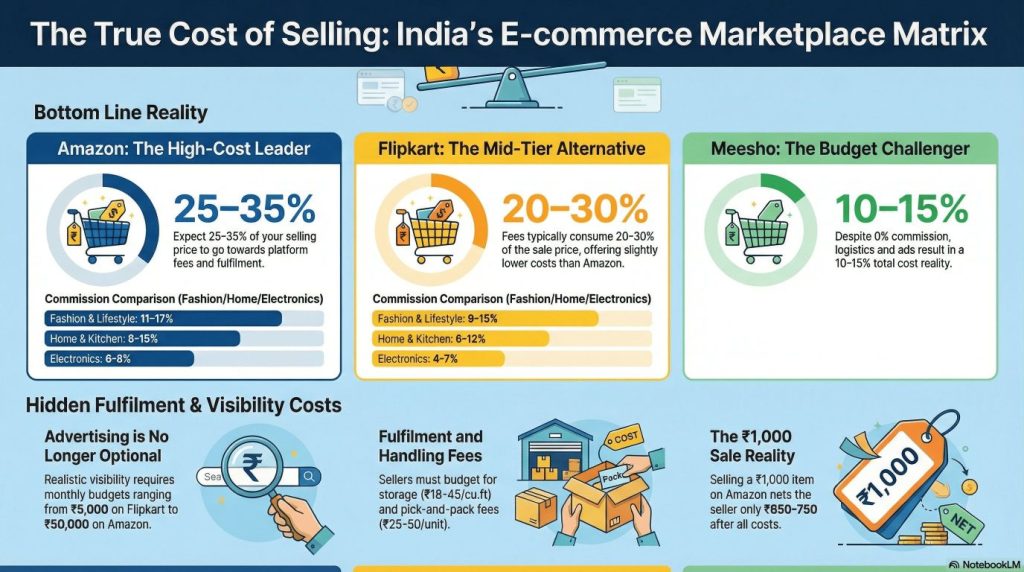
The Real Costs of Selling on Amazon (2026)
Let’s be brutally honest about fees:
Commission Structure:
- Electronics: 6-8%
- Fashion & Lifestyle: 11-17%
- Home & Kitchen: 8-15%
- Beauty & Health: 5-10%
- Books: 13-15%
- Grocery: 5%
Additional Costs You Can’t Ignore:
Fulfillment by Amazon (FBA):
- Storage: ₹20-45 per cubic foot per month
- Pick & Pack: ₹28-50 per unit
- Weight Handling: ₹15-60 per kg
Easy Ship (Amazon’s Logistics):
- ₹25-60 per shipment (depending on weight and zone)
Advertising (Realistic for Visibility):
- Minimum ₹10,000/month for meaningful results
- Average: ₹25,000-50,000 for competitive categories
Payment Gateway:
- 2% of transaction value
Reality Check: Expect 25-35% of your selling price to go to Amazon in total fees. A product you sell for ₹1,000 will net you ₹650-750 after all costs.
Why Sellers Still Choose Amazon
1. Premium Customer Base Amazon’s customers have higher average order values (₹1,850 vs. ₹950 on Flipkart, ₹480 on Meesho). They’re less price-sensitive and more brand-conscious.
2. Global Selling Program The unique ability to export to 200+ countries through Amazon’s global marketplace. Indian handicrafts, textiles, and unique products perform exceptionally well internationally.
Real Example: Arjun from Jaipur sells traditional block-printed fabrics. Domestic sales: ₹2 lakhs/month. International sales through Amazon Global: ₹8 lakhs/month at 40% higher margins.
3. Superior Logistics Infrastructure
- Same-day delivery in 100+ cities
- Next-day delivery covering 90% of serviceable pin codes
- Industry-best return and refund processes
- Premium packaging that reflects well on your brand
4. Advanced Analytics Amazon’s seller dashboard provides insights competitors can’t match:
- Customer search terms that led to your product
- Lost buy box percentage
- Inventory health metrics
- Traffic attribution by source
The Downsides Nobody Mentions
Performance Pressure: Amazon’s metrics are unforgiving. Maintain less than:
- 1% Order Defect Rate
- 2.5% Pre-Fulfillment Cancel Rate
- 4% Late Shipment Rate
Or face account suspension. Many sellers report stress managing these KPIs.
Copycat Private Labels: Amazon’s own brands (Amazon Basics, Solimo, etc.) often compete directly with successful sellers, using marketplace data to identify winning products.
Advertising Arms Race: Organic visibility is declining. In competitive categories, not advertising means not selling. Budget accordingly.
Best For:
 Premium products with good margins (30%+ profit margin) Brands targeting urban, educated, higher-income customers Products that benefit from FBA’s premium packaging Sellers wanting to export globally Those who can invest ₹50,000+ monthly including ads
 Ultra-budget products (under ₹200) Sellers who can’t maintain strict performance metrics Products requiring extensive customer education Businesses with tight cash flow (payment cycles can be 14-21 days)
Flipkart 2026: The Indian Market Master
What’s Changed
- Flipkart Minutes: Launched in Q2 2025, this quick commerce vertical delivers in 10-30 minutes in 15 cities. Initially groceries, now expanded to electronics accessories, beauty, and personal care.
- Shopsy Integration: Flipkart’s social commerce platform Shopsy is being integrated more tightly with the main marketplace, creating a unified ecosystem.
- Video Commerce: Flipkart Live has become a significant sales driver. Sellers can now host live product demonstrations, Q&A sessions, and flash sales directly on the platform.
- Vernacular Push: Enhanced support for 11 Indian languages across the seller dashboard, customer service, and product listings.
Real Costs Breakdown (2026)
Commission Rates:
- Electronics: 4-7%
- Fashion: 9-15%
- Home & Kitchen: 6-12%
- Beauty & Health: 4-8%
- Books: 10-20%
- Grocery: 3-5%
Flipkart Advantage (Fulfillment):
- Storage: ₹18-40 per cubic foot per month
- Pick & Pack: ₹25-45 per unit
- Shipping: ₹22-55 per kg
Seller Hub (Self-Ship):
- Shipping: ₹25-50 per shipment
- Seller must handle packaging and quality
Advertising:
- Sponsored Products: Minimum ₹5,000/month
- Realistic budget for visibility: ₹15,000-35,000/month
Total Cost Reality: Expect 20-30% of selling price to go to Flipkart—slightly lower than Amazon but with trade-offs in service quality.
Why Flipkart Wins for Many Sellers
1. Deep India Understanding Flipkart “gets” the Indian consumer better than any global platform:
- Vernacular language support that actually works
- Payment methods Indians prefer (COD still 40% of orders)
- Regional preference algorithms
- Festival-specific marketing that drives serious volume
2. The Big Billion Days Phenomenon Flipkart’s flagship sale event in October-November accounts for 15-25% of many sellers’ annual revenue. The platform’s marketing machine during this period is unmatched.
Real Numbers: Fashion sellers report 10-15x normal daily sales during BBD. Electronics sellers see 8-12x spikes. The key is inventory planning 2-3 months in advance.
3. Lower Competition in Niches Amazon dominates premium categories. Flipkart is less saturated in mid-market segments, giving new sellers better visibility without massive ad spend.
4. Better for Fashion and Lifestyle With Myntra (Flipkart’s fashion arm) integration and strong fashion-focused customer base, apparel and lifestyle products often perform better on Flipkart than Amazon.
Real Example: Sneha sells ethnic wear from Surat. On Amazon: ₹1.2 lakhs/month. On Flipkart: ₹3.8 lakhs/month. Same products, same pricing. Flipkart’s fashion-focused customers simply convert better for her category.
The Challenges
- Logistics Inconsistency: While improving, Flipkart’s fulfillment isn’t as polished as Amazon’s. Delayed deliveries and packaging issues are more common, which can impact your seller rating.
- Payment Delays: Sellers report payment cycles stretching to 21-30 days during high-volume periods, creating cash flow challenges.
- Seller Support Gaps: Getting resolution for account issues or disputes can take longer than Amazon. The support team, while improving, isn’t as responsive.
- Technology Lags: The seller dashboard and tools aren’t as sophisticated as Amazon’s. Analytics are good but not great.
Best For:
Fashion, lifestyle, and ethnic wear sellers Mid-market products (₹500-3,000 price range) Sellers targeting tier-2 and tier-3 cities Those who can plan for big festival season sales Products popular in regional markets
International expansion plans Categories where logistics precision is critical Sellers needing advanced analytics and tools Ultra-premium brands (Amazon’s customer base fits better)
Meesho 2026: The Reality Check
The Pivot Nobody Saw Coming
Meesho’s zero-commission model that made it famous? It’s evolving. While still technically zero commission for sellers, Meesho introduced new monetization in 2025-2026:
The New Meesho Model:
For Sellers:
- No listing or commission fees (still true)
- BUT: Shipping costs increased 15-20%
- Logistics partners are now limited (must use Meesho-approved partners)
- Advertising is effectively mandatory for visibility (₹8,000-15,000/month)
- Quality control fees introduced for returns (₹20-50 per return)
What This Means: While technically “zero commission,” the total cost of selling on Meesho is now 10-15% of product price when you factor in shipping, returns, and necessary advertising.
The Platform Matured: Meesho is no longer the Wild West it was in 2023-2024. Quality standards have tightened. Low-quality sellers are being removed. The platform is professionalizing.
Real Costs (2026 Reality)
Direct Fees:
- Commission: ₹0 (still!)
- Listing fees: ₹0
Indirect Costs:
- Shipping: ₹30-70 per order (depending on weight and zone)
- Return shipping: Borne by seller
- Quality control fees: ₹20-50 for defective returns
- Advertising (necessary): ₹8,000-15,000/month minimum
- Packaging: ₹10-25 per unit
Total Cost Reality: 10-15% of product price, significantly lower than Amazon or Flipkart, but no longer “free.”
Why Meesho Still Works
1. Massive Tier-2/3 Reach Meesho’s strength remains unmatched in smaller towns and cities. If your products target:
- First-time online shoppers
- Price-conscious consumers
- Social media active women (Meesho’s core demographic)
- Regional language speakers
Then Meesho delivers customers Amazon and Flipkart struggle to reach.
2. Social Commerce Integration Meesho’s WhatsApp Business integration, catalog sharing features, and reseller network create viral distribution that traditional platforms can’t replicate.
Real Example: Kavita in Lucknow sells budget-friendly kurtis. She built a WhatsApp group of 800 customers who share her Meesho catalog virally. Monthly sales: ₹4.5 lakhs, with 60% coming from customer referrals.
3. Lower Price Point Sweet Spot Products priced ₹200-800 perform exceptionally well on Meesho. This price range struggles on Amazon (too cheap for their customer base) and Flipkart (gets lost among competition).
4. Fast Payment Cycles Meesho’s payment cycle is 7-14 days, significantly faster than Amazon or Flipkart. For sellers with tight cash flow, this matters enormously.
The Major Downsides
High Return Rates: Meesho’s return rate averages 15-20% (vs. 8% on Amazon, 7% on Flipkart). Why?
- Price-conscious customers order multiple variants
- Lower purchase commitment at low price points
- “Order for photos” problem (customers order to copy designs)
Quality Perception Issues: Meesho still fights the perception of being “budget/low quality.” Premium products struggle. Branded items don’t perform well.
Limited International Reach: Meesho is India-only. Zero international expansion opportunities.
Customer Service Burden: Sellers handle more customer service on Meesho than on Amazon/Flipkart. The platform’s support is basic.
Best For:
Fashion, accessories, home decor in ₹200-800 price range First-time online sellers with limited capital Products targeting tier-2/3 city women Sellers comfortable with social media marketing Those needing fast payment cycles
Premium or branded products Electronics or high-value items International expansion plans Sellers who can’t handle higher return rates Products requiring detailed customer education
Quick Commerce: The New Opportunity (2026)
Should You Sell on Blinkit, Zepto, or Swiggy Instamart?
The Reality: Quick commerce started with groceries but is rapidly expanding. In 2026, these platforms are viable channels for:
Categories That Work:
- Consumables (snacks, beverages, instant foods)
- Beauty and personal care
- OTC medications and health supplements
- Phone accessories and small electronics
- Stationery and home essentials
- Baby care products
The Economics:
Commission: 15-25% (highest in e-commerce)
Logistics: Handled by platform (you supply to dark stores)
Minimum Order: Bulk supply to local dark stores
Payment Cycle: 14-21 days
Why the High Commission? 10-minute delivery is expensive. The commission funds the hyperlocal logistics network.
Real Seller Experience
Rajesh (Snack Brand in Bangalore):
- Supplies to 45 Zepto and Blinkit dark stores across Bangalore
- Revenue: ₹12 lakhs/month through quick commerce
- Margin: 20% (after 18% commission and logistics)
His Take: “Volume makes up for lower margins. One dark store does what 10 regular retail stores did. Plus, I get paid within 14 days.”
Should You Consider It?
Yes, if:
- You have consumable/FMCG products
- You can supply bulk to dark stores (100-500 units at a time)
- You’re in metros or tier-1 cities (Blinkit/Zepto coverage area)
- Your margins can absorb 15-25% commission
No, if:
- Fashion, furniture, or most electronics
- You’re not in major cities
- Your margins are already thin
- You can’t do bulk inventory drops
The Real Comparison: What Actually Matters
Total Cost of Selling (Realistic Scenario)
Product: ₹1,000 Selling Price
| Cost Component | Amazon | Flipkart | Meesho | Quick Commerce |
|---|---|---|---|---|
| Commission | ₹120 | ₹100 | ₹0 | ₹180 |
| Fulfillment | ₹60 | ₹50 | ₹45 | Included |
| Payment Gateway | ₹20 | ₹20 | ₹20 | ₹20 |
| Advertising (monthly avg) | ₹40 | ₹30 | ₹15 | ₹0 |
| Packaging | ₹15 | ₹15 | ₹20 | Bulk |
| Total Cost | ₹255 | ₹215 | ₹100 | ₹200 |
| Net Realization | ₹745 | ₹785 | ₹900 | ₹800 |
| Margin % | 74.5% | 78.5% | 90% | 80% |
Assumes own fulfillment for Meesho; FBA/Flipkart Advantage for others
Customer Demographics Reality
Amazon Customers:
- Age: 25-45
- Income: ₹8+ lakhs annual household income
- Cities: Metros and tier-1 primarily
- Shopping behavior: Research-driven, brand-conscious
- Average order value: ₹1,850
- Conversion rate: 12-15%
Flipkart Customers:
- Age: 20-40
- Income: ₹4-10 lakhs annual household income
- Cities: All tiers, strong in tier-2/3
- Shopping behavior: Value-seekers, festival shoppers
- Average order value: ₹950
- Conversion rate: 11-13%
Meesho Customers:
- Age: 22-38 (predominantly women)
- Income: ₹2-6 lakhs annual household income
- Cities: Tier-2, tier-3, and rural
- Shopping behavior: Price-sensitive, social recommendation-driven
- Average order value: ₹480
- Conversion rate: 16-18% (high due to low prices)
Return Rates (The Hidden Cost)
| Platform | Average Return Rate | Top Return Categories |
|---|---|---|
| Amazon | 8% | Fashion (15%), Electronics (5%) |
| Flipkart | 7% | Fashion (12%), Home (6%) |
| Meesho | 18% | Fashion (25%), Beauty (15%) |
| Quick Commerce | 3% | Groceries (5%), Beauty (4%) |
Why Meesho’s Higher?
- Customers order multiple sizes/variants
- Lower purchase commitment at low prices
- Easier return policy
The Cost: If you’re selling fashion on Meesho, factor in that 1 in 4 orders might return. This impacts profitability significantly.
Logistics Performance (2026 Data)
Delivery Speed:
| City Type | Amazon | Flipkart | Meesho | Quick Commerce |
|---|---|---|---|---|
| Metros | Same day-1 day | 1-2 days | 2-4 days | 10-30 min |
| Tier-1 | 1-2 days | 2-3 days | 3-5 days | 10-30 min (select) |
| Tier-2 | 2-4 days | 3-5 days | 4-6 days | Not available |
| Tier-3 | 4-7 days | 5-8 days | 5-7 days | Not available |
Delivery Quality Score (Seller Ratings):
- Amazon FBA: 4.7/5
- Flipkart Advantage: 4.3/5
- Meesho Logistics: 3.9/5
- Quick Commerce: 4.8/5 (speed compensates)
Decision Framework: Where Should YOU Sell?
By Product Category
Electronics & Gadgets:
- Amazon (best for premium items)
- Flipkart (good for mid-range and smartphones)
- Quick Commerce (only accessories under ₹500)
- Meesho (avoid unless ultra-budget accessories)
Fashion & Apparel:
- Flipkart (best overall performance for most price ranges)
- Meesho (if budget segment, under ₹800)
- Amazon (if premium/branded, over ₹2,000)
Home & Kitchen:
- Amazon (premium appliances, international brands)
- Flipkart (furniture, large appliances)
- Meesho (decorative items, kitchen accessories under ₹500)
- Quick Commerce (cleaning supplies, small essentials)
Beauty & Personal Care:
- Amazon (premium brands, serums, international products)
- Quick Commerce (daily essentials, OTC items)
- Flipkart (mid-market brands)
- Meesho (budget cosmetics, accessories)
Groceries & FMCG:
- Quick Commerce (if metro presence)
- Amazon Pantry
- Flipkart Supermart
- JioMart (consider as alternative)
By Business Stage
Just Starting (₹0-50K monthly revenue goal):
- Primary: Meesho (lowest cost, fastest start)
- Test: Flipkart (gauge market response)
- Wait on: Amazon (costs too high initially)
Early Growth (₹50K-3L monthly revenue):
- Primary: Flipkart (best balance of reach and cost)
- Secondary: Meesho (specific categories)
- Consider: Amazon (if margins support it)
Scaling (₹3L-10L monthly revenue):
- Multi-platform: All three simultaneously
- 80% budget: Where your category performs best
- 20% budget: Testing other platforms
Established (₹10L+ monthly revenue):
- Multi-platform: Required for risk diversification
- Consider: Quick commerce, ONDC, international via Amazon
- Build: Direct-to-consumer channel alongside marketplaces
By Available Investment
Under ₹50,000 total capital:
- Meesho only (until profitable)
- Focus on high-margin products (60%+ margins)
- Leverage social media for free marketing
₹50,000-2,00,000 capital:
- Primary: Flipkart
- Secondary: Meesho (different product mix)
- Budget: ₹15-25K monthly for advertising across platforms
₹2,00,000-5,00,000 capital:
- All three platforms
- Allocate: 50% best performer, 30% second, 20% testing
- Budget: ₹40-60K monthly advertising
- Consider: Hiring a marketplace manager
₹5,00,000+ capital:
- Multi-platform strategy with channel-specific inventory
- Dedicated person/agency for marketplace management
- Budget: ₹1-2L monthly across all marketing
- Build: Owned DTC website alongside marketplaces
Multi-Platform Strategy: How Top Sellers Do It
The 70-20-10 Approach
70% – Your Hero Platform Identify which platform works best for your product and focus most resources here. This is where you:
- Maintain deepest inventory
- Run primary advertising campaigns
- Provide best customer service
- Optimize listings most carefully
20% – Your Growth Platform The second-best performer gets 20% of attention. This platform:
- Tests new products first
- Gets experimental ad budgets
- Provides market research data
- Acts as backup during hero platform issues
10% – Testing Platforms Use 10% of resources to test new platforms or channels:
- Quick commerce pilots
- ONDC experiments
- Emerging platforms
- Direct-to-consumer trials
Real Multi-Platform Success Story
Mohit – Premium Phone Accessories:
Setup (2024):
- Started on Amazon only
- Monthly revenue: ₹3.2 lakhs
- Profit margin: 28%
Multi-Platform Strategy (2025-2026):
- Amazon (60% revenue): Premium cases, ₹800-2,000
- Flipkart (25% revenue): Mid-range products, ₹400-1,000
- Quick Commerce (15% revenue): Budget cables/chargers under ₹300
Results (Current):
- Monthly revenue: ₹12.8 lakhs (+300%)
- Profit margin: 32% (diversification reduced platform-specific risks)
- Peak season dependency reduced (not reliant on single platform’s sale events)
His Strategy: “Amazon gets my premium line with great photos and detailed descriptions. Flipkart gets the same products at 10-15% lower price points. Quick commerce gets bulk orders of basic necessities that turn fast. Different platforms, different strategies, all profitable.”
Inventory Management Across Platforms
The Challenge: Selling on multiple platforms means risk of overselling or maintaining excessive inventory.
Solutions That Work:
1. Centralized Inventory Management Software:
- Unicommerce (₹3,000-8,000/month)
- Zoho Inventory (₹1,500-6,000/month)
- Browntape (₹2,500-10,000/month)
These sync inventory across platforms in real-time, preventing overselling.
2. Platform-Specific SKUs: Assign different SKUs to the same product across platforms. This lets you:
- Track platform-specific performance
- Run different pricing strategies
- Manage inventory independently
3. Safety Stock Buffer: Maintain 15-20% extra inventory as buffer for unexpected demand spikes on any platform.
Pricing Strategy Across Platforms
Should You Price Differently?
Yes, strategically. Here’s how:
Amazon: 5-10% higher (premium customer base accepts it) Flipkart: Base price (competitive middle ground) Meesho: 10-15% lower (price-sensitive customers)
Example Product:
- Manufacturing cost: ₹200
- Meesho price: ₹399 (99% margin after costs)
- Flipkart price: ₹499 (86% margin after costs)
- Amazon price: ₹599 (79% margin after costs)
Why This Works:
- Different customer expectations per platform
- Profit margins account for different fee structures
- Brand perception varies by platform
- Competition differs across platforms
Platform-Specific Marketing Strategies
Amazon Advertising Ecosystem
1. Sponsored Products (80% of budget):
- Target: High-intent keywords
- Bid: ₹5-25 per click (depending on category)
- ROAS target: Minimum 4:1
- Strategy: Focus on bottom-funnel keywords with purchase intent
2. Sponsored Brands (15% of budget):
- Brand awareness campaigns
- Showcase product portfolio
- Defensive: Bid on your brand name to prevent competitor hijacking
3. Sponsored Display (5% of budget):
- Retargeting website visitors
- Targeting competitor product pages
- Lower funnel conversions
Monthly Budget Allocation (₹30,000 example):
- Sponsored Products: ₹24,000
- Sponsored Brands: ₹4,500
- Sponsored Display: ₹1,500
Flipkart Advertising Approach
1. Product Listing Ads:
- More affordable than Amazon (₹3-15 per click)
- Focus on festival seasons (4x the normal budget during BBD)
- Bid aggressively on mobile (Flipkart is mobile-first)
2. Flipkart SmartAd:
- Automated campaigns using AI
- Good for beginners who don’t understand bidding
- Set ROAS target, let algorithm optimize
Monthly Budget Strategy:
- Regular months: ₹15-20K
- Festival season (Sep-Nov): ₹60-100K (go big or go home)
- Focus: Mobile-optimized creatives
Meesho Marketing Reality
Platform Advertising: While Meesho has advertising options, ROI is often poor compared to organic strategies.
Better Approach – Social Commerce:
1. WhatsApp Catalog Strategy:
- Build customer groups (max 1,024 per group)
- Share catalogs 2-3 times weekly
- Respond within 10 minutes to inquiries
- Offer exclusive “WhatsApp-only” deals
2. Instagram Integration:
- Post products on Instagram
- Use Meesho deep links in bio
- Create Reels showing product usage
- Share customer testimonials and unboxing videos
3. Reseller Network:
- Enable reselling on your products
- Resellers become your marketing force
- Provide them ready-made content to share
- Offer 10-15% reseller margins
Cost: ₹5-8K monthly for content creation vs. ₹15K for platform ads ROI: 3-5x better than paid platform advertising
Common Mistakes That Kill Profitability
Mistake #1: Not Calculating True Costs
The Problem: Sellers look at commission rates (8%, 12%, 0%) and think that’s the total cost.
The Reality: Total cost includes:
- Commission
- Fulfillment/shipping
- Payment gateway fees
- Advertising (mandatory for visibility)
- Packaging materials
- Return logistics
- Customer service time
- Photography and content creation
Real Example: ₹1,000 product on Amazon:
- Stated commission: 12% (₹120)
- Actual total cost: 28% (₹280)
- Seller expected: ₹880 profit
- Seller received: ₹720 profit
- Surprise: 18% less than expected
The Fix: Create a comprehensive cost calculator for each platform including ALL costs.
Mistake #2: Poor Product Photography
The Reality: Your product photo quality directly impacts conversion rates. The difference:
Phone camera, poor lighting:
- Conversion rate: 3-5%
Professional product photography:
- Conversion rate: 10-15%
The Math: 1,000 visitors with 3% conversion = 30 sales 1,000 visitors with 12% conversion = 120 sales 4x more sales from better photos alone
Investment: ₹500-1,500 per product for professional photography pays for itself in 2-3 weeks through higher conversions.
Mistake #3: Ignoring Seasonal Planning
The Problem: Running consistent inventory year-round without accounting for massive seasonal spikes.
The Reality: Indian e-commerce is heavily seasonal:
Peak Months (60% of annual sales):
- August-November (festive season)
- January (New Year sales)
- February (Valentine’s Day for specific categories)
The Fix:
- 3 months before peak: Lock inventory manufacturing
- 2 months before: Increase ad budgets by 3-4x
- 1 month before: Ensure stock at warehouses
- During peak: Customer service on high alert
Mistake #4: Platform Hopping Too Quickly
The Problem: Trying a platform for 2-3 weeks, seeing slow sales, then quitting for another platform.
The Reality: Platforms need time to:
- Index your listings properly (2-4 weeks)
- Understand your product through customer behavior (4-8 weeks)
- Build review credibility (3-6 months)
- Optimize ad campaigns (6-12 weeks)
The Fix: Commit to minimum 3-6 months on a platform before judging its viability.
Mistake #5: Competing on Price Alone
The Problem: Continuously lowering prices to match competitors, destroying margins.
Better Strategy:
Differentiation:
- Better product photos
- More detailed descriptions
- Faster shipping (FBA/Flipkart Advantage)
- Better packaging
- Excellent customer service
- Building reviews (quality over quantity)
Value Addition:
- Combo offers instead of discounts
- Free accessories
- Extended warranties
- Styling guides/how-to content
- After-sales support
Real Example: Two sellers with identical phone cases:
Seller A: Cheapest price (₹199), basic listing, no reviews Conversion: 4%
Seller B: Higher price (₹349), professional photos, 50 reviews, detailed size guide, combo offers Conversion: 14%
Seller B makes more profit per visitor despite higher price.
Tools and Resources for Multi-Platform Selling
Inventory Management
Unicommerce (₹3,000-8,000/month):
- Real-time inventory sync across 20+ platforms
- Order management from single dashboard
- Shipping integration
- Best for: Medium to large sellers
Zoho Inventory (₹1,500-6,000/month):
- Good for startups and growing businesses
- CRM integration
- Multi-channel listing
- Accounting integration
Product Photography
Budget Option (₹5,000-10,000):
- Smartphone + good lighting kit
- White backdrop
- Basic editing apps (Snapseed, Lightroom Mobile)
Professional (₹15,000-50,000 one-time):
- DSLR setup
- Professional lighting
- Editing software
- Or hire professional product photographer
ROI: Better photos increase conversion rates 3-5x. This investment pays for itself quickly.
Content Creation
AI Tools (Free-₹2,000/month):
- ChatGPT for product descriptions
- Canva for infographics
- Remove.bg for background removal
- PixelCut for product photo enhancement
Hiring:
- Freelance copywriter: ₹500-2,000 per product listing
- Graphic designer: ₹500-1,500 per image
- Video creator: ₹2,000-8,000 per product video
Analytics and Tracking
Google Analytics 4: Free, track all traffic sources Seller platform analytics: Built into each marketplace Excel/Google Sheets: Track margins, inventory, ROAS across platforms
The Future: What’s Coming in 2027
Voice Commerce
Voice shopping through Alexa, Google Assistant, and regional language voice assistants is projected to handle 10-15% of e-commerce transactions by 2027.
What Sellers Should Do:
- Optimize product titles for voice search
- Use natural language in descriptions
- Focus on question-based keywords
Hyper-Personalization
AI-driven personalization will show different prices, products, and offers to different customers based on their behavior.
Impact on Sellers:
- Dynamic pricing becomes standard
- Conversion optimization through AI
- Personalized product recommendations matter more
Livestream Shopping
Live commerce (shopping during live video streams) will become mainstream.
Platforms Investing:
- Flipkart Live
- Amazon Live (international, coming to India)
- Instagram Shopping Live
Seller Opportunity: Those comfortable on camera will have significant advantage in building trust and driving sales.
Sustainability Requirements
Eco-friendly packaging and carbon-neutral delivery will shift from optional to mandatory for many categories.
Be Ready:
- Source sustainable packaging now
- Highlight eco-friendly practices
- Get relevant certifications
Final Recommendation: Your Action Plan
Here’s what to do this week:
If You’re Just Starting:
Week 1:
- Choose Meesho as starting platform (lowest risk)
- List 5-10 products with professional photos
- Set up WhatsApp Business account
- Invest ₹10,000 in initial inventory
Week 2:
- Learn platform basics
- Respond to customer inquiries within 30 minutes
- Start building WhatsApp customer groups
- Track what sells, what doesn’t
Month 2-3:
- Add Flipkart if Meesho sales consistent
- Increase inventory on winning products
- Cut products with high returns/low margins
- Consider basic paid advertising (₹5,000/month)
Month 4-6:
- Add Amazon if margins support it
- Optimize listings based on 3-6 month data
- Build review base on all platforms
- Consider marketplace manager/VA
If You’re Already Selling:
This Week:
- Calculate TRUE total cost per platform (not just commission)
- Identify your highest-margin products
- Audit product photos (are they converting?)
- Check if you’re missing seasonal opportunities
This Month:
- Test one new platform you’re not on
- Invest in better product photography for top sellers
- Set up multi-platform inventory management
- Increase ad spend on best performers by 20%
This Quarter:
- Achieve profitability on 2-3 platforms
- Build 4-6 months inventory pipeline
- Hire/train someone for customer service
- Prepare for next festival season 3 months ahead
The Bottom Line
There’s no single “best” platform for all Indian sellers in 2026. The right answer depends on:
- Your product category and price point
- Your target customer demographic
- Your available capital and margins
- Your business stage and goals
- Your competitive advantages
 Amazon wins if you have premium products, good margins, want global reach, and can invest in ads and logistics.
Flipkart wins if you target the Indian mass market, have fashion/lifestyle products, want festival season explosions, and can work with slightly less sophisticated tools.
Meesho wins if you’re starting with limited capital, targeting tier-2/3 cities, selling budget products, and are willing to leverage social commerce.
Quick commerce wins if you have consumables/FMCG, operate in metros, can handle bulk dark store supply, and your margins support higher commissions.
The smartest sellers in 2026 don’t choose one. They build a multi-platform strategy that diversifies risk while maximizing reach. They test, measure, optimize, and scale what works.
Start where you are. Use what you have. But build systematically toward a diversified, profitable multi-platform presence.
The Indian e-commerce market will only get bigger. The question isn’t whether opportunity exists—it’s whether you’ll seize it strategically or struggle trying to figure it out alone.
Ready to launch or scale your e-commerce business across Amazon, Flipkart, and Meesho? Our ecommerce account management team has helped sellers achieve profitable multi-platform presence. From product photography to inventory management to advertising optimization, we handle the complexity so you can focus on growing. Schedule a free consultation to discuss your marketplace strategy.
Last Updated: January 2026 | Market data and platform features current as of Q1 2026
