
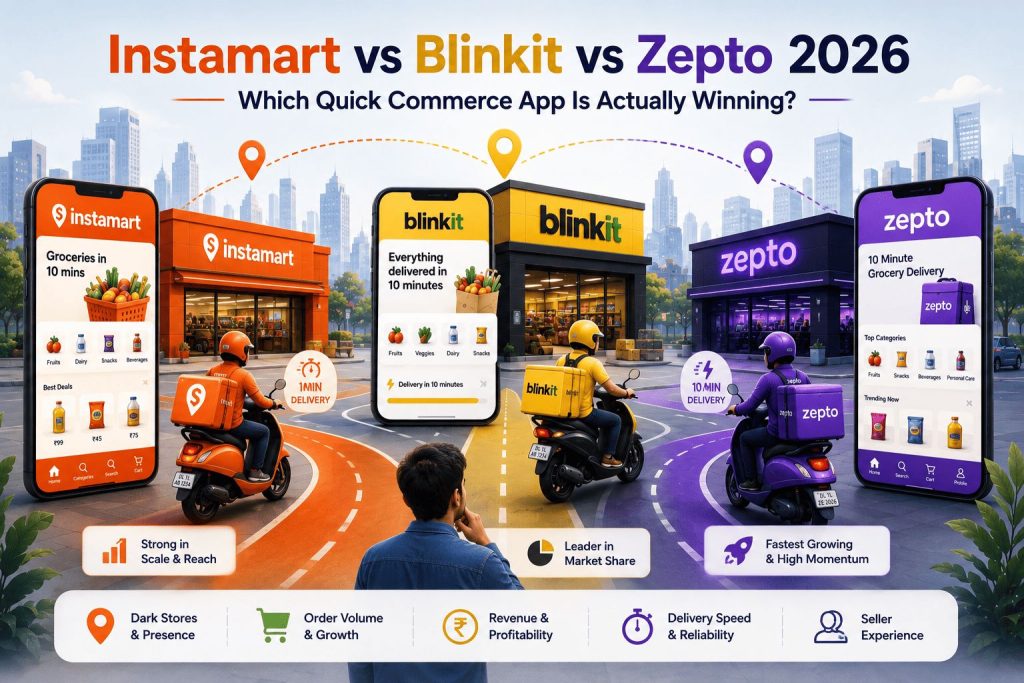
Blinkit has twice the dark stores of its rivals combined. Zepto is racing toward an IPO. Instamart quietly built the biggest shopping baskets in the category. “Winning” depends entirely on what you’re measuring — here’s the real 2026 scorecard.
Ask ten people which quick commerce app is winning in India right now and you’ll get ten different answers — and honestly, all of them could be right, depending on what “winning” means to them.
If you mean scale and reach, Blinkit isn’t close to being caught. If you mean momentum and market buzz, Zepto’s IPO filing has made it the story of the year. If you mean who actually gets more rupees out of each customer per order, the answer might surprise you — it’s not who you’d expect.
We’ve pulled together the real 2026 numbers on all three — dark stores, order volumes, revenue, delivery speed, and what it’s actually like to sell on each platform — because the honest answer to “who’s winning” is more interesting than any single headline number can tell you.
2,243
Blinkit’s dark stores as of March 2026 — nearly double its closest rival
Source: Upstox, June 2026
₹8,010 Cr
Zepto’s planned fresh issue in its upcoming IPO, expected July 2026
Source: Upstox / UDRHP filing
70%
Annual growth rate of India’s quick commerce sector overall in 2026
Source: EcomSarthi, Aug 2026
Scale: Blinkit isn’t just ahead, it’s in a different league
Start with the raw numbers and there’s no real contest. Blinkit processed 91.6 crore total orders during FY26, handling roughly 25 lakh orders a day — significantly ahead of both Zepto and Instamart. Its dark store network stood at 2,243 as of March 31, 2026, which is nearly double what either competitor operates. That physical footprint is the foundation everything else is built on — more stores means shorter delivery distances, tighter delivery windows, and the ability to enter new tier 2 cities faster than rivals can follow.
Separate research from S&P Global paints a similar picture using slightly different figures: Blinkit’s dark store count was projected to more than double from 1,301 in 2025 to 2,157 in 2026, compared with Swiggy Instamart’s 1,254 stores over the same period. Order volumes told the same story — Blinkit processed 424 million orders in fiscal 2025 against Instamart’s 286 million, with 2026 projections of 863 million versus 469 million respectively.
Blinkit
Eternal (Zomato)
2,243
Dark stores (Mar 2026)
Zepto
Standalone, IPO-bound
~1,000+
Dark stores (est. 2026)
Instamart
Swiggy
1,254
Dark stores (2026 proj.)
Revenue tells an even more lopsided version of the same story. Analysts forecast Blinkit’s quick commerce sales reaching ₹268 billion in 2026 — a fivefold jump from ₹52 billion the year before. Swiggy’s Instamart, by comparison, was projected to generate ₹43.5 billion in 2026, up from ₹21 billion — solid growth, but on a fraction of Blinkit’s base.
Momentum: why everyone is suddenly talking about Zepto
If scale is Blinkit’s story, momentum is Zepto’s. The company has filed its updated draft red herring prospectus (UDRHP) with SEBI, and multiple media reports point to a July 2026 IPO. The numbers in that filing are eye-catching on their own — a planned fresh issue of roughly ₹8,010 crore alongside an offer-for-sale of over 11.34 crore shares by existing shareholders.
What makes Zepto’s story genuinely remarkable is the speed of the climb. Goldman Sachs noted that Zepto surpassed $1 billion in annualised sales within just 29 months of launching — and by the time that milestone report came out, Zepto’s market share was already described as “close to that of the number 2 player.” For a company that entered a market Blinkit and Instamart had already been fighting over for years, that’s a genuinely fast climb.
Zomato co-founder Deepinder Goyal said at a recent conference that he believes Blinkit will become larger than Zomato’s own food delivery business within a year — a striking statement about how central quick commerce has become to the country’s biggest food-tech company, and a large part of why search interest around Goyal and quick commerce has spiked so sharply in 2026.
But momentum has a cost, and independent scraped data suggests Zepto may be feeling it. Actowiz Solutions spent six weeks scraping real delivery time, product availability, and pricing data from all three platforms across 18 Indian cities in 2026. Their headline finding: Zepto’s on-time delivery rate dropped from 84% to 76% over just eight weeks of monitoring. Their read on why it matters: “Speed is the only true differentiator. When it slips, churn follows within 2 to 3 ordering cycles” — a genuinely important warning for a company about to face public market scrutiny on its operational metrics for the first time.
Basket size: the metric where the “winner” flips
Here’s where the story gets genuinely interesting, and where different sources tell slightly different versions — worth being upfront about, since most articles on this topic quietly pick whichever number suits their narrative.
One analysis comparing the platforms ahead of Zepto’s IPO found Instamart commanding the highest average order value of the three, with Blinkit at ₹525 and Zepto trailing at ₹300 to ₹350 per order. A separate S&P Global research note, using a different dataset, found the opposite ranking — Blinkit’s average order value projected to rise to ₹709 in 2026, about ₹90 higher than Instamart’s ₹619.
💡Why the numbers disagree:
These figures come from different research firms using different measurement periods and methodologies — some based on scraped transaction data, others on company disclosures and analyst models. Rather than pick one and present it as definitive, the honest takeaway is this: Instamart and Blinkit are both clearly ahead of Zepto on basket size, and the gap between the two of them is close enough that the “leader” genuinely depends on which quarter and which data source you’re looking at. Zepto’s smaller average order value is the more consistent finding across every source — likely reflecting its younger user base and heavier reliance on quick, small top-up orders rather than planned grocery shopping.
Separately, the Actowiz scraped data flagged something worth watching for Instamart specifically: an 8.9% average pricing premium above MRP, which the researchers called “unsustainable” if it continues unchecked — a detail that doesn’t show up in most comparison articles but matters if you’re a regular Instamart shopper wondering why your basket feels a little pricier than it should.
Delivery speed and coverage: what actually differs day to day
For most shoppers, none of the revenue or IPO numbers above matter nearly as much as one simple question: which app gets my order to me fastest and most reliably? Here the three platforms are closer than the funding headlines suggest, though each has a genuine edge in a different situation.
| Factor | Blinkit | Zepto | Instamart |
|---|---|---|---|
| Typical delivery time | 8–12 min (Consistent) | 8–10 min (dropping to 76% on-time) | 10–20 min, wider footprint |
| Dark store network | 2,243 (Largest) | ~1,000+ estimated | 1,254 (2026 proj.) |
| Geographic reach | Tier 1 + expanding Tier 2 | Tier 1 focused, expanding to 20+ cities | Widest footprint via Swiggy network (Best reach) |
| Average order value | ₹525–709 (source-dependent) | ₹300–350 (Lowest, smaller top-ups) | ₹619 (highest per some sources) |
| Product catalogue | Groceries + electronics + FMCG | Groceries + Zepto Cafe cross-sell | Groceries + restaurant cross-sell |
| Fresh produce availability | Sub-75% across all three | Sub-75% across all three | Sub-75% across all three |
That last row is worth pausing on. The Actowiz research found that all three platforms show sub-75% availability specifically in fresh fruits and vegetables — a category every platform is pushing hard as a growth driver despite the operational reality that fresh produce means high spoilage and low availability at the same time. If you regularly order fresh produce through any of these apps and find your list partially unavailable, that’s not a one-off glitch — it’s a structural weak spot across the entire category right now.
If you’re a brand or seller: which platform should you prioritise
This section is for businesses thinking about quick commerce as a sales channel, not just as a shopper.
For Indian Brands and Sellers
Blinkit has the largest dark store network and the simplest onboarding of the three — open self-registration is available directly at seller.blinkit.com, meaning any eligible brand can apply without needing an existing relationship or invitation. Commission ranges from 2% to 18% depending on category.
Zepto is the youngest but most aggressively expanding platform, investing heavily in dark store growth and its own advertising technology. Commission ranges run slightly higher, from 3% to 20%, reflecting its push to monetise faster ahead of its IPO. Unlike Blinkit’s per-city dark store supply model, sellers need to plan for replenishment cycles of 2 to 3 times a week for fast-moving items.
Instamart runs a more curated onboarding model, which cuts both ways — it means less competition per category once you’re in, but also a less open door to get started compared to Blinkit’s self-service registration. Commission ranges from 2% to 15%, generally the most competitive of the three.
💡 The practical recommendation most sellers land on:
List on all three rather than picking one. The reach, commission structure, and competition profile are different enough on each platform that spreading inventory across all three typically outperforms concentrating on a single one — as long as your supply chain can handle the replenishment demands of three separate dark store networks rather than one centralised warehouse.
So which one is actually winning?
Genuinely, it depends on what you’re measuring — and anyone giving you a single-word answer is oversimplifying a much more interesting picture.
Blinkit wins on scale and execution
Nearly double the dark stores of either rival, the highest order volumes by a wide margin, and revenue growing five-fold year on year. If the question is “who is furthest ahead today,” it’s not close. Backed by a publicly traded parent in Eternal, Blinkit also carries less funding uncertainty than its privately-held rivals — though Deepinder Goyal’s own prediction that Blinkit will outgrow Zomato’s food delivery business within a year signals just how much is riding on this one segment.
Zepto wins on momentum and market attention
Zepto crossed $1 billion in annualised sales faster than either rival managed the same milestone, and its IPO filing has made it the most-discussed quick commerce story of 2026. But the recent dip in on-time delivery — from 84% to 76% in just eight weeks of independent monitoring — is a real warning sign heading into a period of intense public market scrutiny. Momentum is real, but so is the operational strain that comes with growing this fast.
Instamart wins on customer spend and reach
With the widest geographic footprint thanks to Swiggy’s existing delivery network, and average order values that rival or exceed Blinkit’s depending on which data source you trust, Instamart has quietly built the most valuable individual customer relationships in the category — even while trailing on total scale. Less flashy than Blinkit’s growth curve or Zepto’s IPO story, but a genuinely strong position if per-customer economics matter more to you than headline order counts.
THE SHORT VERSION
- Blinkit leads decisively on scale — 2,243 dark stores, roughly 25 lakh orders a day, and revenue projected to hit ₹268 billion in 2026, a fivefold jump year on year
- Zepto is the momentum story of 2026, filing for an IPO with a planned ₹8,010 crore fresh issue, expected to list around July 2026
- Independent scraped data found Zepto’s on-time delivery rate dropped from 84% to 76% over eight weeks in 2026 — a real operational concern heading into its public listing
- Basket size data is genuinely mixed across sources, but Instamart and Blinkit both clearly outspend Zepto per order, whose average order value trails at ₹300–350
- All three platforms show sub-75% availability in fresh produce — a structural weak spot across the entire category, not a single-platform problem
- For sellers: Blinkit offers the simplest self-service onboarding, Zepto is expanding fastest, and Instamart’s curated model means less competition per category. Most brands do best listing on all three
Selling on Blinkit, Zepto, or Instamart?
We help Indian brands grow their quick commerce sales with listing strategy, performance advertising, and multi-platform ecommerce marketing.