
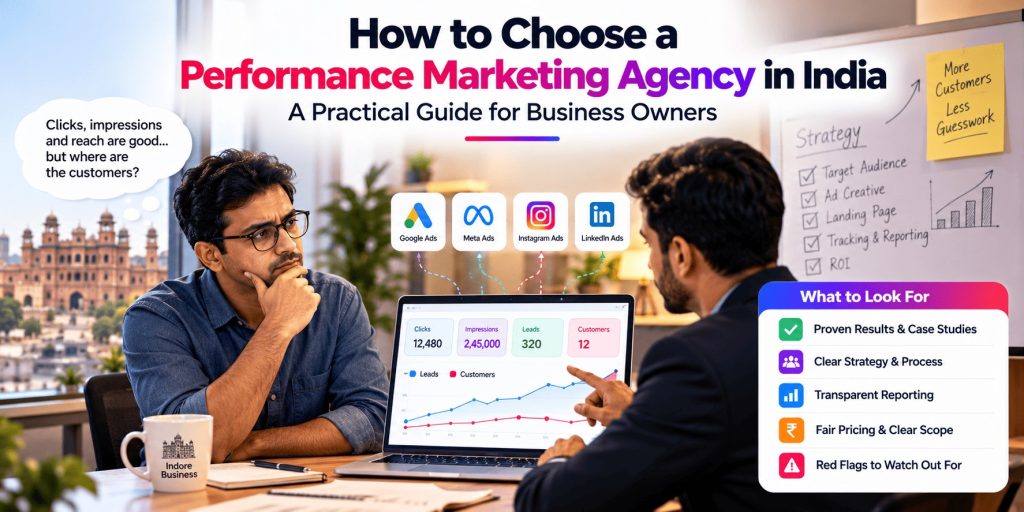
Picture a founder in Indore who has just spent four months and a few lakh rupees on ads. The agency sends a neat monthly report full of clicks, impressions and “reach”. Leads are coming in. But very few of them turn into customers, and nobody can say clearly why. Is it the ads? The landing page? The product? The agency? By the time the founder asks, the contract has renewed.
This happens often, and it usually isn’t because the agency was dishonest. It’s because the business and the agency never agreed, upfront, on what success meant, how it would be measured, and who was responsible for what.
This guide is meant to prevent that. It explains how to choose a performance marketing agency in India: what these agencies actually do, how they charge, what to check before you shortlist anyone, which questions to ask, which warning signs to take seriously, and how to start in a way that protects your budget.
One honest note: we run a digital marketing company and performance marketing services ourselves, so weigh what follows accordingly. We’ve tried to write the guide we’d want to read if we were the ones buying.
In short
- Get your own house in order first. Know what a lead or sale is worth to you, and make sure tracking and follow-up work. No agency can fix a business that can’t measure or answer its leads.
- Compare what each fee rewards, not just what it costs. The cheapest fee is rarely the cheapest outcome.
- Insist on owning your ad accounts and data. This one point protects you more than any other.
- Start with a short, clearly defined pilot instead of a long contract.
- Be wary of guarantees. Nobody can honestly promise results in advance.
What a Performance Marketing Agency Actually Does
A performance marketing agency (you’ll also hear “performance marketing company” or “digital performance marketing agency”, which mean much the same thing) runs paid advertising that is tied to measurable results: leads, sales, calls, sign-ups. Typically that means ads on Google, Meta (Facebook and Instagram), YouTube and sometimes marketplaces and LinkedIn, plus the tracking, testing and reporting that go with them.
A good one will:
- Set up conversion tracking, so you can see which ads lead to enquiries and sales
- Plan and run campaigns, and test different audiences, messages and creatives
- Suggest improvements to the page people land on after clicking
- Report on the numbers that matter to your business, not just clicks
What an agency can’t do is fix a weak product, make up for slow follow-up on leads, or close sales on your behalf. If leads arrive and nobody replies for two days, the best campaign in the world will look bad. Keeping that line clear, between what the agency controls and what you control, makes for a much healthier relationship.
If you’re not sure whether you need performance marketing or broader digital marketing first, our guide on performance marketing vs digital marketing will help you decide.
Agency, Consultant, Freelancer or In-House? Choosing the Right Kind of Help
Before comparing agencies, it’s worth asking whether you need an agency at all.
| Option | Often a good fit when | Watch out for |
|---|---|---|
| Performance marketing agency | You want a team (strategy, ad buying, creative, reporting) without hiring one, and your budget supports it | Fees that don’t match your scale, and junior staff doing the work after a senior pitch |
| Performance marketing consultant | You want a one-time audit, a strategy, or guidance for your own team | Limited hands-on time, and no one running campaigns day to day unless you arrange it |
| Freelancer | Your budget is small and your needs are simple, such as a single channel | Depends on one person’s availability, and skills can be narrow |
| In-house hire | Ad spend is large and steady enough to keep a specialist busy | Hiring takes time, one person can’t cover every skill, and you carry the cost whether or not results come |
Many businesses start with a freelancer or small agency and move to a bigger setup as spend grows, or keep a consultant for strategy while a small team handles execution. There’s no single right answer, only the one that fits your budget, your stage and how much you want to manage yourself.
Before You Start Looking: Get Your Own House in Order
The agencies that look best on paper often disappoint businesses that weren’t ready. Spend a week on these first, and you’ll get better proposals and better results.
1. Know what a lead or sale is worth
Do this simple sum. Say you make ₹4,000 profit on each customer, and about one in five leads becomes a customer. Then each lead is worth about ₹800 to you. If it costs you more than ₹800 to get a lead, you lose money on average. Your agency should work toward a target like this, and you should know yours before any call.
2. Make sure tracking works
You need to be able to see which ads lead to enquiries, calls, WhatsApp chats and sales. If your website doesn’t record these properly, ask the agency how they’d set it up, and what it would cost, before you sign.
3. Have somewhere good for people to land
Sending paid traffic to a slow or confusing page wastes money. A clear page that explains what you offer and makes it easy to enquire is part of the job. Agencies can advise on it, but you need to be ready to change it.
4. Be ready to follow up quickly
Leads go cold fast. Decide who will respond, how quickly, and through which channel. For many Indian businesses that means WhatsApp. Our WhatsApp Business automation guide covers how to set that up.
5. Set a realistic budget
Your budget has two parts: the agency’s fee, and the ad spend that goes to Google, Meta and other platforms. Ad spend is paid separately and should never be mixed up with the fee. Our PPC Budget Calculator can help you work out a starting figure.
How Performance Marketing Agencies Charge in India
Pricing is where most confusion starts, so it deserves a proper look. Prices below come from fee guides published by Indian agencies in 2026. They differ widely, they’re written by agencies, and your own quote will depend on scope, so use them as a rough guide only.
The common models
| Model | How it works | Typical range quoted in published guides | Best when |
|---|---|---|---|
| Fixed monthly retainer | A flat fee each month for an agreed scope | Roughly ₹25,000 to ₹75,000 for very small businesses; around ₹75,000 to ₹2.5 lakh for boutique specialists; ₹1.5 lakh and up for larger programmes | Your scope and budget are stable |
| Percentage of ad spend | The agency takes a share of the budget it manages | Commonly 10% to 20% at smaller budgets, often 8% to 15% at larger ones | Your spend rises and falls with the season |
| Hybrid | A base fee plus a bonus tied to results or extra spend | Varies | You want both sides to share some upside |
| Pay per lead or sale | You pay for each result, not a fee | A few hundred to a few thousand rupees per lead, depending on the industry | Your leads are easy to define and verify |
Remember that GST at 18% applies to the agency’s fee, and to ad spend on the major platforms. If you’re GST-registered, ask your accountant whether you can claim input credit.
What each model rewards
This matters more than the number:
- A flat retainer gives you predictable costs, but the agency earns the same whether your results double or flatline. Ask how it will be held accountable.
- A percentage of spend means the agency earns more when you spend more, not necessarily when you spend better. A good agency will tell you when not to raise your budget.
- Pay per lead sounds ideal, but it can push an agency toward volume over quality. Cheap, low-quality leads can look great on a report and be useless to your sales team. The definition of a “lead” has to be strict and agreed in writing.
- A hybrid can work well, but only if the bonus is based on something you both trust, such as qualified leads or sales, not clicks.
A simple comparison
Here’s an illustration, with made-up numbers, of how different fee models behave at different budgets:
| Monthly ad spend | 15% of spend | Flat retainer of ₹40,000 |
|---|---|---|
| ₹50,000 | ₹7,500 | ₹40,000 |
| ₹2,00,000 | ₹30,000 | ₹40,000 |
| ₹5,00,000 | ₹75,000 | ₹40,000 |
At small budgets, a percentage is usually too small for an agency to work with, so most set a minimum fee. At larger budgets, a flat fee is often the cheaper option. Neither is “right”; it depends on your scale.
And remember to compare outcomes, not fees. For example:
- Agency A: ₹40,000 flat fee, 50 leads of which 10 are qualified. Cost per qualified lead: ₹4,000 in fees.
- Agency B: ₹30,000 (15% of ₹2,00,000), 60 leads of which 8 are qualified. Cost per qualified lead: ₹3,750 in fees.
- Agency C: ₹800 per lead, 60 leads of which 6 are qualified. Cost per qualified lead: ₹8,000 in fees.
Agency C looked cheapest per lead, and was the most expensive per qualified lead. (These figures cover fees only. Ad spend comes on top in every case.)
How to Check an Agency Before You Shortlist It
Before shortlisting a performance marketing agency, look beyond polished pitches and impressive badges. Use these checks to understand whether the agency has relevant experience, communicates well, and is a good fit for your business.
Ask for case studies like yours
A good case study tells you the business type, the starting point, what was done, over what period, and what changed in numbers that matter. Be cautious of screenshots with no context. If you're an ecommerce seller, you want to hear from ecommerce sellers. If you sell services, ask about service businesses.
Talk to a client or two
Ask the agency for references, and ask them real questions. Were results as promised? How did the agency handle a bad month? How quickly did they reply? Would they hire them again?
Find out who will actually work on your account
Many agencies pitch with senior people and hand the work to juniors. That's not necessarily bad, but you should know. Ask who will run your campaigns, how many accounts that person handles, and who you can call when something goes wrong.
Understand what the “badges” mean
Some agencies display a Google Partner badge. It's a real programme, and agencies can't simply buy it. According to published explanations, the requirements involve managing a minimum amount of ad spend, keeping accounts in good health by Google's measures, and having certified team members. That shows platform competence. It doesn't prove the agency will get results for your business, and plenty of capable smaller agencies don't hold it. Treat it as one point in the agency's favour, ask them to show it, and check it yourself. Meta has partner programmes too, so the same advice applies.
Look at how they market themselves
An agency that sells you on results should show care in its own work: a clear website, sensible messaging and content that explains things plainly. It isn't a perfect test, but sloppy self-presentation is worth noticing.
Read “top performance marketing agencies” lists carefully
Lists of the top performance marketing agencies are useful for finding names, but treat them as a starting point. Many are published by agencies themselves or include paid placements, and rankings often reflect size more than fit. A smaller agency that understands your industry may serve you better than a famous one.
Shortlist for fit, not just fame. Relevant experience, clear communication, and transparent reporting are more useful signals than badges or rankings alone.
Questions to Ask on the First Call
You’ll learn a lot from how an agency answers. Here are questions worth asking, and what a good answer sounds like:
| Ask this | A good answer sounds like |
|---|---|
| What would you want to know about my business before suggesting a plan? | A lot of questions about your customers, margins, sales process and past results |
| How will you measure success, and what will you report? | Leads, cost per qualified lead, sales or revenue, tied to your goals, not just clicks |
| Who owns the ad accounts, tracking and data? | You do. The agency works inside your accounts |
| Who will run my account day to day? | A named person, with a realistic account load |
| How do you charge, and what’s included? | A clear fee, a clear scope, and ad spend kept separate |
| What do you need from me? | Quick feedback on leads, access, approvals and landing page changes |
| What results should I expect in the first 90 days? | A realistic, stage-by-stage picture, with no guarantees |
| What happens if it isn’t working at month three? | A plan to review, adjust or part ways, not defensiveness |
| Can I speak to a client in a similar business? | Yes, quickly |
| When would you tell me this isn’t right for my business? | A real answer. An agency that can’t imagine saying “no” is selling, not advising |
Red Flags to Take Seriously
- Guaranteed results. “We guarantee 5x return” or “100 leads a month” can’t be honest before anyone has tested your market.
- No access to your own accounts. If the agency runs ads from its own account and you can’t see the data, you can lose everything when you leave.
- Vague or confusing reports. If you can’t read the report and connect it to your business, ask for a simpler one. If they can’t produce it, that tells you something.
- Reports full of vanity metrics. Impressions and reach are fine as context but they aren’t results.
- Pressure to spend big straight away. A sensible start is small and tested.
- Long lock-ins. A minimum term is normal, but long annual contracts with no exit deserve questions.
- Pay-per-lead with a loose definition of “lead”. Insist on a clear, agreed standard.
- Hidden charges or marked-up ad spend. Ad spend should reach the platforms at cost, and any markup must be stated openly.
- A one-size-fits-all package offered before they’ve asked about your business.
- Secretive methods. Good agencies explain what they’re doing and why.
What Should Be in the Contract
You don’t need a long legal document, but a few points should be clear in writing:
- Ad accounts and tracking in your name, with the agency added as an admin or partner
- Ownership of your data, creatives and landing pages
- The scope: which channels, how many campaigns, how many creatives
- Fees and ad spend, shown separately
- A short initial term (three months is common) and a clear notice period afterwards
- Reporting: how often, and in what form
- A handover clause: what the agency will give you if you leave
A fair agency will be comfortable with all of this.
How to Compare Proposals: A Simple Scorecard
When you have two or three proposals, a scorecard keeps you from choosing on charm. Score each out of the points shown:
| What to judge | Points |
|---|---|
| Fit with your business: relevant experience, understanding of your customers | 25 |
| Tracking and reporting: clear plan, plain-language reports | 20 |
| Fees and incentives: transparent, and rewards the right things | 20 |
| Team and access: who does the work, ownership of accounts | 15 |
| Proof: case studies, references, honest expectations | 15 |
| Communication: how quickly and clearly they responded | 5 |
Adjust the weights to suit you. If lead quality is your biggest worry, give tracking and reporting more points.
What to Expect, and When
Even with the right agency, results take time.
- The first two to four weeks are mostly set-up and learning. Ads need data before they can be improved.
- Around the third month you can usually tell whether things are moving in the right direction: a falling cost per qualified lead, better lead quality, a clearer picture of what works.
- Don’t judge on week one, and don’t judge on clicks.
- Your side matters. Fast follow-up, honest feedback on lead quality, and changes to your pages all affect results.
If you want to understand how paid campaigns fit into the bigger picture, our guide to funnel marketing explains how people move from first click to customer.
Start Small: A 60 to 90 Day Pilot
The safest way to test an agency is a short, clearly defined pilot instead of a big commitment:
- Pick one offer and one or two channels, such as Google search for people already looking, or Meta for a visual product.
- Agree one main number to judge by, such as cost per qualified lead.
- Set a review point at around 60 to 90 days.
- Keep the ad accounts in your name from day one.
- Decide in advance what would make you scale up, change course or stop.
If it works, you’ll have real data to grow from. If it doesn’t, you’ll have lost much less than a year-long contract would have cost.
Where Digital Dawn Fits
We’re a digital marketing company based in Indore, working with ecommerce sellers, service providers, educational institutions and B2B companies, in Indore and across India. You can see what we offer on our digital marketing services, performance marketing services page, including our work on Google Ads, Meta Ads and ecommerce marketing.
Some honest points. We won’t guarantee leads or returns, and you should be cautious of any agency that does. We’ll explain how we charge on the first call. We’d rather tell you a pilot is the right first step than push a bigger package. And if we don’t think performance marketing is right for your business yet, we’ll say so.
If you’d like to talk it through, we’re happy to.
Ready to Talk?
If you’re comparing performance marketing agencies and would like a straight conversation about what your business needs, we’re here to help. Tell us about your business, your goals and your budget, and we’ll tell you honestly what we’d do, or whether something else would serve you better first.
Get in touch:
- Call/WhatsApp: +91-9644940497
- Email: hello@digitaldawn.in
- Website: www.digitaldawn.in
- Contact page: Contact Digital Dawn
Related reading:
PPC Ad Spend ROI Calculator | Funnel Marketing Guide
Sources and further reading:
Pricing ranges in this guide come from fee guides published by Indian agencies in 2026, including Performance Marketing Guru, The Shizz and Zephra. Because agencies publish them, treat them as indicative, not as a market standard.