
The manual approach to the collection of search results will be effective when checking some keywords. But what should be done if hundreds of keywords need to be monitored, if competitor analysis in different locations is necessary, or if data from search engines should be collected every day for research purposes?
In such cases, copying the results into tables will become hard to perform and maintain. The results will not be fully taken into account, the formats will differ, and the same activity should be performed every day instead of data analysis.
Using APIs allows dealing with such challenges in a more effective way. With the help of APIs, applications can perform requests to search engines and use the information received.
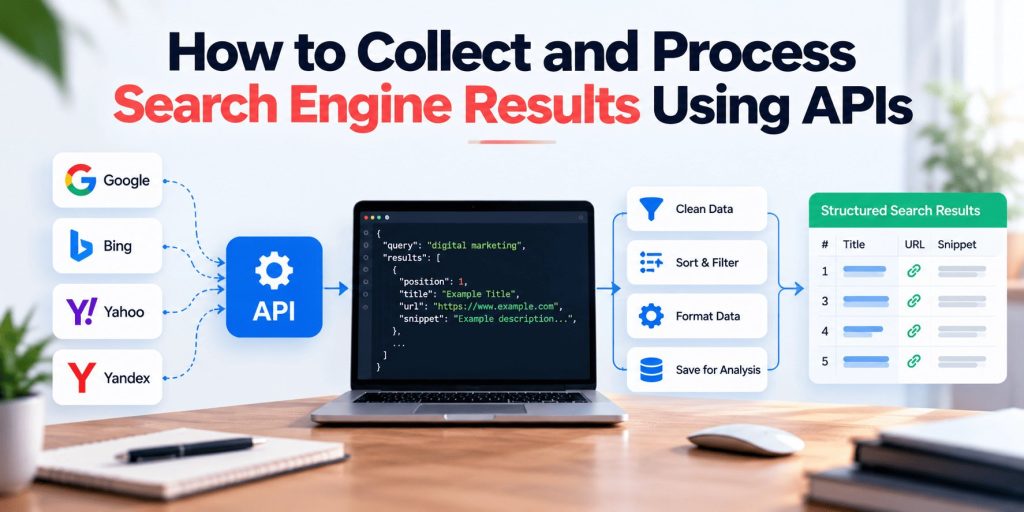
But this operation is not all that should be done. First of all, the received data should be checked, sorted and formatted in the appropriate way for the work with it by the application.
This article deals with the basic steps to collect search engine results using APIs, to process the results and to prepare them for further use.
Why Collect Search Engine Results Through APIs?
The search results can provide valuable data concerning page appearance in specific search queries. Depending on the search engine and the type of results, this data can help the SEO team to analyze rankings, identify competitor pages, track news coverage, or understand what visitors see after entering a specific keyword into the search bar.
🤔 The problem is gathering this data.
For example, let us consider an SEO team that collects information about 500 keywords for a number of websites. Doing this manually will require quite a lot of work. Moreover, it will complicate the historical analysis as one will have to record the results each time.
An automated workflow using an API can send requests regarding those queries, receive the results, and transfer this information further for processing. One can use this process automatically to analyze the current results together with the previously collected ones.
The APIs are also helpful when one has to incorporate the search results into some other applications. For example, a marketing dashboard can show ranking changes, while a research application can collect the results of the searches made in various locations.
Choosing an API for Search Data Collection
When developing the collection process, determine the kind of search data your application requires. Not all APIs provide the same data, and selecting an API based on cost or number of requests will pose difficulties later.
✅ Choose what engines and result types are supported
Take into account the engines that have to be tracked by your application. The rank tracker targeting Google has other requirements than the research tool tracking both Google and Bing results.
Do not forget about the result type. While standard web results are enough for the keyword rank tracking tool, the news monitor has to track news listings, while the product research tool has to track shopping results.
Also pay attention to the list of response fields that are provided by the selected endpoint. If your application requires ranking position, page URL, title, and snippet, make sure that all the data is available.
✅ Check Location and Language Settings
The results from a search may vary based on where and how the search was executed. For instance, if a company is tracking its rankings locally, it will need results in relation to a specific city, not a national search.
Language settings, country, and the device used for the search can also influence the output that is produced by the service provider if such settings are supported. Consistency in these settings for similar searches should be maintained otherwise.
✅ Compare response format, limits, and costs
JSON responses structured in a specific way may be helpful in cases where the responses should be used across an API, database, and report generation software. Individual fields can be processed without the need to extract everything from an HTML page first.
Limits, pagination, response time, pricing, and documentation should also be compared. The service that worked well for your tests may have quite another cost structure for handling thousands of requests.
A web search API from SERPHouse is one option developers can evaluate when building workflows around search engine data. The important step is to compare its available endpoints and response fields with the actual requirements of the project.
How to Collect Search Engine Results Through an API
With the choice of the provider made, there arises a need to ensure a proper structure of the collection process. These steps will make sure that the requests are uniform and facilitate data analysis.
1. Compile the list of searches
Start by compiling a list of queries to be collected. Based on the specifics of the project, the list can be obtained from a database of keywords, a spreadsheet, a request of the client, or a research tool used internally.
The context of each search query should be sufficient. In the case of rank tracking, that would mean including information about the target keyword, website, search engine, location, language, and device configuration.
This will prevent confusion when the same keyword is searched using different configurations. At the same time, repeating the request at a later stage will become more convenient.
It is necessary to filter out empty lines and unnecessary duplicates. When the application processes a big number of searches, it may become necessary to divide the requests into several groups.
2. Send requests and deal with the responses
The app will submit each request to the provider based on the request format described above. Then, the provider will handle the request and provide the search results that are available.
Here, it is important for the app to distinguish whether there was success or failure with the request. Authentication issues, rate limiting, network issues, and invalid arguments are all factors that could disrupt the collection.
Failure of the request does not mean that it was an empty search result. These are two different things. An empty search result can suggest that the response has had no matches, while a failure of the request indicates that the app could not get the expected information.
Keep track of the status of each request and handle temporary failures properly.
3. Paginate the process where needed
In some instances, there is going to be a greater number of results returned compared to what the application is going to need for that specific query.
In case pagination is supported by the provider, there will be additional requests to be made in order to get more results.
The number of pages to be fetched will have to depend on the purpose. In one case, the first page might suffice, but in another scenario, a greater amount of results might be needed.
Paginating will also affect the number of requests and the processing cost. There is going to be a need to determine the number of results needed in advance.
4. Validate the returned data
After retrieval, make sure that the response includes all necessary fields that the application relies on. Just because an API call was successful does not always mean that all records are appropriate for analysis.
For instance, the returned data may include both title and URL, but be missing some other field needed for the reporting system. The response can also include duplicate records or invalid values.
The validation criteria will depend on the application goals. For a ranking monitor, the necessary fields can include a query ID and the record's position in results, whereas for a news tracking application, these would be the headline and URL of the source.
The invalid records can then be marked for further consideration or disposed of in accordance with the application's data policy. Separating validation from collection makes debugging easier.
Cleaning and Organizing Search Results
Original search results never come in the format needed by a report system. Data cleaning ensures data consistency but should be carried out cautiously so as not to omit vital data.
👉 Make sure that the fields are standardized
Similar pieces of data can have different names depending on the application that uses them. While one application might call the address of a web page a URL, the other one will keep it in a different property.
Establish a consistent internal scheme for the fields used by your application. Typical examples include query, search engine, result title, destination URL, position, date of the collection, and related location parameters.
Not all endpoints provide all the fields, and the application should be ready for the absence of some data.
👉 Maintain the original details of the collection
Search results are subject to change. When the program keeps track of only the last result, it will be hard to explain any changes in ranking or reports.
It is good practice to maintain a timestamp for each collection together with the search parameters used. This will provide an opportunity to compare the results received in similar conditions.
Another good idea is to maintain some level of detail about the source of each record. This will allow for quick reference in case of an unexpected data value in the report.
📊 Turning Collected Results Into Useful Insights
Search results become more useful once they can be associated with a particular company or research question.
In the case of SEO, a platform may compare the collected positions of pages and look for any significant changes that need to be addressed. In the case of competitor research, a software may group results by domain and keywords used to see which sites come up for a certain set of queries.
In the case of news monitoring, results may be organized by selected topics and associated source URLs to allow a user to analyze the content.
Market research software may use collected data for additional analysis.
These applications will apply different processing algorithms to the data, but they have one thing in common: collected results must be such that they allow answering the research questions.
Observations can be obtained from search data for analysis. Further data may be required to provide reasons for the observations.
Common Challenges in API-Based Search Collection
A carefully thought-out collection process is still subject to certain challenges when the number of requests increases.
⚠️ Limitation and error handling: Providers have a limit on the number of requests allowed during a certain period. The application needs to take the restrictions into consideration, manage the number of errors and implement appropriate retry logic.
⚠️ Inconsistency: Search results can differ from one collection to another and depend on the search parameters set. It is important to keep the necessary information about the request to make useful comparisons.
⚠️ Unexpected responses: Changing the response format of the API endpoint complicates the process of processing the data. The incoming data needs to be checked and processed regardless of new unexpected fields.
⚠️ Unnecessary API Costs: Retrieval of an unnecessary number of pages or redundant requests can lead to unnecessary costs. Determine collection frequency and the amount of results based on application requirements.
Solving these problems in advance simplifies the process of system expansion and helps track the quality of the collected information.
Final Thoughts
Search engine results data collection via APIs is a convenient option for rank tracking, competitive analysis, news feeds, and many other tasks that require search data. However, the collection request is just the starting point.
Queries have to be crafted thoughtfully, responses have to be analyzed and validated, duplicates have to be handled in context, and historical data has to stay relevant. Otherwise, any data collection, regardless of its size will become hard to validate and interpret.
Before implementing a data collection pipeline, try running it with a reasonable number of queries and analyze the results starting from collection up to storage. Make sure that failed queries are recognized, required fields are extracted, and stored records provide answers to the questions that the application is supposed to find out.
A reliable search data pipeline does not depend on the number of results collected. The question is about their relevance and traceability.