
Something interesting happened at the end of August 2026 that most Indian marketers scrolled past without a second thought.
On August 27, OpenAI quietly turned on advertising inside ChatGPT for Indian users — making India one of the first countries outside the US and Europe to get access to what may be the most significant new advertising platform since Meta launched Instagram Ads in 2013.
Five days later, on September 4, the self-serve ChatGPT Ads Manager opened to Indian businesses at ads.openai.com. Daily budgets start at ₹725. No agency partnership required. No minimum commitment. Anyone with a product and an internet connection can now put an ad in front of 100 million ChatGPT users in India.
Most businesses don’t know this yet. Which means, if you’re reading this right now, you have something valuable: a window.
This article explains exactly what ChatGPT Ads are, how the platform works in India, what it costs, and — most importantly — whether it’s actually worth your time and money right now.
A Quick Bit of Background: Why ChatGPT Even Has Ads
Sam Altman famously called advertising a “last resort” for OpenAI as recently as 2024. The company was built on the idea that people would pay for access to good AI, and for a while, that seemed to be working — ChatGPT Plus launched at $20/month and found millions of subscribers.
But there’s a mathematics problem with that model. More than 95% of ChatGPT’s one billion weekly users as of August 2026 are on the free tier. OpenAI is spending billions of dollars on computing infrastructure to serve all of them, and subscriptions alone weren’t covering it — especially with a planned IPO approaching that would require the company to show a credible path to profitability.
The pivot to advertising was not a failure of strategy. It was arithmetic.
OpenAI announced its advertising plans on January 16, 2026. Testing began in the United States on February 9. And unlike most advertising systems, OpenAI has been unusually specific about what it will and won’t do with user data — a conscious choice to differentiate from the surveillance-advertising reputation that has followed Meta and Google for years.
🔥 India got ChatGPT Ads on August 27, 2026 — about six and a half months after the US. For context, when Facebook launched its ad platform, India waited nearly four years. OpenAI clearly has different priorities for the Indian market.
What ChatGPT Ads Actually Look Like
Before we talk about costs and targeting, it helps to understand what you are actually buying.
ChatGPT ads are not pop-ups. They are not banners. They do not interrupt conversations or appear between messages the way Instagram Stories ads appear between your friends’ posts.
Here is exactly what happens: a user on the free or ₹399/month Go tier asks ChatGPT something — “what are the best CRM tools for a small business in India?” or “I’m looking for a digital marketing agency in Indore” or “what laptop should I buy under ₹60,000?” — ChatGPT generates its normal response. Then, at the bottom of that response, a clearly labelled “Sponsored” placement appears showing a relevant brand.
That’s it. The ad sits below the answer. The answer above it is completely unaffected by the ad below it. OpenAI has been emphatic about this — the AI model generating the response doesn’t even know an ad exists in the thread. The two systems are technically separated.
This matters because it addresses the obvious concern: can a brand pay to make ChatGPT recommend their product? No. The organic answer is what it is. The ad is a separate, labelled addition at the bottom.
What users see is more like a sponsored card than a traditional ad unit — a brand name, a short line of copy, and a call to action. Think of it as the AI equivalent of a promoted result in Google Search, but appearing after an answer rather than before one.
How We Got Here
Understanding the timeline helps you understand where the platform currently is and why early movers have an advantage.
OpenAI Announces Its Advertising Plans
OpenAI announces its advertising plans. The ChatGPT Go tier launches at $8/month globally (₹399/month in India), giving OpenAI a large base of logged-in, verified adult users to show ads to.
Ads Go Live in the United States
Ads go live in the United States, but only with select enterprise brands at a $200,000 minimum commitment and $60 CPM. At this stage, ChatGPT advertising remains largely out of reach for small businesses.
CPM Rates Fall as More Brands Enter
CPM rates drop to as low as $25 as more brands enter. OpenAI also introduces cost-per-click bidding with a recommended starting bid of $3–$5 per click.
Self-Serve ChatGPT Ads Manager Launches
The self-serve ChatGPT Ads Manager launches at ads.openai.com for US businesses. The $200,000 minimum spend is eliminated, opening the platform to businesses of all sizes.
Expansion Reaches Europe and India
OpenAI expands ChatGPT advertising to 31 European countries, followed by its expansion into India.
ChatGPT Ads Go Live in India
ChatGPT Ads go live for Indian users. More than 50 brands launch during the first week. WPP and Omnicom are named as the first official agency partners for India.
OpenAI Confirms India's Self-Serve Expansion
OpenAI's official blog confirms that self-serve Ads Manager is launching in India, Europe, the Middle East and North Africa.
Indian Advertisers Can Start Using Ads Manager
Self-serve access opens at ads.openai.com for Indian advertisers. Daily budgets start at ₹725, making the platform accessible to businesses of every size.
We Are Still at the Beginning of This Story
The platform is only weeks old in India. The brands that moved in September and October 2026 are entering during the earliest stage of ChatGPT advertising, much like businesses that created Facebook pages in 2009 or Google Ads accounts in 2002.
Who Sees ChatGPT Ads in India
This is one of the most important things to understand before you spend a single rupee.
Ads are shown to:
- Logged-in adult users on the Free tier (no subscription)
- Logged-in adult users on the Go tier (₹399/month in India)
Ads are NOT shown to:
- ChatGPT Plus subscribers ($20/month)
- ChatGPT Pro subscribers ($200/month)
- ChatGPT Team, Business, Enterprise, and Education account holders
- Users under 18 (OpenAI runs age prediction and suppresses ads for likely minors)
- Anyone who is not logged in
This means your ads reach free users and entry-level subscribers — which, given that over 95% of ChatGPT’s user base is on the free tier, is the overwhelming majority of those 100 million weekly Indian users.
The flip side of this: the users who don’t see your ads (paid subscribers) tend to be heavier, more committed ChatGPT users — often professionals, developers, and enterprise employees. You’re reaching the broad, high-volume free user base, which skews toward students, researchers, and people exploring AI for the first time. That’s still a significant audience, but it’s worth knowing who you’re reaching.
How to Access ChatGPT Ads Manager in India
Since September 4, 2026, the process is straightforward.
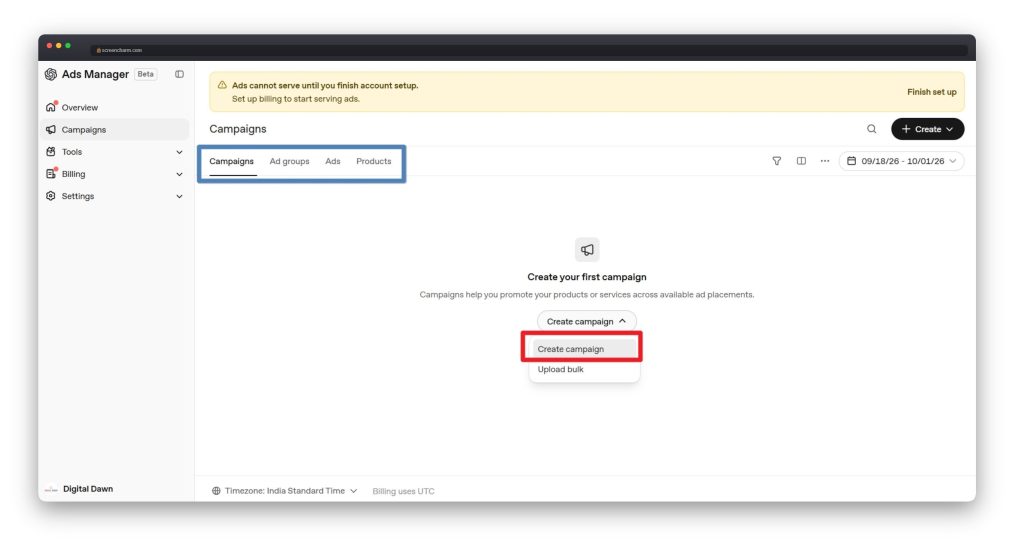
Go to ads.openai.com and sign up. You’ll need an OpenAI account (the same one you use for ChatGPT), a business name, billing information, and a clear sense of what you want to advertise.
There is no minimum spend. Daily budgets start at ₹725 — about what you’d spend on a modest chai and samosa run for the office, though hopefully with better returns. You can set a daily limit, a campaign duration, and a total budget cap.
The Ads Manager gives you two ways to buy:
- CPM (Cost per Mille / per thousand impressions): You pay for every thousand times your ad is shown, regardless of whether anyone clicks. Good for brand awareness — getting your name in front of users who are researching your category.
- CPC (Cost per Click): You pay only when someone actually clicks your ad. OpenAI’s recommended starting bid is $3–$5 per click (approximately ₹250–420 per click). Good for performance campaigns where you want measurable actions.
Both options run through a relevance-weighted second-price auction — essentially the same mechanism Google has used for years. You set a maximum bid; the actual amount you pay is determined by what the next-highest bidder offered, plus one cent. This system rewards relevance, not just budget.
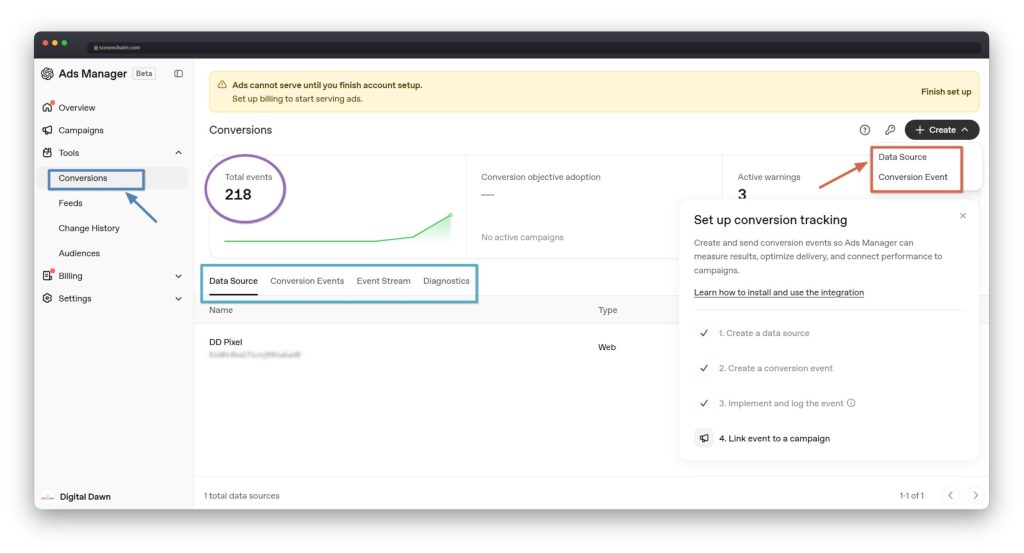
💡 Tracking and measurement: OpenAI offers a JavaScript pixel (similar to the Meta Pixel) and a Conversions API for businesses that want to track what happens after someone clicks. These launched in May 2026 alongside the self-serve platform and are available to Indian advertisers from day one.
![]()
What It Costs: Pricing in Indian Context
Here is the honest pricing picture as of October 2026.
The platform launched in India with daily budgets starting at ₹725. There’s no published Indian CPM rate yet (the platform here is literally weeks old), but based on the global trajectory:
US pricing evolution:
- Launch (Feb 2026): $60 CPM (~₹5,100)
- April 2026: $25 CPM (~₹2,100)
- Recommended CPC: $3–$5 (~₹250–420 per click)
Indian pricing is expected to be lower than US rates — this is standard across all advertising platforms. Google Ads CPCs in India run roughly 5–10x lower than equivalent US campaigns. Meta Ads India CPMs are a fraction of US rates. ChatGPT Ads in India will likely follow a similar pattern, though we don’t have enough data yet to quote specific Indian benchmarks with confidence.
What we do know:
- Minimum daily budget: ₹725 (~$8.60)
- You can start, pause, and stop whenever you want
- No minimum commitment period
- Postpay billing (you pay after the spend, not upfront)
A realistic monthly budget for an Indian SME testing this platform:
- Conservative test: ₹725/day × 30 days = ₹21,750/month
- Active campaign: ₹2,000–5,000/day = ₹60,000–1,50,000/month
- These figures will shift as Indian-specific benchmarks emerge in Q4 2026
👉 Compare this to what you’re already spending: If you’re running Google Ads or Meta Ads, you’re probably already spending ₹20,000–1,00,000 per month. Running a parallel ChatGPT Ads test at ₹725/day gives you comparative data from a completely different user intent environment — and you won’t need to stop your existing campaigns to do it.
How ChatGPT Decides Which Ads to Show
Targeting on ChatGPT works differently from what you’re used to on Google and Meta, and understanding this difference helps you write better ads and set realistic expectations.
OpenAI matches ads to conversations based on:
- What the person is currently talking about — the most important factor. If someone is asking ChatGPT about cloud accounting software, ChatGPT Ads will show them ads from relevant accounting or business software companies. The match is contextual to the conversation, not to demographic data.
- The person’s past conversations — with consent, the system uses patterns from previous chats to understand what a user has been researching. This is limited and privacy-preserving by design.
- Past ad interactions — how the user has responded to ads before (dismissed them, clicked them, etc.).
What the system does NOT use: the actual text of private conversations is not shared with advertisers. OpenAI has explicitly stated that advertisers do not receive access to user chats, chat history, memories, or personal details. The targeting is inference-based, not data-sharing-based.
💡 What this means practically for advertisers: You cannot target “25–35 year old women in Bengaluru who earn ₹10 lakhs and are interested in fashion.” The platform doesn’t work that way — at least not yet. What you can do is target by the topics people are discussing, which for high-consideration categories is actually a better signal. A person asking ChatGPT “what’s the best health insurance plan for a family of four in India” is more valuable to an insurance company than someone who has “health insurance” in their Facebook interest graph because they liked a hospital’s page six months ago.
The Categories You Cannot Advertise In
OpenAI has excluded certain categories from ChatGPT Ads entirely, and some of these will affect Indian advertisers specifically.
The exclusions include certain financial products, certain health and pharmaceutical categories, and content that conflicts with OpenAI’s usage policies. The exact exclusion list is governed by OpenAI’s advertising policies at ads.openai.com.
Indian businesses to check carefully before applying:
- Fintech and lending products — some are excluded, some are not
- Health insurance and pharmaceutical brands — subject to restrictions
- Alcohol brands — likely restricted
- Political campaigns — not permitted
- Crypto and speculative investment platforms — not permitted
If your business falls into a grey area, check OpenAI’s current ad policies before setting up a campaign. The list may evolve as the platform matures.
ChatGPT Ads vs Google Ads vs Meta Ads: The Honest Comparison
Let’s put all three in context, because this is not a replacement conversation — it’s an addition conversation.
✅ Google Ads reach people who are actively searching for something specific. The intent is explicit — they typed a query. This makes Google Ads ideal for capturing demand that already exists. “Plumber in Indiranagar” — that person needs a plumber now.
✅ Meta Ads reach people who are not searching for anything. They are scrolling through content and your ad interrupts them. This makes Meta Ads good for creating demand — showing people a product they didn’t know they wanted — and for retargeting people who have already shown interest.
✅ ChatGPT Ads occupy a third position that neither Google nor Meta covers well. The person is actively thinking and researching — but they haven’t yet formed a specific enough query to type into Google Search. They’re in the consideration phase, exploring options, weighing decisions. “I’m planning to start an online business, what should I know?” — that’s not a Google search yet. But it’s a perfect moment to introduce a relevant brand.
| ChatGPT Ads | Google Search Ads | Meta / Instagram Ads | |
|---|---|---|---|
| User mindset | Thinking and researching | Actively searching | Passively scrolling |
| Stage in buying journey | Early consideration | High intent, near purchase | Awareness / retargeting |
| India audience size | 100M+ weekly users | Much larger | 350M+ monthly users |
| Targeting depth | Contextual (topic-based) | Keyword-based | Demographic + interest |
| Daily minimum (India) | ₹725 | ~₹500+ | ~₹500+ |
| Ad visibility | Bottom of AI response | Top of search results | In-feed |
| User intent quality | Very high | High | Medium |
| Platform maturity in India | Brand new (Sep 2026) | Very mature | Mature |
| Competition among advertisers | Very low (early days) | High | High |
💡 The key advantage of acting now: In the early months of any new ad platform, CPMs and CPCs are lower because there are fewer advertisers bidding for the same audience. Google Ads in India has thousands of businesses competing for the same keywords, driving costs up. ChatGPT Ads in India has, at the time of writing, a fraction of that advertiser competition. The early-mover advantage on CPCs and CPMs is real and measurable.
We have been providing services in both google and meta ads for the businesses. You can check it out here:
Google Ads Services | Meta Ads Services
Types of Businesses That Should Consider Testing Now
Not every business is equally well-suited to ChatGPT Ads at this stage. Here is an honest breakdown.
High potential right now:
SaaS and software products
ChatGPT's user base in India skews heavily toward developers, tech workers, and startup founders. If you sell a business tool, productivity software, or developer product, this is your audience.
EdTech and online learning
Students and learners are a massive segment of ChatGPT's Indian user base. People asking ChatGPT about career paths, competitive exams, skill-building, or degree programmes are very much in the consideration phase for education products.
Professional services
CA firms, consultants, marketing agencies, legal services — when someone asks ChatGPT "how do I register a private limited company in India," they may well be in the market for a professional to help them do it.
D2C brands with researched products
Skincare, supplements, health and wellness products where users actively seek information and comparisons before buying. The "what's the best [category] product" query type is extremely common in ChatGPT and well-suited to sponsored introductions.
B2B products
High-consideration, higher-ticket B2B sales are often driven by research phases. ChatGPT has become a significant tool for business research in India, particularly among startup founders and decision-makers.
Should probably wait:
Local service businesses
(plumbers, electricians, salons, restaurants) — ChatGPT Ads don't yet support specific local area targeting within India. Someone in Mumbai asking about dentists doesn't need your dental clinic in Indore showing up. Until geo-targeting gets granular within India, locally-focused services will get poor ROI.
Businesses with very tight margins
If you're selling products at ₹200–500 and your customer acquisition cost needs to be under ₹50, this platform isn't going to work for you at ₹250–420 per click. Your economics need to support the cost.
Impulse-purchase categories
Snack foods, low-cost apparel, anything where the buying decision happens in a moment of want rather than a process of research. ChatGPT's environment is deliberate and research-oriented, not impulse-triggering.
Excluded categories
As discussed above. Check before assuming.
Does your customer naturally use research to make a buying decision?
What Makes a Good ChatGPT Ad
This is where almost all existing advice falls short because the platform is so new. But some principles translate well from what we know about high-intent advertising.
Match your ad to research intent, not purchase intent. Someone asking ChatGPT a research question doesn’t want to buy yet — they want to learn. Your ad copy should position your brand as the answer to a question, not the solution to an immediate problem. “Find out how [your product] helps Indian businesses do X better” lands better than “BUY NOW, 50% OFF TODAY.”
Keep it short and specific. ChatGPT users are reading an AI response — they’re in information-absorption mode. A clear, specific, relevant ad line works. A cluttered ad with too many claims does not.
Your landing page matters enormously. The click is just the beginning. A person who just finished reading a detailed ChatGPT response about a topic is a sophisticated, informed visitor. A generic homepage or a pushy sales landing page will waste every click. Send them to a page that continues the conversation — detailed, informative, helpful.
Test the category match. Think about what a user would have to be asking ChatGPT to make your product relevant. If you can’t picture a natural question that leads to your ad showing up and making sense, reconsider whether your category is a fit.
The Honest Reality of Where Things Stand
We’re going to say something that most “comprehensive guides” to new platforms won’t say: $1 billion annualised revenue in under 200 days, 3x ROAS for an ecommerce advertiser, 80%+ new customer traffic.
ChatGPT Ads opened to Indian businesses on September 4, 2026. That’s weeks ago. The agencies claiming Indian click-through rates and conversion benchmarks are either working from US data (a different market) or making educated guesses. Anyone publishing “India ChatGPT Ads benchmarks” this early is working with insufficient information.
What we know with certainty:
- The platform is live and accessible to Indian businesses right now
- Daily budgets start at ₹725 with no minimum commitment
- The user base (100M+ weekly Indian users) is large and engaged
- The advertiser competition is currently very low, meaning early testers will pay less per click than advertisers who enter six months from now
- OpenAI has named WPP and Omnicom as agency partners, signaling serious infrastructure investment in India
What we don’t know yet:
- Indian-specific CPM and CPC benchmarks
- Which Indian categories are performing best
- How Indian users respond to ads in ChatGPT (dismissal rates, engagement rates)
- Whether the platform will add location targeting within India soon
The appropriate mindset for October 2026 is: test, learn, and set realistic expectations. Start at ₹725/day. Run for 30 days. Watch what happens. Adjust. The businesses that will win on this platform in 2027 and 2028 are the ones building institutional knowledge about it right now — when the information is scarce, the competition is low, and the cost is minimal.
How to Actually Get Started — Step by Step
Go to ads.openai.com. Sign in with your OpenAI account or create one if you don't have it.
Create your first campaign. Choose your objective: Awareness (CPM) or Clicks (CPC). For most Indian businesses testing for the first time, CPC at the recommended starting bid makes more sense — you only pay when someone actually clicks.
Define your targeting. Choose the topics or categories relevant to your business. This is contextual targeting, not demographic, so think about what people are asking ChatGPT when your product is relevant.
Write your ad. Brand name, a single benefit-focused line, and a destination URL. Keep it direct and honest.
Set your budget. Start at ₹725/day. Run for at least 21 days before drawing conclusions — the algorithm needs time to optimise.
Install the tracking pixel. Go to your advertising settings and install the OpenAI conversion pixel on your website. Without this, you'll be running blind on what clicks turn into customers.
Check your results weekly, not daily. New platforms have noisy short-term data. Weekly averages are more meaningful than daily fluctuations on a platform this early.
One alternative for businesses that want professional support: WPP and Omnicom are the official agency partners in India, but any digital marketing agency with access to ads.openai.com can run campaigns. The official partnership status affects access to OpenAI's support team, not who can buy ads.
Should Your Business Try ChatGPT Ads Right Now?
Simple framework for deciding:
Try it now if:
- You sell a researched, considered purchase (SaaS, education, professional services, B2B, higher-ticket D2C)
- You can afford ₹725/day for 30–60 days as a learning investment
- You want to build early expertise on a platform that will become significantly more competitive over the next 12 months
- You are comfortable with “we don’t know yet” as a starting data point
Wait if:
- Your daily ad budget is under ₹500 (the minimum is ₹725)
- You need precise local targeting within a specific Indian city or neighbourhood. It’s not available in India yet, but the US rollout signals it’s on the roadmap. Watch for this!
- You’re in an excluded category
- Your margins cannot absorb a ₹300–500 cost per click while you gather performance data
- You need to justify every rupee immediately and don’t have room for a learning phase
🔥 The bigger picture: India is ChatGPT’s second-largest market in the world. OpenAI is clearly treating it as a priority — the gap between US launch and India launch was six months, not six years. The platform will grow here. The advertisers who understand how it works in 2026 will have an enormous advantage over those who arrive in 2027 wondering why costs are higher than they expected.
The ₹725/day entry point makes this one of the lowest-cost learning experiments available to an Indian marketer right now. The question is not whether ChatGPT Ads will eventually matter in India. The question is whether you want to be in the room when the rules are still being written.
Digital Dawn is a digtial marketing company in Indore helping Indian businesses grow through Google Ads, Meta Ads, Google Business Profile, and emerging platforms including ChatGPT Ads. If you want help setting up and running your first ChatGPT Ads campaign in India, we’re happy to talk.
