
India Post is now delivering orders on it. Commerce Minister Piyush Goyal says it’s processed over 350 million transactions. In July 2026 it crossed 500 million cumulative transactions. ONDC is no longer an experiment — here’s what it actually is and how any Indian seller can get on it.
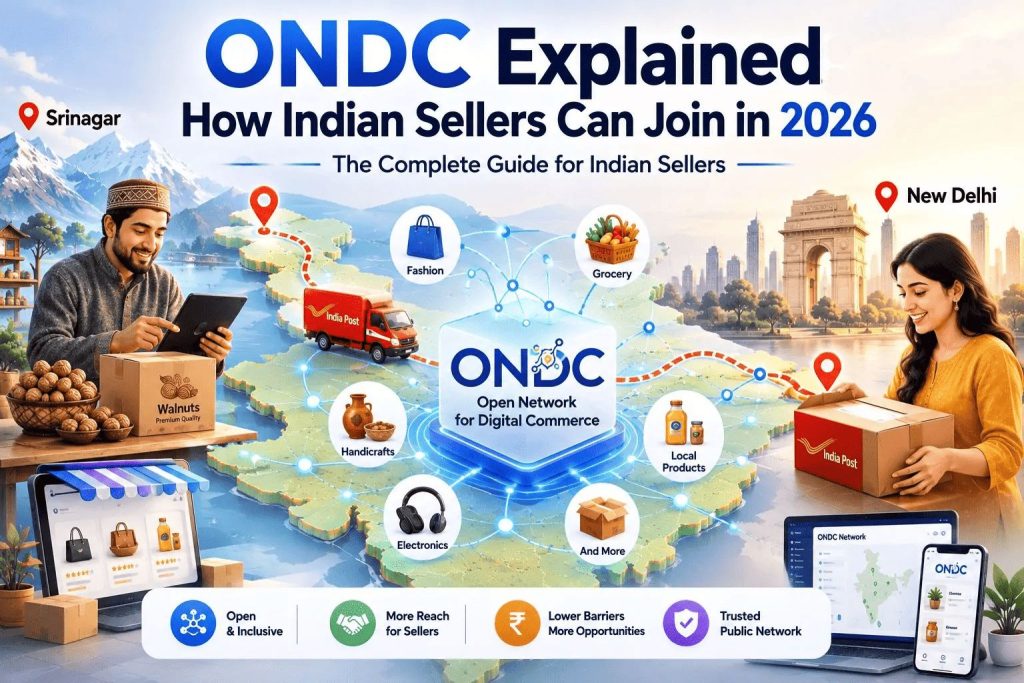
On January 13, 2026, a seller from Srinagar received a pickup request for a parcel of walnuts. Two days later, that parcel was delivered to a buyer in New Delhi. Nothing remarkable about that, except the logistics provider who handled it end-to-end was India Post — and the order was booked through ONDC.
When India’s 1.6 lakh post offices are now part of an ecommerce network, something has genuinely shifted. India Post isn’t a startup experimenting with quick delivery — it’s 150 years old and reaches corners of the country that Amazon and Flipkart don’t. Its presence on ONDC signals that this is no longer a government pilot project quietly running in a few cities. It’s public infrastructure, and it’s worth understanding.
This guide explains what ONDC actually is — without the jargon — why it matters specifically for small and medium Indian sellers, and exactly how to get on it in 2026.
500 Mn+
Cumulative transactions on ONDC, crossed in July 2026
Source: WORLDEF / ONDC data, Aug 2026
2 Lakh+
Active retail merchants on ONDC as of mid-2026
Source: WORLDEF, Aug 2026
60 Lakh
Daily transactions ONDC is targeting by end of 2026, up from 5–6 lakh in 2025
Source: Costbo / ONDC leadership, 2026
What is ONDC — in plain language
ONDC stands for Open Network for Digital Commerce. It was launched by the Government of India’s Department for Promotion of Industry and Internal Trade (DPIIT) in 2021. But the name and the acronym don’t really tell you what it is or why it matters, so let’s start with an analogy.
THE SIMPLEST WAY TO UNDERSTAND ONDC
Think about how UPI works for payments. Before UPI, if you had a Paytm wallet, you could only send money to other Paytm users. If they were on PhonePe, it didn’t work. UPI created a common protocol that made all these apps talk to each other — so now a PhonePe user can pay a Google Pay merchant and everything works seamlessly.
ONDC is trying to do the same thing for buying and selling. Right now, if you’re a seller on Amazon, your products are only discoverable to Amazon shoppers. If a buyer is using the Magicpin app, they can’t see your Amazon listing. ONDC creates a common protocol that allows any seller app and any buyer app to communicate — so a seller registered with one app can be discovered by buyers on any other app in the network.
That’s why some people call it the “UPI of ecommerce.” The comparison isn’t perfect, but it captures the core idea: open infrastructure that removes the dependency on any single platform’s walled garden.
In practice, ONDC is not an app you download or a website you shop on. It’s a set of open-source standards and protocols — called the Beckn Protocol — that different apps can plug into. Sellers register through a seller app (more on those shortly), and their products become discoverable to buyers using any buyer app connected to the same network. The actual checkout, payment, and logistics can involve different providers, all communicating through common standards.
Why ONDC matters for small Indian sellers specifically
The honest context here is that ONDC was created because the government was concerned about what was happening to small sellers on Amazon and Flipkart. Both platforms have faced allegations of preferential treatment for their own private label brands, manipulation of search rankings, and terms that effectively lock sellers in while extracting growing commission percentages. Whether or not you agree with every specific allegation, the structural reality is real: a seller on Amazon depends entirely on Amazon’s algorithms, Amazon’s policies, and Amazon’s commission structure. If Amazon raises its fees or deranks your products, there’s not much you can do.
Commerce Minister Piyush Goyal said ONDC was launched to “democratize e-commerce in India” and create “a level playing field for small enterprises.” Of the sellers onboarded in the early years, 70% were small and medium businesses — which tells you something about who the network was actually designed to help.
For a seller in Indore, Surat, Coimbatore, or Patna, ONDC offers something genuinely different from the existing marketplace model. You register once and become visible across multiple buyer apps simultaneously. You’re not locked into one platform’s ecosystem. You choose your own logistics provider — including, now, India Post. And ONDC itself does not charge commission at the network level, though the seller apps that facilitate your registration may have their own fee structures.
This doesn’t mean ONDC has solved everything — the challenges are real and we’ll come to them. But the structural proposition is worth understanding before deciding whether it’s worth joining.
Where ONDC actually stands in 2026
The honest picture in 2026 is: bigger than most people realize, but still not at the scale the government originally targeted.
ONDC crossed 500 million cumulative transactions in July 2026 — a number that went from 0.2 million in FY2023 to 218 million during FY2026 alone. The network recorded 16.5 million transactions in a single month by March 2025, with daily transactions running at 5 to 6 lakh at that point. ONDC leadership has stated the target is 60 lakh daily transactions by the end of 2026 — which would be a 10x jump from where things stood a year ago.
Beyond retail, ONDC has expanded into mobility and public services in ways most people haven’t noticed. Over a million drivers have joined the network’s ride-hailing ecosystem, and around 80% of India’s metro ticketing inventory is now available through ONDC. More than 370,000 public transport trips per day were being facilitated through the network as of June 2026. This is no longer just a shopping network — it’s becoming public digital infrastructure for commerce of all kinds.
THE INDIA POST MILESTONE — WHY IT MATTERS MORE THAN A NEWS HEADLINE
On January 13, 2026, India Post booked its first ONDC order — a shipment of walnuts from Srinagar to New Delhi, placed by UdyamWell, an initiative supporting rural entrepreneurs and artisans. The delivery was completed two days later.
The significance isn’t the walnut shipment. It’s what India Post’s integration enables going forward. With over 1.6 lakh post offices across the country, India Post reaches villages and towns that no private courier service covers reliably. For a craftsperson in a remote part of Rajasthan or a farmer selling produce from a small town in Bihar, India Post as a logistics option on ONDC means they can now reach a buyer in Chennai or Pune — without depending on whether Delhivery or Blue Dart has coverage in their area.
Sellers on any ONDC-enabled buyer app can now select India Post for pickup, booking, tracking, and delivery through the digital Click and Book model. This is what “democratising ecommerce” looks like in practice rather than in a press release.
How to join ONDC as a seller in 2026
This is where most people get confused — and the confusion is understandable. You cannot “sign up for ONDC” on a single website the way you’d register on Amazon Seller Central. ONDC is a network, not a platform. You access it through a seller app — a third-party application that connects your business to the ONDC network and handles your product catalogue, orders, and logistics.
The process is straightforward once you understand that structure. Here’s how it works step by step.
Get Your Documents Ready First
Most seller apps require a GST registration number, your PAN card, active bank account details, and your business address. GST is mandatory for most product categories on ONDC — the same exemptions that apply on Amazon and Flipkart broadly apply here too. Non-GST sellers can participate in certain exempt categories, but if you sell most regular goods, you'll need to be GST registered.
Choose a Seller App and Register
Pick one of the ONDC-connected seller apps (see the list below), visit their website or download their app, and complete the registration form with your business and personal details. The sign-up process typically takes under an hour if your documents are ready.
Complete KYC Verification
After registration, the seller app verifies your KYC details — this typically takes 2 to 3 business days. Some apps have faster approval timelines. You'll get notified once your account is approved and active on the network.
Upload Your Product Catalogue
Once approved, you list your products — including title, description, images, pricing, and inventory. Your seller app handles the formatting and pushes your listings to the ONDC network. Several apps now offer AI-assisted listing tools that generate descriptions and keywords from a product photo, significantly reducing the time this takes.
Set Up Logistics
Choose how you'll fulfil orders. On ONDC, you can ship through your own courier tie-ups, through logistics provider apps connected to the network, or — as of 2026 — through India Post's Click and Book service. The network's unbundled logistics model means you're not locked into a single fulfilment provider the way you might be on Amazon FBA.
Go Live and Manage Orders
Once your catalogue is published, your products become discoverable to buyers across the ONDC network — not just through the specific buyer app your customers might be using, but through any app connected to the network. Orders come through your seller app dashboard, and fulfilment follows the same process as any other ecommerce channel.
Which seller app should you use?
This is probably the most practical question in this whole guide. There are several ONDC-connected seller apps available, each with slightly different strengths. Here are the ones most relevant to Indian sellers in 2026:
Mystore
One of the most widely used ONDC seller apps, built by StoreHippo. Supports both D2C brands and marketplace sellers, with tools for catalogue management, order tracking, and Shopify/WooCommerce integration. Actively expanding its seller base through 2026 with new tools for discovery and analytics.-> Explore: Mystore
Paytm for Business
Paytm's seller interface connects to ONDC and benefits from Paytm's existing merchant network. Familiar to sellers who already use Paytm for payment collection.
CostBo
Built for brands and high-growth businesses rather than first-time sellers. One of the first ONDC 1.2.0 certified platforms, handling catalogue management, inventory, logistics orchestration, and multi-warehouse setups. Strong fit for FMCG and consumer brands with existing distributor networks.-> Explore: CostBo
Digihaat
Focused on rural and artisan sellers, making it particularly relevant for handicrafts, handloom, and traditional Indian goods. If you're an artisan or sell products that fit the "Vocal for Local" and One District One Product narrative, Digihaat's audience skews appropriately toward these categories.-> Explore: DigiHaat
SellerApp (ONDC)
Has helped over 1,100 sellers onboard to ONDC and offers Shopify and WooCommerce connectors so existing store owners can extend to ONDC without rebuilding their catalogue.
☝️ One thing to check before you sign up
ONDC itself does not charge commission, but individual seller apps have their own pricing models — some charge a monthly subscription, others take a small percentage per transaction, and a few operate on a freemium model. Always check the current fee structure of whichever seller app you choose before signing up, since these can change and are not standardised across apps.
ONDC vs Amazon vs Flipkart: an honest comparison
Rather than making a case for one over the other, here’s a direct comparison of the practical differences that matter most for an Indian seller deciding where to invest their time in 2026:
| Factor | ONDC | Amazon India | Flipkart |
|---|---|---|---|
| Network commission | Zero (ONDC level) | 2–38% + fees | 5–24% + fees |
| Buyer reach | Across all connected buyer apps | Amazon’s own large base | Flipkart’s own large base |
| Logistics flexibility | High — choose your own provider, including India Post | FBA preferred, limited flexibility | Flipkart Smart Fulfilment preferred |
| Platform dependency risk | Low — open network, no single platform controls you | High — Amazon controls your visibility | High — Flipkart controls your visibility |
| Setup complexity | Moderate — requires choosing and learning a seller app | Well-documented, familiar | Well-documented, familiar |
| Trust and buyer familiarity | Still building — less name recognition | Very high | Very high |
| Best for | Small sellers, artisans, rural entrepreneurs, MSMEs | Branded products, premium categories | Fashion, home, electronics, Tier 2/3 India |
The honest limitations of ONDC right now
Any article that only talks about ONDC’s potential without acknowledging its real current challenges would be doing you a disservice. Here’s what’s actually hard about selling on ONDC today.
⚠️ Buyer experience is still fragmented.
Unlike Amazon where the checkout, payment, and delivery experience is smooth and consistent, ONDC’s decentralised model means different buyer apps offer different interfaces and experiences. A buyer using Magicpin sees things differently from a buyer using Paytm’s buyer app, and the quality of that experience varies. Until buyer apps collectively raise their UX standards, ONDC conversion rates will trail Amazon and Flipkart’s polished funnels.
⚠️ Dispute resolution is more complex.
On Amazon or Flipkart, dispute resolution — returns, refunds, missing orders — goes through a single platform’s process. On ONDC, because multiple parties are involved (seller app, buyer app, logistics provider), disputes can be harder to resolve when responsibility isn’t clear. The network has dispute resolution protocols, but the practical experience is still more complicated than on a single integrated platform.
⚠️ Discoverability is growing but not yet at marketplace scale.
The sheer number of buyers actively shopping through ONDC-connected buyer apps is still significantly smaller than Amazon’s or Flipkart’s buyer base. For a seller purely chasing volume, Amazon and Flipkart are still where most transactions happen. ONDC is the right channel to add alongside existing marketplace presence, not necessarily a replacement for it in 2026.
💡 The practical recommendation for most Indian sellers
Treat ONDC as an additional channel, not a replacement. If you’re already selling on Amazon or Flipkart, adding ONDC through a seller app like Mystore or CostBo gives you additional reach — particularly to buyer apps that serve audiences in smaller cities — without any meaningful cannibalisation of your existing sales. The zero network commission makes experimentation genuinely low-cost.
THE SHORT VERSION
- ONDC is a government-backed open network that lets sellers on one app be discovered by buyers on any other connected app — think of it as the UPI of ecommerce
- It crossed 500 million cumulative transactions in July 2026 and now includes over 2 lakh active retail merchants, mobility services, and metro ticketing across India
- India Post joined as a logistics provider in January 2026, delivering its first order (walnuts from Srinagar to Delhi) on January 15 — its 1.6 lakh post offices now give ONDC sellers rural delivery reach no private courier matches
- To join as a seller, you don’t sign up for ONDC directly — you register through a seller app like Mystore, CostBo, or Digihaat, which connects you to the network
- ONDC itself charges zero commission at the network level, though seller apps have their own pricing structures to check before signing up
- Current limitations are real: fragmented buyer experience, complex dispute resolution, and lower buyer volumes than Amazon or Flipkart — treat ONDC as an additional channel alongside existing marketplaces, not a replacement
Selling online and not sure which platforms to prioritize?
Selling online and not sure which platforms to prioritize?We help Indian brands and sellers choose the right channels, set up their presence, and grow with performance marketing that actually converts — whether that’s Amazon, Flipkart, Meesho, ONDC, or your own store.