Best Platforms to Sell Online in India 2026: Where to Sell What

best online selling platforms india 2026

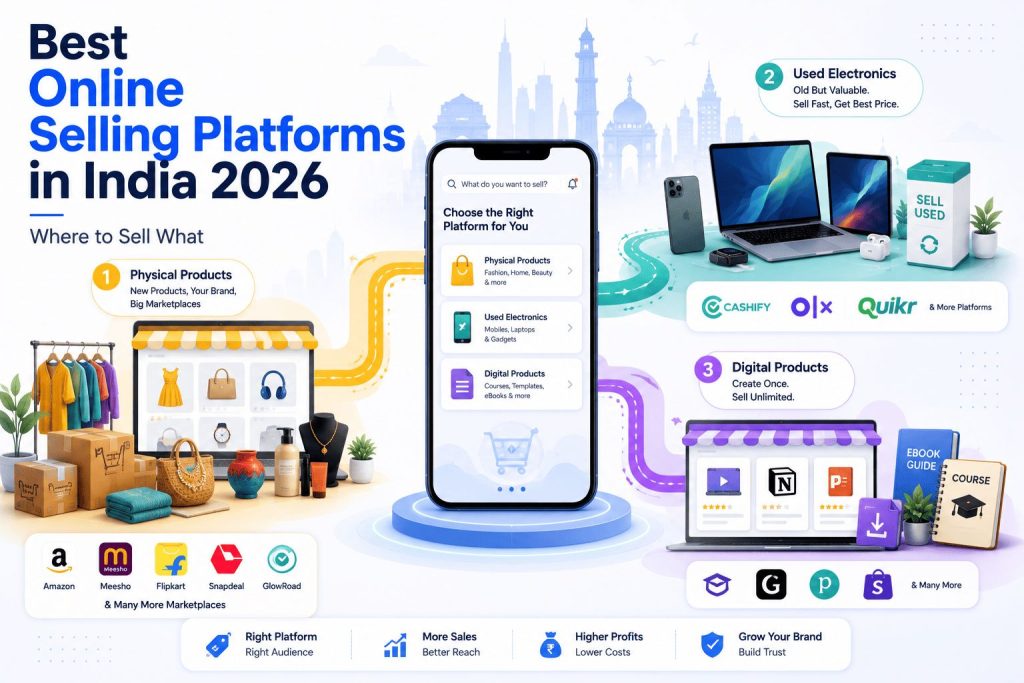
“Best platform to sell online” isn’t really one question — it’s three. New products, old belongings, and digital downloads all need a different home. Here’s a practical, India-specific guide to picking the right one, without the generic listicle fluff.

Someone typing “best online selling platform” into Google in 2026 could mean three completely different things. They might be launching a new fashion or home decor line and trying to figure out Amazon versus Meesho. They might be clearing out an old phone and laptop before an upgrade and wondering if Cashify beats OLX. Or they might be a designer or teacher sitting on a folder of templates and courses, wondering how to actually sell them online.

Most articles on this topic pick one of these three situations and pretend it answers the whole question. It doesn’t. The right platform for a new handmade jewellery brand is completely wrong for someone selling a used MacBook, and both are wrong for someone selling a Notion template. This guide is split into all three, so you can jump to the one that actually matches what you’re trying to do.

₹170 Bn

Size of India’s ecommerce market in 2026, still growing fast across every category
Source: SW Cybernetics, 2026

14 Cr+

Customers shopping on Meesho alone — mostly from tier 2 and tier 3 India
Source: StoreBase, 2026

₹955 Bn

Projected size of India’s digital product and creator economy by 2026
Source: SuperProfile, 2026

1. Selling new products: marketplaces vs your own store

If you make, source, or manufacture products and want to sell them online, you have two broad paths. Sell on an existing marketplace where the buyers already are, or build your own store and bring the buyers to you. Most successful Indian sellers eventually do both, but almost everyone should start with a marketplace.

The big three marketplaces

amazon, flipkart, meesho

Amazon · Flipkart · Meesho

We’ve covered this comparison in detail in a dedicated best online selling platforms guide, but the short version: Amazon is the strongest choice for branded, premium, or review-driven products, and its March 2026 move to zero referral fees on items under ₹1,000 made it dramatically cheaper at the value end. Flipkart matches Amazon’s reach with a stronger fashion and home skew, plus deeper tier 2 and tier 3 penetration through its own logistics network. Meesho charges zero commission in every category and allows non-GST sellers in permitted categories, making it the lowest-barrier entry point in Indian ecommerce — though margins are thin and return rates run high because of its price-sensitive,
largely COD buyer base.
 
Amazon: 2–38% + fees  |  Flipkart: 5–24% + fees  | Meesho: 0% commission
 
Verdict:
Don’t pick just one. A common and effective approach among Indian sellers is to validate a product on Meesho first with no upfront cost, then move to Flipkart and Amazon once demand is proven and margins matter more. For the full fee breakdown and category-by-category guidance, see our dedicated Amazon vs Flipkart vs Meesho comparison linked at the end of this article.

Building your own store

shopify, woocommerce, dukaan, storebae

Shopify · WooCommerce · Dukaan · StoreBase

A marketplace gets you buyers instantly, but you’re renting an audience Amazon and Flipkart own, not building one you control. Your own store solves that — you keep 100% of the customer relationship, control your branding, and don’t share margin with a marketplace commission. The trade-off is you have to bring your own traffic through ads, SEO, or social media, which takes time and budget most brand-new sellers don’t have yet.

Shopify remains the most powerful option for scaling a proper D2C brand, with the widest ecosystem of apps and payment integrations. WooCommerce is the flexible, lower-cost option if you already have a WordPress site or want more control without a monthly platform fee. Indian-focused platforms like Dukaan and StoreBase have built specifically for the Indian market with local payment gateways, GST-ready invoicing, and pricing suited to smaller sellers — StoreBase, for instance, runs on a simple ₹99 a month hosting fee plus a capped percentage of sales.

Check detailed guide on comparison between Shopify and Woocommerce

Verdict:
Start on a marketplace to prove your product sells. Build your own store once you have repeat customers and want to stop paying commission on every single sale — and once you’re ready to invest in driving your own traffic.

🇮🇳 What most first-time Indian sellers get wrong

The most common mistake is picking one platform and putting everything into it. The Indian ecommerce market rewards sellers who price and position the same product differently across platforms — the same item might sell at ₹199 on Meesho to a price-sensitive tier 3 buyer, ₹349 on Flipkart, and ₹549 on Amazon to a buyer who trusts the platform enough to pay more. Treat each platform as a different customer segment rather than a duplicate listing exercise.

The second common mistake is underestimating returns. Meesho’s return rates often run 25 to 40% because of its cash-on-delivery, price-sensitive tier 2/3 buyer base. Amazon’s are typically lower, 10 to 20%, because more buyers prepay. Factor this into your pricing and packaging before you commit inventory to any single platform.

2. Selling old phones, laptops, and used belongings

This is a completely different game from selling new products, and it splits into two approaches: instant buyback services that pay you immediately at a lower price, or classifieds where you list and wait for a buyer at potentially a higher price.

Instant buyback services

cashify, cashkr, cars24

Cashify · Cashkr · Cars24 (for vehicles)

Cashify is the largest and most recognised buyback platform in India, covering phones, laptops, tablets, and gaming consoles. You get an instant quote based on your device’s condition, book a free doorstep pickup, and get paid on the spot — no negotiating with strangers, no waiting for a buyer. Cashkr works similarly and has built a reputation around same-day payment and certified data wiping, with pickup available across more than 2,000 pincodes. For vehicles specifically, Cars24 runs the same instant-offer model — free inspection, an offer on the spot, and they handle the paperwork and RC transfer.

The trade-off with all buyback services is price. Because they need margin to resell your device, you’ll typically get 20 to 40% less than what a private buyer might pay you directly. What you’re paying for is certainty, speed, and zero hassle.

Verdict:
Use buyback services when convenience matters more than squeezing out the last rupee — especially for devices that are hard to sell privately, like older or damaged phones.

Classifieds and Marketplaces

olx, quikr, facebook marketplace

OLX · Quikr · Facebook Marketplace

OLX remains India’s most recognisable classifieds platform, covering everything from phones and furniture to real estate and vehicles, with the largest user base of any resale app in the country. Selling privately through OLX typically gets you 10 to 20% more than an instant buyback service would offer, because you’re cutting out the middleman’s margin. The trade-off is a higher volume of low-quality enquiries, “last price?” messages, and the occasional scam attempt — you need to be more careful and patient. Quikr operates as a similar classifieds alternative, while Facebook Marketplace has grown into a genuinely useful option in India for local, in-person sales where you already have some trust signal through a shared network or location.

Verdict:
If you have the time to deal with negotiation and screening buyers, OLX or Facebook Marketplace will typically get you a better price than an instant buyback. If you want speed and zero hassle, go with Cashify or Cashkr instead.

PlatformPaymentSpeedTypical Price vs. Private Sale
CashifyUPI / Bank TransferSame-day (metro)20–40% lower
CashkrUPI / Bank TransferSame-day, 2,000+ pincodes20–40% lower
OLXCash (buyer pays direct)Days to weeks10–20% higher
Flipkart / Amazon ExchangeCheckout credit onlyInstant, at checkoutLower, but only usable toward a new purchase

3. Selling digital products: ebooks, courses, and templates

This is the fastest-growing category in this entire guide, and the one most underserved by existing India-focused content. If you have a skill, a course, a set of templates, or written content to sell, you genuinely do not need a website or any coding to start.

Instamojo

instamojo

India’s original digital product platform

Instamojo was built in India, for Indian creators, and it shows in the details that matter most — native UPI support, INR pricing that doesn’t feel foreign to Indian buyers, and GST-ready invoicing. It handles ebooks, courses, and service-based digital products well. Pricing runs around 5% plus a small fixed fee per transaction depending on your plan. The trade-off is that its interface feels a step behind newer, more polished competitors, and Instamojo has increasingly shifted focus toward physical goods ecommerce rather than digital products specifically.

Verdict:
The safest default if your audience is entirely Indian and you want UPI to just work without any friction.

——————————————————————————————————————————–

Gumroad and Payhip

gumroad, payhip

Global platforms, best for international audiences

Gumroad is one of the most established names in digital product selling globally — simple, minimal, and trusted by creators for over a decade. Its current flat fee sits around 10%, which many Indian creators find steep, and it has no native UPI support, meaning Indian buyers need a card to check out — real friction in a market that is overwhelmingly UPI-first. Payhip is the more India-friendly alternative in this pair, with a lower 5% fee on its free tier and a flat $99 a month plan that drops fees to zero once you’re selling at real volume. Neither platform, however, was built with the Indian buyer in mind the way Instamojo was.

Verdict:
Use Gumroad or Payhip if a meaningful share of your buyers are international. If your audience is purely Indian, the lack of native UPI support will cost you conversions that a local platform wouldn’t.

——————————————————————————————————————————–

Graphy, Podia, and Teachable

graphy, podia, teachable

Best for full online courses

If what you’re selling is a structured course rather than a single downloadable file, these platforms are built specifically for that. Graphy (formerly Unacademy Graphy) is built for Indian creators and educators specifically, with local payment support baked in. Podia offers zero transaction fees on its paid plans, which matters once you’re selling consistently, along with membership and community features. Teachable provides the most comprehensive course-building toolkit — quizzes, certificates, drip content — but is priced and built primarily for a global, not India-first, audience.

Verdict:
If your product is a genuine multi-lesson course rather than a single file, these beat Gumroad or Payhip on structure and student experience.

PlatformFeeNative UPIBest For
Instamojo~5% + small fixed feeYesIndian audience, ebooks, services
Payhip5% free tier / 0% at $99/moNoGlobal audience, simple setup
Gumroad~10% flatNoGlobal creators, established trust
GraphyPlan-basedYesIndian educators, structured courses
Podia0% on paid plansNoCourses + membership + community

The UPI problem is bigger than it looks: Several newer India-first platforms have emerged specifically because Gumroad and similar global tools don’t support UPI natively — and for a market that is overwhelmingly UPI-first, that single gap costs real conversions at Indian price points like ₹150 or ₹500. If your buyers are mostly Indian, weigh this heavily before choosing a global platform purely because it’s more well-known.

The pattern across every category in this guide is the same: there is no single best platform, only the best platform for what you’re actually selling and who you’re selling it to. The sellers who do well are the ones who match the platform to the product, not the ones who found “the best one” on a listicle and stopped looking.

THE SHORT VERSION

  • Selling new products: start on Meesho (zero commission) to validate demand, then expand to Flipkart and Amazon as margins and brand-building matter more
  • Amazon cut referral fees to zero on products under ₹1,000 in March 2026, making it dramatically cheaper at the value end than it used to be
  • Selling old electronics: use Cashify or Cashkr for instant, hassle-free payment at a 20–40% discount, or OLX for a better price with more effort and patience
  • Selling digital products: Instamojo is the safest default for Indian buyers thanks to native UPI support; Gumroad and Payhip suit a more international audience
  • India’s digital product and creator economy is projected to reach ₹955 billion by 2026 — one of the fastest-growing corners of online selling right now
  • Whatever you’re selling, don’t put everything into one platform. Price and position the same product differently across channels to reach different buyer segments

Ready to sell online but not sure where to start?

We help Indian sellers and D2C brands choose the right platforms, set up their store, and grow with performance marketing that actually converts.

FAQs

What is the best platform to sell products online in India in 2026?

It depends entirely on what you're selling. For new products you make or source, Meesho is the easiest starting point since it charges zero commission and allows non-GST sellers in permitted categories. For old electronics like phones and laptops, Cashify offers the fastest, most hassle-free payout. For digital products like ebooks or courses, Instamojo is the most India-friendly option because of its native UPI support. There is no single best platform across all categories — the right choice depends on whether you're selling something new, used, or digital.

Which is cheaper for sellers — Amazon, Flipkart, or Meesho?

Meesho is the cheapest by a clear margin since it charges zero commission in every category. Amazon became significantly more affordable in March 2026 after cutting referral fees to zero on products priced under ₹1,000. Above that price point, Amazon's referral fees range from 2 to 38% depending on category, plus closing and fulfilment fees, which can push total channel costs to 15 to 25% of the selling price. Flipkart's commissions run roughly 5 to 24% by category, also with a 0% rate on sub-₹1,000 products and its value app Shopsy.

Should I sell on a marketplace or build my own online store?

Start with a marketplace like Meesho, Flipkart, or Amazon if you're new to online selling — it gets you in front of buyers instantly with no upfront investment in traffic or website building. Build your own store using Shopify, WooCommerce, or an India-focused platform like StoreBase once you have proven demand and want to stop paying commission on every sale, or once you're ready to invest in your own branding and customer relationships. Most successful Indian sellers eventually use both — a marketplace for reach, their own store for margin and brand control.

Where can I sell my old phone or laptop online in India for the best price?

If price matters more than convenience, OLX typically gets you 10 to 20% more than an instant buyback service, since you're selling directly to a buyer without a middleman's margin. If speed and hassle-free payment matter more, Cashify or Cashkr offer instant quotes, free doorstep pickup, and same-day payment via UPI or bank transfer — though you'll typically receive 20 to 40% less than what a private sale might get you, since these services need margin to resell the device.

Is OLX safe for selling used items in India?

OLX is widely used and has the largest user base of any classifieds platform in India, but because it connects you directly with random buyers, you do need to take basic precautions. Meet in a public place or a location with people around, avoid sharing payment details over a phone call before meeting in person, and be prepared for a higher volume of low-quality enquiries and price negotiation attempts compared to an instant buyback service. If you'd rather skip that hassle entirely, Cashify or Cashkr offer a more controlled, if slightly lower-paying, alternative.

What is the best platform to sell digital products like ebooks or courses in India?

Instamojo is generally the best starting point for an Indian audience because it supports UPI natively and prices in INR, which reduces checkout friction for Indian buyers. If your audience includes a meaningful number of international buyers, Gumroad or Payhip are stronger choices, though Payhip's lower fee structure (starting at 5% versus Gumroad's roughly 10%) makes it the more cost-effective of the two for creators just starting out. For structured multi-lesson courses rather than single downloadable files, Graphy, Podia, or Teachable offer better course-building tools than a simple digital download platform.

Do I need GST registration to sell online in India?

It depends on the platform and product category. Meesho allows non-GST sellers in certain permitted categories, making it accessible to very small or new sellers. Amazon and Flipkart generally require GST registration for most product categories, though exemptions exist for specific categories like books. If you're selling digital products through platforms like Instamojo or Gumroad, GST requirements depend on your total turnover and the nature of the product — it's worth confirming your specific obligations with a tax professional as you scale, since digital services can have different GST treatment than physical goods.

Can I sell the same product on Amazon, Flipkart, and Meesho at the same time?

Yes, and this is actually a common and effective strategy among experienced Indian sellers. You can price and position the same product differently on each platform — for example, a lower price on Meesho to appeal to price-sensitive tier 2/3 buyers, a mid-range price on Flipkart, and a slightly higher price on Amazon where buyers are typically willing to pay more for the platform's trust and delivery speed. Just make sure your inventory management can handle fulfilling orders across multiple platforms without overselling stock you don't actually have.