
Picture this: You’re a digital marketer in Mumbai, pitching to a potential client for their ₹2 lakh monthly Meta advertising budget. They ask one simple question: “Are you Meta certified?” You hesitate. The client goes with your competitor who has that blue badge on their LinkedIn profile.
This scenario plays out hundreds of times every week across India. The difference between winning and losing business increasingly comes down to credentials, not just experience. But here’s what everyone wants to know: Is Meta Blueprint certification actually worth the ₹8,000-12,500 investment? Will that badge really help you get better clients, land higher-paying jobs, or improve your campaign results?
I’ll give you an honest answer based on real data, actual experiences from Indian marketers, and the current state of the digital marketing industry in 2026. This isn’t a sales pitch for Meta’s certification program. It’s a practical guide to help you decide whether this investment makes sense for your specific situation.
By the end of this article, you’ll understand exactly what Meta Blueprint certification involves, how much it truly costs, which certification matches your career stage, how to prepare without wasting money on expensive prep courses, and most importantly, whether the return on investment justifies the expense.
Let’s start with the basics and work our way to the decision framework.
What is Meta Blueprint Certification?
Before we dive into costs and benefits, you need to understand what you’re actually buying. Meta Blueprint certification is Meta’s official credentialing program that validates your expertise in advertising across Facebook, Instagram, Messenger, and WhatsApp. But there’s an important distinction that confuses many people.
Meta offers two separate things under the Blueprint brand. First, there are Meta Blueprint courses, which are completely free learning materials. Over 100 mini-courses covering everything from basic ad creation to advanced campaign optimization. Anyone can access these without paying a rupee. Second, there are Meta Blueprint certifications, which are paid proctored exams that test your knowledge. These cost money and require you to pass a supervised test.
Think of it like college. The courses are like attending lectures and studying from textbooks. The certification is like taking your final exam and getting your degree. Thousands of people watch the videos, but only those who pass the exam get the official credential that appears on LinkedIn profiles and resumes.
Meta created this certification program because over 3 million people worldwide had taken their free courses, but there was no way to verify who actually understood the material versus who just clicked through videos while browsing Instagram. For businesses spending crores on Meta advertising, having certified professionals managing campaigns became a trust signal they could rely on.
When you earn a Meta Blueprint certification, you’re proving you understand Meta Ads Manager and Business Suite, campaign structure and objectives, audience targeting strategies, creative best practices, performance measurement and optimization, Meta pixel implementation and conversion tracking, and budget management and bidding strategies. This isn’t theoretical knowledge tested through memorizing definitions. The exams present real advertising scenarios and ask you to make the right decisions, just like you would when managing actual client campaigns.
The certification tells potential clients and employers: “This person has been tested by Meta itself and proven they know how to run effective campaigns on our platforms.” That’s worth something in a crowded marketplace where everyone claims to be a “social media expert.”
Types of Meta Blueprint Certifications Available in 2026
Meta offers seven distinct certifications, each targeting different skill levels and specializations. Choosing the wrong one wastes your money and time. Let me break down each certification so you can pick the right starting point.
🏅 Meta Certified Digital Marketing Associate (100-101)
This is the entry-level certification, and it’s where most Indian marketers should start. The exam costs $99 USD, which translates to approximately ₹8,000-8,500 depending on exchange rates. You get 90 minutes to answer 50-60 multiple choice questions covering campaign basics, analytics, and platform fundamentals.
The certification covers creating and managing ads across Facebook and Instagram, basic audience targeting, reading campaign reports, and understanding Meta’s advertising policies. If you’re new to Meta advertising or have been running campaigns informally without structured training, this certification ensures you have a solid foundation.
Even experienced marketers benefit from taking this first. I’ve seen people who’ve run ads for two years discover they were missing fundamental concepts that were costing them money. The associate certification fills those knowledge gaps.
──── ୨୧ ────
🏅 Meta Certified Media Buying Professional (410-101)
This intermediate certification costs $150 USD (approximately ₹12,000-12,500) and takes 105 minutes with 60-75 multiple choice questions. It’s designed for campaign managers and performance marketers who are actively running campaigns and need to demonstrate tactical buying skills.
The exam tests your knowledge of advanced audience targeting, campaign optimization techniques, bidding strategy selection, budget allocation across campaigns, and troubleshooting poor performance. This is the certification that proves you can actually manage significant ad budgets effectively.
If you’re managing ₹50,000 or more in monthly ad spend for clients or your business, this certification demonstrates you have the advanced tactical skills needed for that responsibility. Clients feel more comfortable handing over large budgets to certified media buyers.
──── ୨୧ ────
🏅 Meta Certified Media Planning Professional (400-101)
Another professional-level certification at $150 USD, this one targets media planners, strategists, and agency leads rather than day-to-day campaign managers. You get 105 minutes for the exam, and the questions focus on strategic thinking rather than tactical execution.
The certification covers cross-platform strategy, audience targeting strategy, and budget management from a planning perspective. You’re tested on strategic campaign planning, cross-platform media strategies, audience research and segmentation, campaign forecasting and planning, and client strategy development.
This certification makes sense for senior marketers who spend more time planning campaigns and setting strategy than they do actually building ads in Ads Manager. If you’re the person who creates the overall campaign approach that others execute, this is your certification.
──── ୨୧ ────
🏅 Meta Certified Marketing Science Professional (200-101)
This advanced certification costs $150 USD and targets data analysts and measurement specialists specifically. Unless you work in analytics as your primary role, skip this one. The exam requires a strong analytical background and tests your knowledge of advanced analytics and measurement, attribution modeling, conversion lift studies, A/B testing methodologies, and marketing mix modeling.
This is for people who spend their days analyzing data, not running campaigns. If you’re a general marketer or campaign manager, the Media Buying Professional certification serves you better.
──── ୨୧ ────
🏅 Meta Certified Creative Strategy Professional (300-101)
At $150 USD, this certification focuses on the creative side of Meta advertising. It’s designed for creative directors and content strategists who need to understand what makes ads perform well on Meta platforms.
The exam covers creative best practices for Meta platforms, Reels and Stories optimization, video content strategies, user-generated content, and creative testing methodologies. If you’re primarily focused on campaign targeting and optimization rather than creating ad content, this certification isn’t essential. But for creative professionals who want to understand performance principles, it provides valuable knowledge.
──── ୨୧ ────
🏅 Meta Certified Community Manager (600-101)
This $99 USD certification targets social media managers and community managers who focus on organic social media rather than paid advertising. The exam covers community building on Facebook and Instagram, content strategy for organic reach, crisis management, engagement strategies, and Facebook Groups management.
If your primary role involves managing a brand’s social media presence, responding to comments, creating organic content, and building community rather than running paid ads, this is the right certification for you. For performance marketers focused on paid advertising, the Digital Marketing Associate or Media Buying Professional certifications are more relevant.
──── ୨୧ ────
🏅 Meta Certified Business Marketing Strategy (700-101)
The final certification costs $150 USD and targets marketing strategists and business owners who need to understand how Meta advertising fits into overall business strategy. The exam covers full-funnel marketing strategies, business objective alignment, multi-channel integration, and ROI optimization.
This makes sense for business owners, marketing leaders, and strategists who need the big picture understanding of how paid social fits into a comprehensive marketing approach. Campaign managers focused on execution typically don’t need this certification.
──── ୨୧ ────
Meta Blueprint Certification Cost: The Real Investment
Let’s talk about money honestly. The exam fees are just the starting point. Here’s what you’ll actually spend to get certified.
The exam itself costs either $99 USD for associate-level certifications (Digital Marketing Associate and Community Manager) or $150 USD for all professional-level certifications. In Indian rupees, that translates to approximately ₹8,000-8,500 for associate level and ₹12,000-12,500 for professional level, though the exact amount varies with exchange rates.
But the exam fee isn’t your only cost. You need to factor in study time, which has an opportunity cost. If you typically bill ₹500-1,000 per hour for your work, the 30-40 hours you’ll spend studying represents ₹15,000-40,000 in time you could have spent earning money. For employed professionals, this matters less since you study outside work hours, but for freelancers, it’s a real consideration.
If you choose to buy study materials beyond Meta’s free courses, third-party prep courses range from ₹2,000-10,000, and practice tests cost ₹500-2,000. Personally, I don’t think these are necessary. Meta’s official free courses are comprehensive, and the practice questions they provide are representative of the actual exam. Save your money.
The bigger hidden cost is retake fees. If you fail the exam, you must wait 5-30 days depending on the certification and pay the full fee again. Each attempt costs the same as the original exam. This is why thorough preparation matters. A second attempt doubles your investment to ₹17,000 for associate level or ₹25,000 for professional level.
There’s also the renewal cost to consider. Meta certifications are valid for 12 to 24 months depending on which one you earn. When your certification expires, you must retake the exam and pay the full fee again to renew it. Many marketers let their first certification expire and then pursue a higher-level certification rather than simply renewing the same one, which is a smart strategy.
Let me give you three real-world investment scenarios. If you pass the Digital Marketing Associate exam on your first attempt using only free study materials, your total investment is ₹8,500. If you need one retake, your total investment becomes ₹17,000. If you pursue multiple certifications, starting with Digital Marketing Associate at ₹8,500 and adding Media Buying Professional at ₹12,500, your total investment is ₹21,000.
For payment, you’ll need an international credit card, a debit card with international transactions enabled, or PayPal. Make sure your card allows international transactions before scheduling the exam. I’ve seen people schedule their exam only to discover at payment time that their card doesn’t work for international purchases.
Is Meta Blueprint Certification Worth It? The Honest Analysis
Now we get to the question that really matters. Should you spend ₹8,500-12,500 on this certification? The answer genuinely depends on your specific situation. Let me walk through when it makes sense and when it doesn’t.
When the Investment Makes Sense
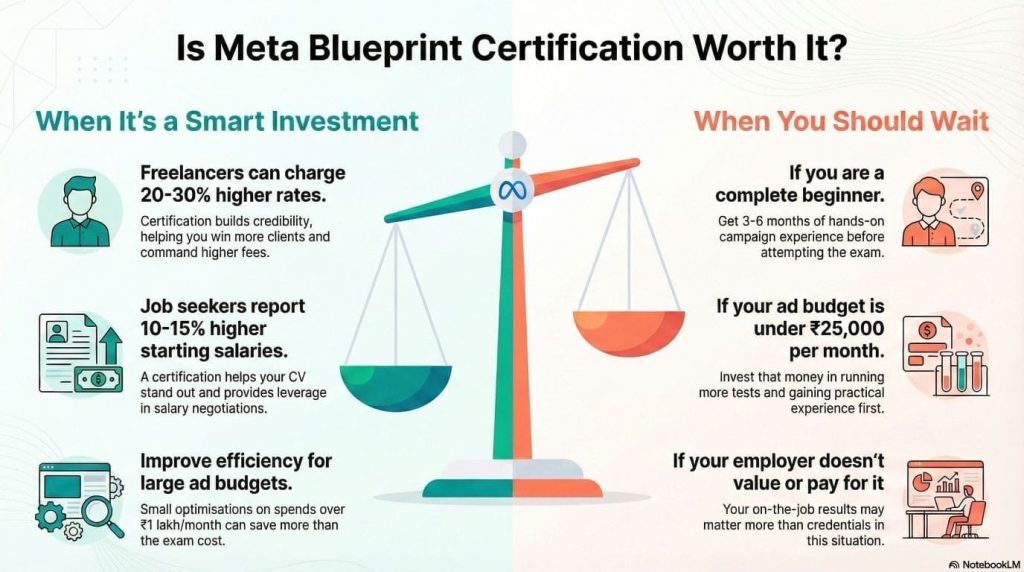
If you’re a freelancer or agency owner, getting certified is often a smart investment, especially if you don’t yet have extensive case studies in your portfolio. The certification badge builds credibility when you’re competing for clients who are choosing between multiple proposals. Freelancers consistently report being able to charge 20-30% higher project rates after certification. When a client is deciding between you at ₹25,000 per month and another freelancer at ₹20,000 per month, that certification badge often tips the decision in your favor. The client feels more confident that their money is going to someone with verified expertise.
For agencies, having certified team members becomes increasingly important as clients specifically ask about credentials. Many clients now request that at least one person on their account team be Meta certified. Meta also offers a “Certified Company” program where agencies with multiple certified employees get special recognition and access to better Meta support. If you run an agency, certifying at least one or two key team members makes business sense.
Job seekers benefit significantly from certification. A growing number of job postings in India now list “Meta Blueprint Certified” as preferred or required qualification. Having the certification on your resume helps you pass initial screening filters and gives you leverage during salary negotiations. Certified professionals in tier-1 cities consistently report 10-15% higher starting salaries compared to non-certified candidates with similar experience. On a ₹6 lakh annual salary, that’s ₹60,000-90,000 extra per year. The certification pays for itself in the first two months of employment.
If you manage significant ad budgets, the certification becomes even more valuable. When you’re managing ₹1 lakh or more in monthly ad spend, small improvements in campaign efficiency from better knowledge can save far more than the certification cost. A 5% improvement in campaign efficiency on ₹1 lakh monthly spend saves ₹5,000 per month or ₹60,000 annually. The certification pays for itself in less than two months.
Sometimes the real value isn’t the certificate itself but the structured learning process. If you’ve been learning Meta advertising haphazardly through YouTube videos, blog posts, and trial and error, the certification study process forces you to learn systematically and fill knowledge gaps. You might discover you’ve been using campaign objectives wrong, targeting audiences inefficiently, or measuring success using the wrong metrics. The structured curriculum ensures you understand the complete picture rather than just random pieces.
When You Should Skip It
Don’t pursue certification if you’re a complete beginner who has never run a Meta campaign. The exam tests practical knowledge and decision-making, not just theoretical understanding. If you’ve never navigated Ads Manager, created audiences, or analyzed campaign metrics, you’ll struggle with scenario-based questions that ask “What would you recommend in this situation?” Get 3-6 months of hands-on experience first, even if you’re just running small campaigns with ₹100-200 per day budgets. Then pursue certification once you understand the basics through real application.
If your total ad budget is under ₹25,000 per month, certification probably isn’t your best investment right now. At that budget level, focus on learning and optimization rather than credentials. Invest that ₹8,500 in running more tests, trying new strategies, and building your experience. Consider certification later when you’re managing larger budgets where improved efficiency creates meaningful returns.
For in-house marketers working for a single company that doesn’t value certifications, the ROI is questionable. Your results matter more than your credentials. If your employer doesn’t care whether you’re certified and won’t pay for it, the benefit is primarily future career mobility rather than immediate impact. You’ll need to decide whether the long-term career benefit justifies the personal investment.
If ₹8,500 represents a significant financial burden and you’re not confident you’ll pass the exam, wait. Save up, prepare more thoroughly, and take the exam when you’re truly ready. There’s no value in failing and having to pay again because you rushed into it before you were prepared.
The Real ROI Calculation
Let me show you the actual math for a typical Indian freelance digital marketer. Your investment includes the certification cost of ₹8,500 plus study time of 30-40 hours. If your opportunity cost is ₹500 per hour, that’s ₹15,000-20,000 in time. Your total investment is ₹23,500-28,500.
Now for returns. Conservative estimates suggest you’ll win 2 additional clients per year specifically because of the certification, generating ₹40,000-60,000 in additional revenue. You’ll be able to charge 10% higher rates across your client base, adding ₹12,000-20,000 annually. Your total returns in the first year are ₹52,000-80,000.
That’s an ROI of 180-280% in the first year alone. The investment pays for itself within 3-6 months for most freelancers and agency owners. In year two and beyond, you keep reaping the benefits with no additional investment unless you choose to pursue advanced certifications.
For in-house marketers, the benefits are less tangible but still valuable. Higher starting salaries, better job opportunities, and faster career progression are harder to quantify but real. If certification helps you land a job with ₹1 lakh higher annual salary, the ROI is immediate and substantial.
How to Get Meta Blueprint Certified: The Complete Process
You’ve decided certification makes sense for you. Now let’s walk through exactly how to make it happen, from creating your account to displaying your badge.
1. Setting Up Your Blueprint Account
Start by visiting blueprint.facebook.com and clicking “Get Certified.” You’ll sign in with your Facebook or Meta account. Use a professional account if you have one, not your personal profile with pictures of your last vacation and weekend parties. This account will be permanently associated with your certification credentials.
Complete your profile with your professional information. This matters because when you earn your certification, the badge displays your name as it appears in your Blueprint profile. Make sure everything is spelled correctly and looks professional.
2. Choosing Your Certification Path
Based on the earlier breakdown of all seven certifications, most Indian marketers should start with the Meta Certified Digital Marketing Associate. Even if you have experience, this foundational certification ensures you understand core concepts correctly. You can always pursue advanced certifications later.
Don’t try to skip levels. The foundational knowledge in the Associate certification directly supports success in professional-level certifications. Trying to jump straight to Media Buying Professional without taking the Associate exam is like trying to run before you can walk. You might pass, but you’ll have knowledge gaps that show up in your actual campaign management.
3. Studying Using Free Resources
Meta provides comprehensive free study materials for every certification. For the Digital Marketing Associate, you’ll work through modules titled “Get Started with Meta Advertising,” “Create and Manage Ads,” “Measure and Optimize Campaigns,” and “Reach Your Business Goals.” These aren’t superficial overviews. They’re detailed courses that teach you exactly what you need to know.
Your study approach matters more than the amount of time you spend. Don’t just watch videos passively while scrolling through your phone. Take detailed notes. Pause videos to try concepts in a live Ads Manager account if you have access to one. Complete the knowledge checks after each module and actually think about the questions rather than just clicking through.
Plan for 30-40 hours of study time spread over 3-4 weeks. Studying 1-2 hours per day is more effective than cramming 10 hours in one day on the weekend. Your brain needs time to process and internalize the concepts.
4. Taking Practice Tests Seriously
Meta offers sample questions for each certification on their website. These practice tests are your best predictor of actual exam performance. Don’t take them until you’ve completed all the study modules. When you do take them, simulate exam conditions. Set a timer, eliminate distractions, and answer questions without looking up answers.
Your target is scoring 80% or higher consistently on practice tests before scheduling the real exam. If you’re scoring 60-70%, you’re not ready yet. Go back and review the topics where you’re weak. Take the practice test again a few days later. Only schedule your actual exam when you’re hitting 80%+ reliably.
Third-party practice tests exist, but Meta’s official practice questions are the best representation of actual exam difficulty and format. Save your money and stick with the official materials.
5. Scheduling Your Exam
Once you’re confident and consistently scoring well on practice tests, schedule your exam. Log into Meta Blueprint, select your certification, choose your exam date and time, and pay the exam fee. You’ll receive a confirmation email with detailed exam instructions.
Book your exam at least 1-2 weeks in advance. Don’t rush into it the day after deciding you’re ready. Give yourself time to do final review and ensure your exam environment is properly set up. Early morning slots often work best when you’re fresh and less likely to be interrupted.
6. Preparing Your Exam Environment
This is critical and causes more exam failures than you’d expect. The Meta Blueprint exam uses live human proctors who monitor you via webcam throughout the entire exam duration. They’re looking for any behavior that suggests cheating, and they don’t hesitate to terminate exams if they see anything suspicious.
You need stable internet with minimum 2 Mbps upload and download speeds. A spotty connection that drops mid-exam can cause you to fail through no fault of your own. Test your internet speed the day before your exam. If your home internet is unreliable, consider booking a coworking space or going to a friend’s home with better connectivity.
Your webcam must show your face clearly throughout the exam. Position it so the proctor can see your full face and hands. They need to verify you’re not looking at notes or receiving help from anyone. Your microphone is used for identity verification at the start of the exam.
Your desk must be completely clean. Only your computer, keyboard, and mouse are allowed. No phone, no notes, no second monitor, no drinks, no food. Nothing. The proctor will ask you to use your webcam to show your entire desk area and the walls around you. Remove everything before starting the system check.
You need a private room with no other people present. If someone walks into your room during the exam, the proctor may terminate your exam. Lock the door, put up a “Do Not Disturb” sign, and tell everyone in your household that you cannot be interrupted.
Have your government ID ready. A passport, Aadhaar card, or driver’s license works. The proctor will verify your identity by comparing your ID to your face on camera.
7. Taking the Actual Exam
Log in 15 minutes before your scheduled exam time. The system will run a technical check verifying your browser, webcam, and microphone all work properly. Fix any issues before the exam starts, not during it.
The proctor will connect and ask you to show your ID to the camera. They’ll verify your identity and ask you to use your webcam to show your desk area and the walls around you. They’re checking for any notes, second devices, or people who might help you. Once they’re satisfied, the exam begins.
You’ll see one question at a time. Most certifications use 50-75 multiple choice questions, and you have 90-105 minutes depending on which exam you’re taking. That’s roughly 1.5-2 minutes per question, which is plenty of time if you know the material. On some exams, you cannot go back to previous questions, so read each question carefully and answer it before moving on.
The questions mix straightforward knowledge checks with scenario-based problems. A knowledge question might ask “What is the difference between reach and impressions?” A scenario question presents a situation like “A client wants to increase mobile app installs with a ₹50,000 budget and a target cost per install of ₹250. Which campaign objective should they use?” The scenario questions test your ability to apply knowledge to real situations.
Don’t overthink questions. Your first instinct is usually correct. If you know the material, the right answer typically feels obvious. Trust your preparation.
The passing score is 700 or higher on a scale of 300-1000. You don’t need to answer every question correctly. Getting 70-75% of questions right is usually sufficient to pass, though the exact percentage varies slightly by exam.
8. Getting Your Results and Certificate
Results appear immediately after you complete the exam. If you pass, congratulations! Your certification badge will be available in your Meta Blueprint account within 24-48 hours. You’ll receive an email with your digital badge and instructions for adding it to LinkedIn and other professional profiles.
If you don’t pass, you’ll see feedback showing which knowledge areas you need to improve, but you won’t see the specific questions you missed. This feedback guides your study for the retake. You must wait at least 5 days before scheduling another attempt, and you’ll pay the full exam fee again.
For people who pass, the first thing you should do is update your LinkedIn profile. Add the certification to your “Licenses & Certifications” section with the certification name, Meta as the issuing organization, the issue date, and the expiration date. You can also add the digital badge image to your profile header for visibility.
Update your email signature to include your certification. “Priya Sharma, Meta Certified Digital Marketing Associate” looks professional and reminds everyone you interact with about your credential.
If you have a personal website or your agency has a team page, add your certification badge there too. Meta provides official badge images you can download and display.
Meta Blueprint Study Strategy: How to Pass on Your First Attempt
Let me share what actually works for preparing efficiently and passing without needing retakes.
The Four-Week Study Plan
Week 1
Week one focuses on foundation. Complete all the recommended mini-courses for your specific certification. If you already understand some concepts, watch at 1.5x or 2x speed, but don’t skip sections entirely. You might discover you have gaps in topics you thought you knew well. Take detailed notes on key concepts, definitions, and when to use different features. Plan for 10-12 hours of study this week.
Week 2
Week two is about practical application. If you have access to a real Ads Manager account, even one managing small budgets, try implementing what you learned. Create test campaigns, build audiences, set up conversion tracking. The hands-on practice makes abstract concepts concrete. If you don’t have client campaigns to work with, see if you can get access to a friend’s business account or create your own business page and run small test campaigns with ₹50-100/day budgets. The money you spend testing is an investment in your learning. Plan for 8-10 hours this week.
Week 3
Week three is deep study focused on your weak areas. Review all your notes from weeks one and two. Identify topics where you’re still confused or uncertain. Go back to those specific mini-courses and watch them again with fresh perspective. Take the practice tests Meta provides for your certification. Don’t just answer the questions—understand why each answer is correct or incorrect. Join Meta Blueprint study groups on Facebook. Several Indian-focused groups exist where people share tips and practice questions. Plan for 10-12 hours this week.
Week 4
Week four is final preparation. Take full practice exams under timed conditions. Score yourself honestly. If you’re consistently hitting 80% or higher, you’re ready. If not, postpone your exam and spend another week reviewing. Focus on memorizing key metrics, definitions, and when to use different campaign objectives. The day before your exam, do light review but don’t try to cram new information. Rest properly and get good sleep. Plan for 8-10 hours this week.
That’s a total of 36-44 hours spread over four weeks, which is manageable even if you’re working full-time.
Free vs Paid Study Resources
Meta’s official Blueprint courses are comprehensive and completely free. Start there. The courses are created by the same people who write the exam questions, so they’re perfectly aligned with what you’ll be tested on. They include video lessons, text explanations, and knowledge checks after each module.
Meta’s sample questions and practice exams are also free and extremely valuable. These give you the best sense of actual exam difficulty and question format.
YouTube has several Indian creators who share Meta Blueprint exam tips and experiences. These can be helpful for understanding what to expect, but don’t use them as your primary study material. They’re supplements, not replacements for Meta’s official content.
Third-party prep courses cost ₹2,000-10,000 and usually aren’t necessary. They often just repackage Meta’s free content with added practice questions. As long as you thoroughly work through Meta’s mini-courses and do well on their practice exams, you should be able to pass. Save your money.
Paid practice test platforms cost ₹500-2,000 and can be helpful if you learn well through repetitive testing, but they’re optional. Meta’s free practice questions are usually sufficient.
One-on-one tutoring runs ₹5,000-15,000 and is overkill for most people. Only consider this if you’ve failed the exam multiple times and can’t figure out what you’re doing wrong.
What Actually Works
Study actively, not passively. Don’t just watch videos while browsing Instagram. Take notes. Pause and think about concepts. Try to explain what you learned to someone else, even if that someone is just yourself talking out loud.
Focus on understanding scenarios rather than memorizing facts. The exam tests decision-making through questions like “A client wants to achieve X goal with Y budget and Z constraints. What should they do?” If you understand the underlying principles, you can reason your way to the correct answer even if you don’t remember specific facts.
Don’t just memorize that “Conversion campaigns need 50 conversions per week to exit learning phase.” Understand WHY that matters, what happens if you have fewer conversions, and what you should do in that situation. Understanding the “why” makes the “what” easier to remember.
Use your real campaign experience to anchor the concepts. When the study material discusses audience targeting, think about audiences you’ve built for actual campaigns. When it explains bidding strategies, relate it to bidding decisions you’ve made. Connecting abstract concepts to your real experience makes them stick better.
Join study groups and learn from others. People preparing for the same exam can share insights about topics they found confusing, tips for remembering complex information, and moral support when preparation feels overwhelming. Just search “Meta Blueprint Certification India” in Facebook Groups and you’ll find several active communities.
Trust your instincts on scenario questions. Don’t overthink them. If you know the material, the “obvious” answer is usually correct. Test writers design questions so that people who understand the concepts will naturally choose the right answer, while people who don’t understand will overthink and choose something wrong.
After Certification: Maximizing Your Return on Investment
You passed the exam and have your shiny new badge. Now what? The certification only provides value if you actually use it to advance your career or business.
📌 Update All Your Professional Profiles
Your LinkedIn profile should be your first stop. Add the certification to your “Licenses & Certifications” section with complete details including the certification name, Meta as the issuing organization, the date you earned it, and the expiration date. Don’t hide the expiration date—it shows you’re keeping current information on your profile.
You can also add the certification badge image to your LinkedIn profile header for immediate visibility when anyone views your profile. Some people add it as a small badge in the corner of their profile picture, though this can look cluttered.
Update your LinkedIn headline to include your certification. “Digital Marketing Specialist | Meta Certified Digital Marketing Associate” is more impressive than just “Digital Marketing Specialist.”
Write a post announcing your achievement. Don’t be obnoxious about it, but a simple “Proud to announce I’ve earned my Meta Certified Digital Marketing Associate certification” with the badge image gets visibility and congratulations from your network. This reminds everyone that you’re now certified, which can lead to opportunities.
Your resume needs updating too. Add a “Certifications” section if you don’t already have one. List the full certification name, the date earned, and your certification number. Including the certification number proves you actually have it rather than just claiming you do.
Update your email signature across all your professional accounts. “Priya Sharma, Meta Certified Digital Marketing Associate” or just “Meta Certified” if space is limited. This passive reminder appears in every email you send to clients, prospects, and professional contacts.
If you’re a freelancer or run an agency, your website needs updating. Create a “Certifications” or “Credentials” section on your about page. Display the badge prominently. Mention the certification in your service descriptions. When describing Meta advertising services, note that campaigns are managed by Meta certified professionals.
📌 Leverage It for Business Growth
Freelancers should immediately update all their marketplace profiles. Upwork, Fiverr, Freelancer, and any other platforms you use need updating with your new credential. Include the certification in your profile description and mention it when submitting proposals.
When writing proposals, don’t just say “I can help with your Meta advertising.” Say “As a Meta Certified Digital Marketing Associate, I can help with your Meta advertising using proven strategies and best practices.” The certification differentiates you from dozens of other proposals the client is reviewing.
You have justification to raise your rates. If you were charging ₹20,000 per month for Meta advertising management, you can reasonably increase to ₹22,000-24,000. The 10-20% premium is standard for certified professionals versus non-certified ones. Existing clients might not appreciate a sudden increase, but all new clients should pay your new certified rates.
Agencies should update their website and all marketing materials to highlight team certifications. If you have three certified team members, mention that prominently. “Our team includes Meta certified professionals” builds trust with prospects who are evaluating multiple agencies.
During sales pitches, mention certifications naturally when relevant. “Your campaigns will be managed by our Media Buying Professional certified team member who has been verified by Meta for their expertise.” This positions your agency as credible and professional.
Consider working toward Meta’s “Certified Company” status if you run an agency. Once you have enough certified team members, your entire agency gets special recognition from Meta including improved access to support and resources. This becomes a significant differentiator when competing for large clients.
For job seekers, apply for positions that specifically request Meta certification but that you might have skipped before. Many job postings list certification as “preferred” rather than “required.” You now meet that preference, which moves your application higher in the stack.
During interviews, mention your certification when discussing your Meta advertising experience. “I’m a Meta Certified Media Buying Professional, which has formalized my practical experience running campaigns over the past three years.” This combines credential with experience for maximum impact.
Use the certification during salary negotiations. If the offer is ₹6 lakhs annually and you were hoping for ₹6.5 lakhs, your certification gives you leverage. “Given my Meta certification and proven ability to manage campaigns effectively, I was hoping we could land closer to ₹6.5 lakhs.” The certification provides concrete justification for your counter offer.
📌 Keep Your Certification Current
Your certification expires after 12 or 24 months depending on which one you earned. Most expire after 12 months. Set a calendar reminder for three months before expiration. This gives you time to study and schedule your renewal exam without letting the certification lapse.
When renewal time approaches, you have choices. You can simply retake the same exam to renew your existing certification. You pay the full exam fee again, but the study is easier since you already know the material. You just need to review any platform updates since you originally certified.
Alternatively, you can let your current certification expire and pursue a higher-level certification instead. If you started with Digital Marketing Associate and have gained significant experience over the past year, consider taking the Media Buying Professional exam instead of just renewing Associate. This shows career progression and increased expertise.
Some people strategically let certifications lapse during periods when they’re not actively job hunting or pursuing new clients, then recertify when they’re ready to make a career move. This saves money but means you won’t have an active certification on your profile for that period. Decide based on your specific situation and career goals.
Meta Blueprint vs Other Digital Marketing Certifications
You’re probably wondering how Meta Blueprint compares to other certifications available to Indian marketers. Let me give you honest comparisons.
Meta Blueprint vs Google Ads Certification
Google Ads certification is completely free. You pay nothing for the exams. This makes it accessible to everyone and removes financial risk. The exams are easier than Meta Blueprint, particularly the Google Ads Search and Display certifications. Recognition in India is very high—most businesses know and value Google Ads certification.
Meta Blueprint costs ₹8,500-12,500 per exam, requires more in-depth knowledge, and tests more complex scenarios. Recognition is growing rapidly but hasn’t quite reached Google Ads levels yet in India. Meta Blueprint covers Facebook, Instagram, Messenger, and WhatsApp advertising.
So which should you choose? Get both. Google Ads certification is free, so there’s absolutely no reason not to earn it. The time investment is similar to Meta Blueprint, but without financial cost. Add Meta Blueprint if you work significantly with Meta platforms or want to demonstrate comprehensive paid advertising expertise.
For agencies serving diverse clients, having team members certified in both Google Ads and Meta Blueprint signals you can handle whatever platform the client needs. The combination is more powerful than either alone.
Meta Blueprint vs HubSpot Certifications
HubSpot offers numerous free certifications covering inbound marketing, content marketing, email marketing, CRM, and marketing automation. They’re completely free and relatively easy to earn. The content is excellent for learning broader marketing strategy beyond just advertising tactics.
HubSpot certifications focus on inbound marketing philosophy and the full customer journey from awareness to purchase to retention. Meta Blueprint focuses specifically on paid social advertising execution and optimization.
These are complementary rather than competitive. HubSpot certifications make you a better overall marketer who understands strategy, content, and automation. Meta Blueprint makes you a better paid social advertiser who can execute campaigns effectively. Consider earning several HubSpot certifications alongside Meta Blueprint for a well-rounded credential portfolio.
The limitation of HubSpot certifications is they’re seen as somewhat easier to obtain since they’re free and don’t require proctored exams. They’re valuable for knowledge but don’t carry the same weight as Meta Blueprint when specifically discussing paid advertising expertise.
Meta Blueprint vs Digital Marketing Bootcamps
Many Indian edtech companies offer comprehensive digital marketing certification programs for ₹30,000-80,000. These typically include video lessons, assignments, projects, mentorship, and job placement support. Some focus heavily on Meta and Google advertising, while others cover the full spectrum of digital marketing.
These bootcamps provide broader education covering SEO, content marketing, email marketing, analytics, and paid advertising across platforms. They’re better for complete beginners who need foundational knowledge across digital marketing. Meta Blueprint assumes you already understand marketing basics and focuses specifically on Meta’s platforms.
The best approach for someone starting from zero is to take a comprehensive digital marketing bootcamp first to learn the fundamentals across all channels. Once you have that foundation and have practiced running campaigns, add Meta Blueprint certification to validate your paid social expertise specifically.
Bootcamps provide structure, accountability, mentorship, and community that self-study doesn’t offer. Meta Blueprint is self-directed learning where you’re responsible for your own progress. Some people thrive with self-study, while others need the external structure of a bootcamp.
If budget allows, doing both maximizes your career prospects. The bootcamp gives you breadth of knowledge across digital marketing, and Meta Blueprint gives you depth and official validation of your Meta advertising expertise.
Common Mistakes That Waste Money and Time
Learn from the failures of others so you don’t repeat them.
❌ Taking the Exam Too Soon
The most expensive mistake is scheduling your exam before you’re truly ready. Overconfidence costs people ₹8,500-12,500 in failed attempts that could have been avoided with a few more days of preparation.
Don’t schedule the exam immediately after finishing the mini-courses. Give yourself time to absorb the material, take practice tests, identify weak areas, and study those topics more deeply. If you’re scoring 60-70% on practice tests, you’re not ready regardless of how close your scheduled exam date is. Postpone it.
The exam has real monetary cost. Unlike a practice test where getting questions wrong just means trying again, each real exam attempt costs money. Be certain you’re prepared before clicking that payment button.
❌ Ignoring Practice Tests
Some people skip Meta’s practice tests thinking they’re not representative of the real exam or that their time is better spent on other study activities. This is wrong. The practice tests are created by the same people who write actual exam questions. They’re your best predictor of exam performance.
Take practice tests seriously. Set a timer matching the actual exam duration. Eliminate all distractions. Answer each question without looking up answers. Score yourself honestly. If you’re consistently scoring below 80%, you need more study time before scheduling your exam.
Review every question you got wrong on practice tests. Understand why the correct answer is correct and why your chosen answer was wrong. This focused review of mistakes is more valuable than randomly studying more material.
❌ Not Testing Your Technical Setup
Technical problems cause exam failures that have nothing to do with your knowledge. I’ve seen people lose their certification attempt because their internet disconnected mid-exam, their webcam stopped working, or their browser crashed.
Do the technical system check at least 2-3 days before your exam, not five minutes before it starts. Meta provides a system check tool that verifies your browser, internet speed, webcam, and microphone all meet requirements. Run this check well in advance so you have time to fix any issues.
Test your backup internet connection if you have one. If your home internet is unreliable, identify a coworking space, friend’s house, or other location with stable connectivity that you can use for the exam.
Make sure your webcam shows your face clearly and that your microphone picks up your voice without excessive background noise. The proctor needs to verify your identity and monitor you throughout the exam.
❌ Studying from Outdated Materials
Meta updates its advertising platform constantly. Study materials from 2023 might not reflect current features and best practices. The exam tests current knowledge, not what was true two years ago.
Only use Meta’s official Blueprint courses because they’re kept current. If you find study guides or notes from other people online, verify they’re recent. Look for creation dates or “updated for 2025/2026” labels.
Check the exam guide for your specific certification. Meta publishes official exam guides showing which topics are covered and when the exam was last updated. If the exam guide shows a recent update date, make sure your study materials reflect those changes.
❌ Overthinking Scenario Questions
Some test-takers struggle with scenario-based questions because they overthink them. They imagine complex edge cases and “what-ifs” that lead them away from the straightforward correct answer.
Meta’s scenario questions test whether you can apply basic principles to realistic situations. They’re not trying to trick you with obscure edge cases. If you understand the core concepts, the right answer typically feels obvious and logical.
Trust your instincts. Your first choice is usually correct if you’ve studied properly. Don’t second-guess yourself and change answers unless you spot an actual mistake in your reasoning. Overthinking leads to wrong answers more often than it leads to right ones.
❌ Not Budgeting for Potential Retakes
Many people budget exactly ₹8,500 for their certification and have no contingency if they don’t pass on the first attempt. This creates enormous pressure and financial stress if they fail.
Budget for at least one potential retake when planning your certification. Have ₹17,000-20,000 available rather than just ₹8,500. This mental cushion removes financial anxiety and lets you focus on preparation without panic.
If you pass on the first attempt, great—you have that extra money for something else. If you need a retake, you’re prepared financially and can immediately schedule your second attempt rather than saving up for months while your knowledge fades.
Final Verdict: Your Meta Blueprint Certification Decision
After covering costs, benefits, preparation strategies, and real-world impacts, here’s the straightforward answer to whether you should get Meta Blueprint certified.
Pursue certification if you’re a freelancer or agency owner actively competing for clients who ask about credentials, if you’re job hunting in digital marketing and want to stand out from other candidates, if you manage ₹50,000 or more in monthly Meta ad budgets where improved efficiency creates measurable returns, if you want structured learning to systematically improve your Meta advertising skills, or if your employer is willing to pay for it as professional development.
Skip certification, at least for now, if you’re a complete beginner with no hands-on campaign experience, if you manage very small ad budgets under ₹25,000 monthly where the ROI doesn’t justify the investment, if you work in-house for a company that doesn’t value certifications and won’t compensate you differently for having it, if you can’t comfortably afford the ₹8,500-12,500 exam fee plus potential retake costs, or if you’re not confident you’ll pass and the financial risk is too high.
The reality that nobody wants to admit is that Meta Blueprint certification won’t transform you from a mediocre marketer into an excellent one. Certification validates existing skills and knowledge. It opens doors by building credibility. But the actual value comes from you being good at your job, not from having a badge on LinkedIn.
For Indian marketers building careers in digital advertising, the ROI is generally positive when you leverage the certification actively. Don’t just earn it and forget about it. Update your profiles, mention it in proposals, use it during negotiations, and actually apply what you learned to improve campaign performance. The certification becomes valuable through how you use it, not just from having it.
If you decide to pursue certification, commit to doing it right. Study thoroughly, pass on your first attempt, keep your certification current, and actively use it to advance your career or business. The investment pays back through better opportunities, higher rates, improved campaign results, and career advancement that compounds over years.
Ready to start your Meta Blueprint certification journey? Visit meta blueprint certifications page, create your account, choose your certification path, and begin working through the free study materials. Take your time preparing. Pass on your first attempt. Then leverage that credential to create opportunities that wouldn’t exist without it.
At Digital Dawn, our team includes Meta certified professionals who manage campaigns across Facebook and Instagram for businesses throughout India. We understand both the technical platform knowledge and the strategic thinking needed to drive real results through paid social advertising. Whether you’re pursuing certification yourself or need certified experts to manage your Meta advertising investment, we’ve seen firsthand how proper expertise translates into measurable business outcomes.
Looking for expert performance marketing services including Meta advertising managed by certified professionals? Our team can help you scale your campaigns profitably while you focus on running your business.