
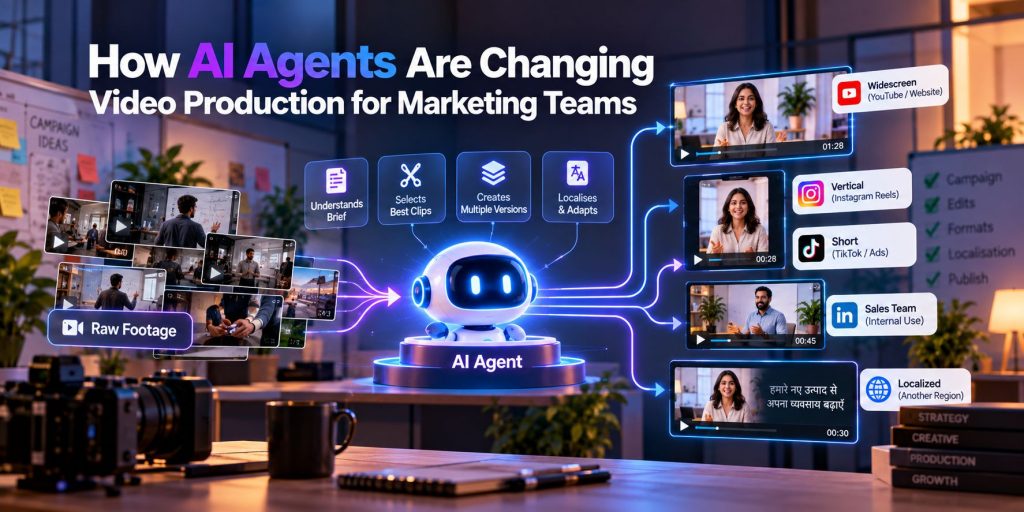
Ask a marketing lead what slows their video output and you rarely hear “we’re out of ideas.” You hear about the queue. One launch video turns into a widescreen cut, a vertical cut, a six-second bumper, a version for the sales team and a localized version for another region. Each one waits for an editor who is still buried in the last request.
AI agents are starting to loosen that queue. They don’t replace the editor. They take on the repetitive middle of the job, the stretch between raw footage and a cut worth reviewing. This article looks at what that shift involves, where agents fit in a real production process, what changes for marketing teams, and where a person still has to hold the pen.
What “Agent” Means in Video Work
The term gets used loosely, so it helps to pin it down. A text-to-video tool takes a prompt and hands back a clip. You can ask again and get a different clip, but you can’t reach in and nudge a single cut. The tool decides everything between your sentence and the result.
An agent works differently. You give it a goal, such as assembling a ninety-second product story from the footage in a shared folder. It works through the steps: reviewing material, choosing takes, placing clips, trimming, adding titles. Then it reports back, and you steer from there. The instruction is the kind you’d give an assistant editor, and the response is closer to an assistant’s work than a vending machine’s output.
For a marketing team, the difference that matters is where the work lands. A rendered file is a dead end the moment a stakeholder wants the second scene shorter. You either re-prompt and hope, or send it to an editor to rebuild. A set of edits on a timeline stays open. Anyone can change a cut, swap a title or move a clip, and the rest of the project stays intact. That’s what makes agent-made work something a team can build a process around, instead of a novelty someone demoed once.
Why Open Connections Between Agents and Editors Matter
Most teams already have a favorite assistant. Marketers use Claude or ChatGPT for briefs and copy, and more technical teams spend their days in tools like Cursor or Claude Code. For a long time those assistants could write a script but couldn’t touch the edit. The gap was plumbing, and it’s starting to close.
The Model Context Protocol, usually shortened to MCP, is an open standard that lets an assistant call outside tools in a structured way. If a video editor exposes itself as an MCP server, any compatible assistant can open a project, import media and change the timeline directly, without anyone building a custom integration for each pairing.
Video editors are starting to follow, and invideo is one of them. It’s a browser-based editor built around a professional multitrack timeline, with separate video and audio layers and dedicated spaces for editing, color and audio. People use it the way they’d use any timeline editor: cutting, trimming, layering and finishing by hand.
What makes it relevant here is that the same timeline can also be driven by an outside assistant. Through invideo remote agent support, a team connects the assistant it already uses (Claude, ChatGPT in developer mode, Claude Code, Codex, Cursor, VS Code or Gemini CLI) with a normal account sign-in and no API key, and the agent works in the same project as the people on the team.
Three details of how this setup works say a lot about where the category is heading:
- One shared timeline. The agent and the person work in the same editor. You can watch the agent’s cursor move while making your own edits at the same time, so there’s no waiting for it to finish before you can step in.
- Edits you can inspect and undo. Each change is an explicit operation, such as a cut, a clip placement, a line of text or an effect, rather than a flattened render. You can adjust any of them or return to an earlier checkpoint if the agent heads somewhere you don’t like.
- Exports that fit existing pipelines. The cut can leave as a finished video or as a project file for Premiere Pro, Final Cut Pro or DaVinci Resolve. That matters for teams whose agencies or in-house editors still work in those tools, because the agent’s work can feed their process instead of competing with it.
Where Agents Fit in the Production Process
It helps to walk through the usual production stages and see where an agent adds value and where it doesn’t.
Planning and pre-production
Planning is where general-purpose assistants already earn their keep. They can turn a campaign brief into a short list, suggest a structure for a two-minute explainer, or draft a script variant for a different audience. None of this needs an editing tool at all.
What’s new is continuity. When the same assistant that helped plan the video can also open the project and start assembling it, the plan doesn’t get lost in translation between tools. The shot list becomes the instruction for the first cut.
Post-production
This is where agents change the day-to-day most, because post-production is full of steps that are tedious but well defined.
Picture a team that records a forty-minute customer interview and needs a ninety-second testimonial. The slow part has never been creative judgment. It’s the scrubbing: finding usable answers, comparing takes, trimming pauses and laying everything out in order. An agent can handle that first assembly while the editor works on something else. The editor comes back to a rough cut and spends their time on rhythm and emphasis, which is the part that needs a human ear anyway. The same applies to webinar recordings, event footage and product demos.
Finishing passes like color correction and audio mixing are within reach too. An agent connected to a full timeline editor can adjust footage and balance sound as part of the same session. Treat these as strong first passes. A person with a good eye and decent monitors should still make the final call, especially on skin tones and dialogue clarity.
Marketing video also rarely ships as a single file. Different platforms want different shapes, and different audiences want different emphasis. Once a master edit exists, an agent can produce variations on the same timeline: a shorter cut, an alternate opening, a version with different on-screen text. Because those variations are edits rather than renders, a reviewer can open any of them and change it. Agents in this setup can also generate images, video and audio from inside the same session, which helps when a gap in the footage needs filling. Use that sparingly. Real footage of real customers and products still carries more trust than generated filler.
What Changes Inside a Marketing Team
Plain-language direction is the new interface, which makes briefs matter more than they used to. “Make it punchy” produces a different edit for every reader, human or machine. Teams that get good results tend to write down the audience, the single point the video has to land, the length, the tone and a reference or two. That habit helps human editors as well, which is a useful side effect.
Roles shift rather than disappear. Editors move toward direction and finishing: taste, pacing and polish. Marketers gain the ability to request a change and see it happen without opening a ticket. Producers spend less time chasing status and more time deciding what’s worth making. The risk is a blurry line about who signs off. If an agent, a marketer and an editor can all touch the same timeline, someone needs to own the final version. Decide that early.
Review also gets faster and more frequent. When a revision takes minutes instead of days, stakeholders can react to a real cut on Tuesday instead of a storyboard on Friday. That’s good for quality, as long as the team resists the temptation to keep tweaking forever. Setting a fixed number of review rounds keeps speed from turning into churn.
Where People Still Matter
Agents are good at execution and unreliable at judgment, and the gap shows up in predictable places.
Story and taste. An agent can assemble what you asked for. It can’t tell you the testimonial would land harder if it opened on the second answer. That instinct comes from watching a lot of videos and knowing an audience.
Claims and compliance. Anything a video says about a product, a price or a result should be checked by someone accountable for it. Speed makes it easier to publish a mistake faster, so the review step matters more, not less.
Brand consistency. If every team uses the same tools with loose direction, output drifts toward the same generic look. A style guide helps, and so does a human who notices when everything starts to feel samey.
Access and security. Connecting an agent to a work account is a permissions decision. Setup can involve changing settings in the client you’re using, and on some team or enterprise plans an owner has to add the connector. Decide who is allowed to connect what before the first pilot, not after.
A Practical Way to Start
Teams that try to automate everything at once usually stall. A smaller start works better.
- Pick one recurring format. Product update videos, interview cut-downs and event recaps all work well because the structure repeats.
- Write a one-page brief template covering audience, message, length, tone and reference examples.
- Split the work on purpose. Let the agent handle assembly, trims and first-pass versions. Keep story decisions, final polish and approval with a named person.
- Measure the right things. Track turnaround time and the number of revision rounds. Raw video count tells you very little.
- Keep source material organized. Agents can only pick good takes from footage that’s labeled and easy to find.
After a month, you’ll know where the agent saved time and where it created extra reviews. Adjust from there.
Conclusion
The interesting change isn’t that software can now make an edit. It’s that the edit lives somewhere shared, where a person and an agent can both work on it. That turns video production from a hand-off between people into something closer to collaboration, with the agent covering the repetitive steps and the team deciding what’s worth saying.
Marketing teams that treat agents as fast, tireless assistants, and keep humans responsible for the story, will get the most out of them. Teams that hand over the whole job will find out quickly how much judgment the old process was quietly providing.