
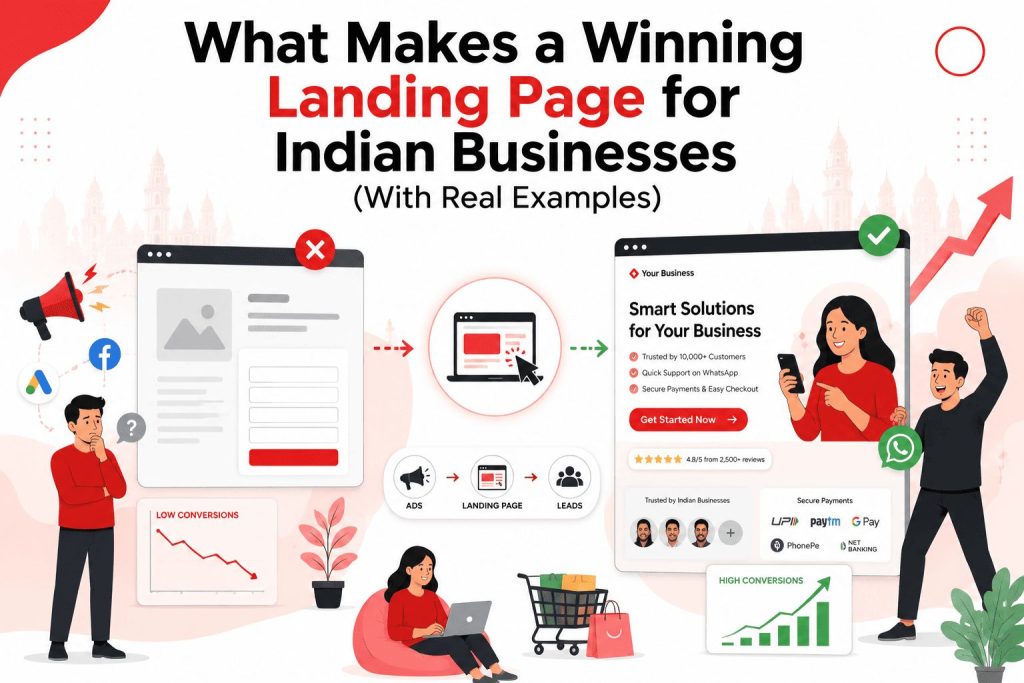
Here’s a situation that plays out constantly across Indian businesses running digital ads.
A business owner sets up a Google Ads campaign. The targeting looks right. The keywords are relevant. The daily budget is decent. Clicks start coming in — but barely anyone fills out the form, calls, or buys. The business owner blames the ads. Reduces the budget. Tries a different campaign. Same result.
The ads were never the problem. The landing page was.
A landing page that works brilliantly for a US SaaS company or a British ecommerce brand will often underperform significantly in India — not because Indian consumers are harder to convert, but because the trust signals, payment cues, communication preferences, and design expectations are genuinely different. A form that converts well in California may sit completely empty in Coimbatore if it doesn’t address the specific doubts and decision-making patterns of Indian buyers.
This guide is specifically about what makes landing pages work in India. We’ll cover the elements that every winning landing page needs, the India-specific factors that most generic guides completely ignore, and the mistakes that drain conversion rates on Indian landing pages every day.
What Is a Landing Page (And What It Is Not)
Before getting into what makes a landing page win, let’s be clear about what it actually is — because the term gets confused with regular web pages constantly.
A landing page is a standalone web page built for one specific goal. Someone clicks an ad, a social media post, an email link, or a search result, and they “land” on this page. Everything on it — the headline, the copy, the images, the button — exists to move that visitor toward one action. Not two actions. Not three. One.
That single focus is what separates a landing page from a homepage or a service page. Your homepage is designed for exploration — it introduces your brand, lets visitors navigate to different areas, and tells your overall story. A landing page removes all of that. No navigation menu. No sidebar. No links leading elsewhere. Just the offer and the decision.
This distinction matters because many Indian businesses are sending paid traffic — Google Ads clicks, Instagram ad traffic, WhatsApp link clicks — directly to their homepage. That’s like paying someone to come to your shop and then leaving them at the entrance with no direction. A landing page is the guided experience that says: here’s exactly what you get, here’s why it’s worth it, here’s what to do next.
Why Generic Landing Page Advice Often Fails Indian Businesses
Most landing page guides are written by American or European marketers for American or European audiences. The psychology, the design patterns, the trust signals, the conversion tactics they recommend are built on research conducted in Western markets with Western consumers.
Indian consumers bring fundamentally different expectations and concerns to any digital transaction.
👉 Trust is earned differently in India. In many Western markets, a clean, minimal website with good design automatically signals legitimacy. In India, a very minimal page can actually raise suspicion — where’s the address? Where’s the phone number? Who is behind this? Indian consumers have been burned enough by online fraud that they look for specific, concrete verification signals that Western landing page templates simply don’t include.
👉 Payment behavior is completely different. India has one of the most diverse payment ecosystems in the world — UPI, net banking, credit and debit cards, wallet payments, EMI options, cash on delivery. A landing page that only shows international payment logos or doesn’t prominently display familiar payment options creates unnecessary friction for Indian buyers.
👉 WhatsApp is a conversion tool, not just a messaging app. For a large percentage of Indian businesses — especially in services, education, healthcare, real estate, and local retail — the actual sale happens over WhatsApp, not through a web form. A landing page designed without a WhatsApp CTA is missing a conversion channel that, for many Indian business categories, outperforms email forms by a wide margin.
👉 Price sensitivity is expressed differently. Indian consumers respond strongly to specific price framing — EMI breakdowns, “starting from ₹X” language, comparison to alternatives, and clear value justification. A landing page that shows only a final price without context will lose conversions to one that breaks down why the price is reasonable.
👉 Mobile is not secondary — it is primary. Over 70% of Indian internet traffic comes from mobile devices. For many Indian users, their smartphone is their primary or only device for accessing the internet. A landing page that looks beautiful on a desktop and is barely functional on mobile is failing most of its Indian visitors.
The Core Elements Every Winning Landing Page Needs
These are the foundations. Every high-converting landing page in India and globally needs these elements in place before any optimization work makes sense.
1. A Headline That Speaks to a Specific Outcome
The headline is the first thing every visitor reads. It has approximately three seconds to answer one question: what’s in it for me?
A weak headline states what you do. A strong headline states what the visitor gets or achieves.
Weak: “Digital Marketing Services for Your Business“
Strong: “Get More Leads From Your Website in 30 Days — or We Work for Free”
Weak: “CA Coaching Institute in Indore”
Strong: “CA Foundation Classes in Indore Starting ₹2,999 — Batch Starting June 15”
The strongest headlines are specific. Specific numbers. Specific outcomes. Specific timeframes. Specific audiences. Vagueness costs conversions.
For Indian landing pages specifically, headlines that acknowledge a local context — city names, Indian market realities, rupee denominations, recognizable local references — consistently outperform generic ones. “Grow Your Business in Indore” resonates more with an Indore business owner than “Grow Your Business Online.”
2. A Subheadline That Supports and Extends the Headline
The subheadline sits directly below the main headline and does the explaining the headline couldn’t do in its brevity. It answers the “how” or “why” that the headline raises.
If the headline is: “Get More Leads From Your Website in 30 Days” The subheadline might be: “We audit your current website, redesign your most important pages for conversion, and set up tracking so you can see exactly where leads are coming from — starting at ₹15,000.”
Together, the headline and subheadline should give a visitor enough information to decide whether they want to keep reading.
3. A Clear, Singular Call to Action
Every winning landing page has one primary call to action — one button, one form, one phone number, one next step. When you give visitors multiple options, they often choose none. This is called decision paralysis, and it kills conversion rates on Indian landing pages every day.
The CTA button text matters enormously. Weak CTA text tells visitors what to do to you. Strong CTA text tells visitors what they get.
Weak: “Submit” / “Click Here” / “Send”
Strong: “Get My Free Quote” / “Book My Free Consultation” / “Start My 7-Day Free Trial”
For Indian audiences specifically: make the next step feel low-risk and low-commitment. “Book a Free Consultation” outperforms “Contact Us.” “Get a Free Audit” outperforms “Request a Callback.” The word “free” removes the financial risk perception. Specificity removes the uncertainty about what happens next.
4. A Hero Section That Immediately Communicates Value
The hero section is everything visible before a visitor scrolls — what designers call “above the fold.” On mobile, this is roughly the first screen the visitor sees.
Most Indian visitors will decide within five seconds whether to keep reading or hit the back button. The hero section carries that entire decision.
A strong hero section includes the headline, subheadline, your primary CTA button, and one supporting visual — a product image, a screenshot, a photo of results, a picture of the person or team behind the service. Nothing else. Every additional element in the hero section competes for attention and dilutes the message.
5. Social Proof That Indian Audiences Actually Trust
Social proof is the evidence that other people have used this product or service and it worked. It reduces the perceived risk of acting. But not all social proof is equal in India.
What works strongly for Indian audiences:
Customer testimonials with full names, photos, and their city or state. “Rahul Verma, D2C Founder, Bengaluru” is more credible than “R.V., Business Owner.” The specificity makes it feel real.
Star ratings with actual numbers. “4.8 stars from 312 reviews” is more powerful than “5 stars.” Paradoxically, a 4.8 feels more authentic than a perfect 5.
Client logos from recognizable Indian companies. If you’ve worked with brands Indian visitors recognize, showing those logos near the top of the page builds instant credibility.
Case study results with specific numbers. “We helped a Pune-based coaching institute grow from 40 to 180 enrolled students in one academic year” is more convincing than “We help educational businesses grow.”
Video testimonials. Especially for higher-ticket products and services, a 30 to 60 second video of a real customer talking about their experience converts significantly better than a text testimonial. Indian audiences are increasingly video-native — they respond to authenticity in video in a way that text quotes can’t match.
What doesn’t work as well:
Anonymous testimonials with no identifying information. Indian consumers have grown skeptical of these.
Testimonials from non-Indian sounding names or locations when the product is India-specific. Incongruence between the testimonial and the target audience creates subconscious doubt.
Fabricated-looking review stars with no actual count or source.
6. A Benefits-Focused Description of the Offer
After the hero section, a winning landing page explains what the visitor gets in terms of outcomes, not features. This is the features vs. benefits distinction that matters everywhere but is especially important in India where buyers are practical and ROI-conscious.
Features describe what something is or does. Benefits describe what the visitor gets from it.
Feature: “24/7 customer support available”
Benefit: “Get answers whenever you need them — even at 11 PM before a big client presentation”
Feature: “AI-powered campaign management”
Benefit: “Your ads keep optimizing while you focus on running your business”
For Indian business owners and consumers, the benefit framing should connect to real, practical outcomes — saving time, making money, avoiding a problem, gaining status or confidence. Abstract benefits (“transform your business”) are less effective than concrete ones (“get 3 to 5 qualified leads per week from your existing website traffic”).
India-Specific Elements That Separate Good Landing Pages From Great Ones
These are the elements that generic landing page guides miss entirely — and the ones that make the most meaningful difference for Indian conversions.
7. WhatsApp as a Primary CTA
This is the single biggest difference between landing pages built for Indian audiences and those built for Western ones.
For a significant percentage of Indian service businesses — digital marketing agencies, coaching institutes, healthcare providers, real estate agents, immigration consultants, financial advisors, and local retailers — the WhatsApp message is where the lead actually converts into a customer. Not the form fill. Not the callback. The WhatsApp conversation.
Indian consumers are comfortable with WhatsApp in a way they are not equally comfortable with web forms. A form feels formal and impersonal. WhatsApp feels like talking to a person. The gap in perceived trust between the two is significant.
A landing page for an Indian service business should offer WhatsApp as a CTA option — either as the primary CTA or alongside a form. “Chat With Us on WhatsApp” with a direct click-to-chat link is not a lesser option compared to a form — for many categories, it is the better-converting option.
The technical setup is simple: use WhatsApp’s click-to-chat format (wa.me/91XXXXXXXXXX?text=Hi, I saw your ad and want to know more) to pre-fill a message that gives context when the prospect contacts you. This also helps your team understand where the lead came from.
8. Trust Signals That Address India-Specific Concerns
Indian consumers have specific fraud-related concerns about online transactions that a well-designed landing page should address directly — not assume away.
Business registration and legitimacy signals:
- GST number displayed prominently
- Physical address — not just a city name, but a full address
- Landline or local mobile number (not just an email)
- “Years in business” or founding year — longevity signals stability
Payment security signals:
- Familiar Indian payment logos: UPI, Razorpay, Paytm, Google Pay, PhonePe, net banking
- “100% secure payment” with a padlock icon
- SSL certificate indication
- Refund or money-back policy stated clearly
For ecommerce specifically:
- Cash on delivery (COD) option prominently displayed — COD significantly reduces purchase hesitation for Indian consumers, especially for new brands
- Delivery timeline stated specifically (“Delivered in 3 to 5 working days”)
- Easy return policy stated in plain language
Many Indian consumers arrive at a landing page with a default skepticism that must be actively dissolved before they will act. The trust signals above are not decorations — they are directly responsible for the conversion or the exit.
9. Price Transparency and Indian Price Psychology
Indian consumers do not respond well to vague pricing on landing pages. “Contact us for pricing” — a common Western B2B tactic — creates friction in India because it requires an action (contacting) before the prospect even knows if the price is in their range.
For landing pages targeting Indian audiences:
✓ Show a price range if not a fixed price. “Services starting from ₹8,000/month” gives a prospect enough information to self-qualify without creating the full commitment of contacting for pricing.
✓ Break down EMI options. For higher-ticket products and services, showing an EMI breakdown immediately reduces the perceived cost barrier. “₹15,000 total or ₹2,500/month for 6 months” changes how the price feels without changing what it is.
✓ Anchor pricing. Show the original price crossed out alongside the current price where a discount applies. This visual cue is highly effective for Indian consumers who are accustomed to negotiation and discount culture. “₹25,000 ₹18,000” communicates both value and saving simultaneously.
✓ Rupee denomination, always. This sounds obvious but landing pages that show dollar prices for products or services aimed at Indian buyers create unnecessary friction. Seeing ₹ instead of $ removes a micro-conversion barrier that costs sales quietly.
10. Mobile-First Design That Actually Works
Mobile optimization for Indian landing pages means more than making the desktop version responsive. It means designing for the specific context in which Indian mobile users actually browse.
Indian mobile users often browse on mid-range Android phones with varying screen sizes. They are frequently on cellular data rather than WiFi, meaning page load speed is more critical than in broadband-dominated markets. And they are often browsing in environments where they cannot easily use both hands — commuting, in between tasks, waiting.
Practical implications for Indian mobile landing pages:
✓ Page speed above all. A landing page that takes more than three seconds to load on a 4G connection will lose a significant percentage of Indian mobile visitors before they see a single word of the page. Compress images. Minimize heavy scripts. Test load speed on a mobile connection, not just WiFi.
✓ Large tap targets. Buttons should be large enough to tap accurately with a thumb on a phone held in one hand. Small buttons that require precise tapping cause frustration and exits. Minimum 44 pixels tall for any tappable element.
✓ Single column layout. Multi-column layouts that look clean on desktop become confusing on mobile. For Indian landing pages, a clean single-column layout that flows logically from top to bottom performs better than complex grid layouts.
✓ Sticky CTA button. A call-to-action button that stays fixed at the bottom of the screen as a visitor scrolls dramatically increases conversions on mobile. The visitor never has to scroll back up to take action — the option is always visible.
✓ Click-to-call prominently placed. For service businesses in India, a phone number that activates a call with one tap should appear in the hero section on mobile. Many Indian consumers, particularly in B2B and local services, prefer calling over filling a form. Making the phone number tap-to-call removes one step from that decision.
11. Language and Tone That Resonates With Indian Audiences
The language on your landing page signals who this is for. Landing page copy written in formal corporate English will feel distant to many Indian business owners and consumers who are more comfortable with a direct, conversational tone.
For landing pages targeting non-metro audiences or specific regional markets, consider whether Hindi or a regional language version would convert better. For many categories — local services, mass-market products, educational content — a Hindi landing page will significantly outperform an English one simply because it feels more personally addressed.
Even for English-language landing pages, certain adjustments make the copy feel more India-relevant:
Use Indian references where appropriate. Mention the Indian context — “for Indian businesses,” “in the Indian market,” city names if targeting local — rather than generic global framing.
Use direct address. “You” works well. Overly formal third-person phrasing (“businesses seeking to optimize their digital presence”) creates distance. “If you want more leads from your website” is more direct and more effective.
Avoid jargon the target audience won’t know. For technical services or products, translate the benefit into plain language rather than assuming the visitor knows the technical terms. A business owner searching for “how to get more customers online” does not necessarily know what “conversion rate optimization” means — but they understand “more website visitors becoming customers.”
The Anatomy of a Winning Indian Landing Page: A Top-to-Bottom Walkthrough
Here is how all of the above elements come together into a complete page structure. This order is based on how Indian visitors actually read and decide on landing pages.
✅ Section 1 — The Hero (Above the Fold)
- Headline: specific outcome-focused claim
- Subheadline: supporting explanation with key details
- Primary CTA button: “Get My Free Quote” / “Book a Free Call” / “Chat on WhatsApp”
- Hero image or video: product, result, team, or demonstration
- Optional: one trust signal (star rating, number of clients, or award)
✅ Section 2 — The Problem Statement Address the pain point the visitor came with. Describe the situation they’re in before your product or service. When visitors feel understood, they keep reading. This section creates the emotional resonance that makes the solution feel relevant.
✅ Section 3 — The Solution Overview Introduce what you offer as the answer to the problem. Keep it simple — three to five bullet points of key benefits, each written as an outcome rather than a feature.
✅ Section 4 — Social Proof Block Three to five testimonials with photos and full names. If possible, include one video testimonial. Add client logos if you have them. If you have a notable client count or results metric (“Trusted by 200+ Indian businesses”), state it here.
✅ Section 5 — How It Works A simple three to four step process that shows the visitor exactly what happens after they act. This removes the fear of the unknown — one of the biggest conversion barriers on Indian landing pages. “Step 1: Fill the form. Step 2: We call you within 24 hours. Step 3: You get your custom proposal.” The simpler the process looks, the lower the perceived risk of starting.
✅ Section 6 — Pricing or Offer Details Price range or specific price, EMI options if applicable, what’s included, any guarantees or refund policy. For B2B services, a “What’s Included” breakdown with specific deliverables reduces the ambiguity that stops Indian buyers from acting.
✅ Section 7 — Trust and Legitimacy Block GST number, physical address, phone number, years in business, certifications, payment logos, SSL security badge. This section directly addresses the legitimacy concerns that Indian consumers bring to unfamiliar brands.
✅ Section 8 — Final CTA Repeat the primary CTA at the bottom of the page for visitors who have read through the entire page. Many of your highest-intent visitors will read everything before acting — make sure the action is right in front of them when they’re ready.
Optional: FAQs Address the three to five most common objections or questions your sales team hears. A visitor who has their objection answered on the page doesn’t need to contact you to get that answer — removing that barrier speeds up the conversion.
Common Landing Page Mistakes Indian Businesses Make
❌ Sending All Traffic to the Homepage
The homepage is not a landing page. It has navigation links, multiple messages, multiple CTAs, and is designed for exploration rather than conversion. Sending paid ad traffic to your homepage is one of the most common and most costly mistakes in Indian digital marketing. Every campaign should have a dedicated landing page matched specifically to the ad’s message.
❌ Using a Generic International Template Without India Adaptation
There are thousands of landing page templates available — from Elementor, Divi, Canva, and various page builder tools. Most are designed for Western audiences. Simply buying a template and filling in your content without adapting it for Indian trust signals, payment options, and WhatsApp integration means the underlying framework is working against your conversions.
❌ Too Many CTAs or Navigation Links
Every link you add to a landing page that is not the primary CTA is a potential exit. Navigation menus, links to blog posts, links to social media — all of these pull the visitor’s attention away from the action you want them to take. A true landing page has no navigation menu and only one external link: the CTA.
❌ Forms That Ask for Too Much Information
Long forms are one of the most consistent conversion killers on Indian landing pages. Every additional field you add reduces the likelihood that the form gets completed. For lead generation, name, phone number, and one qualifying field is usually enough to have a productive first conversation. You do not need the visitor’s full address, company size, and five-year business plan before you speak to them.
The shortest form that gives your sales team what they need to make the follow-up call is the right form length.
❌ No Follow-Up Plan for Leads
A landing page that converts is only valuable if what comes next is equally strong. Indian businesses frequently invest in landing pages but have no systematic follow-up process — leads come in, nobody calls within 24 hours, the prospect loses interest and moves on. The landing page’s job is to start the conversation. Your follow-up’s job is to close it.
Set a clear internal SLA for lead response time. For high-intent leads from paid campaigns in India, a call within one to two hours of form submission dramatically outperforms calling the next day. The prospect is warmest in the hour after they submitted the form — that’s the window to reach them.
❌ No Testing or Iteration
Most Indian businesses build a landing page, launch it, and leave it unchanged for months or years. The businesses getting the best conversion rates from their landing pages are the ones testing continuously — trying different headlines, different CTAs, different form lengths, different hero images.
You don’t need a complex A/B testing setup to start. Change one element. Run it for two weeks. Check if conversion rate went up or down. Keep the winner. Change the next element. Over six months of this simple process, a landing page that was converting at 2% can reach 6% or higher — tripling the leads from the same ad spend.
What “Conversion Rate” Actually Means for Indian Landing Pages
Conversion rate is the percentage of landing page visitors who take the desired action — fill the form, call, make a purchase, or click to WhatsApp.
Global benchmarks suggest that the average landing page converts at around 4 to 5%. A good landing page converts at 8 to 12%. An exceptional one can reach 20% or higher in some categories.
But these numbers vary enormously by category, traffic source, and what counts as a conversion. A landing page for a free resource or a free consultation will naturally convert higher than one for a high-ticket product. Traffic from Google Search (people actively searching for your product) converts higher than traffic from display ads (people who weren’t looking for you).
For Indian businesses, realistic benchmarks by category:
| Category | Realistic Conversion Range |
|---|---|
| Local service (pest control, plumbing, cleaning) | 8–20% |
| Educational course or coaching | 5–15% |
| B2B service (digital marketing, IT, accounting) | 3–8% |
| Ecommerce product | 2–6% |
| High-ticket product or service (above ₹50,000) | 1–4% |
| Real estate enquiry | 2–5% |
If your current landing page is converting below the low end of your category range, there is a specific problem to diagnose. If it’s at the high end, you’re doing something right — study what it is and apply it to other pages.
Tools to Build Landing Pages in India (Free and Paid)
You don’t need an expensive developer to build a landing page that converts. Here are the most practical options for Indian businesses at different budget levels.
🛠️ For WordPress users: Elementor (free and paid versions) and Divi are the most widely used landing page builders in India among WordPress sites. Both have templates and drag-and-drop editing. The free versions of both are sufficient to build functional landing pages.
🛠️ For non-WordPress websites: Canva has added landing page functionality that works for simple lead capture pages. It’s free, easy to use, and integrates with common email marketing tools.
🛠️ For dedicated landing page tools: Unbounce, Instapage, and Leadpages are global standards with strong A/B testing features. Pricing is in dollars, which is a consideration for Indian businesses, but all three offer trial periods. For agencies managing multiple client landing pages, these tools are worth the investment.
🛠️ For beginners building their first page: Google Sites or Carrd.co (paid plan around ₹800 to ₹1,200/year) allow you to build simple landing pages quickly without any technical knowledge. These are not ideal for complex pages but work well for basic lead capture.
🛠️ For tracking performance: Google Analytics 4 and Meta Pixel should be installed on every landing page from day one. Without tracking, you cannot know whether your landing page is working, where visitors are dropping off, or which traffic sources are converting. Setting these up correctly before launching is non-negotiable.
Digital Dawn is a digital marketing agency based in Indore helping Indian businesses design, build and optimize landing pages that convert. If your current landing pages are not delivering the leads or sales your ad spend deserves, get in touch with our team.