
Every serious SEO conversation eventually circles back to the same three names: SEMrush, Ahrefs, and Moz. They’ve been the dominant players in the space for years, and in 2026, all three are still very much worth talking about — but for very different reasons.
Here’s the problem. Most comparison articles either go surface-level (“Ahrefs is great for backlinks!”) or drown you in feature tables without telling you what any of it actually means for your workflow. That’s not useful when you’re about to commit ₹1,00,000 or more per year to a tool.
This guide takes a different approach. We’ve broken down all three tools across eight key categories — keyword research, backlinks, site audit, competitor analysis, rank tracking, content tools, local SEO, and reporting — with a clear winner for each. Then we’ve matched each tool to the type of user it actually suits best.
Whether you’re a blogger just getting started, an in-house SEO professional, or an agency managing multiple client accounts, this comparison will help you make the right call.
Quick Overview: What Each Tool Is Really About
Before diving into features, it helps to understand the philosophy behind each platform.
SEMrush is an all-in-one marketing suite. It started as an SEO tool but has expanded to cover PPC research, content marketing, social media management, and competitor intelligence. If you want one platform to manage your entire digital marketing operation, SEMrush is built for that.
Ahrefs is laser-focused on organic search. It’s best known for its backlink database — widely considered the most accurate and freshest in the industry — and its clean, data-rich interface. It doesn’t try to do everything. It tries to be the best at what it does.
Moz is the most approachable of the three. It’s beginner-friendly, more affordable, and the creator of Domain Authority (DA) — still the most widely recognized authority metric in SEO. It’s particularly strong for local SEO use cases.
At-a-Glance Comparison
| SEMrush | Ahrefs | Moz | |
|---|---|---|---|
| Best For | All-in-one marketing teams | Backlinks & organic SEO | Beginners & local SEO |
| Starting Price | ₹11,800/month | ₹2,450/month (Starter) | ₹8,300/month |
| Free Trial | 7 days | No (Starter plan available) | 7 days |
| Keyword Database | 25B+ keywords | 10B+ keywords | 500M+ keywords |
| Backlink Index | Strong | Best-in-class | Limited |
| Ease of Use | Moderate | Moderate | Easy |
| PPC & Social Tools | ✅ Yes | ❌ No | ❌ No |
Prices approximate, based on USD to INR at ₹84. Verify current pricing at official websites.
Feature-by-Feature Comparison
1. Keyword Research
🏆 Winner: SEMrush (with Ahrefs close behind)
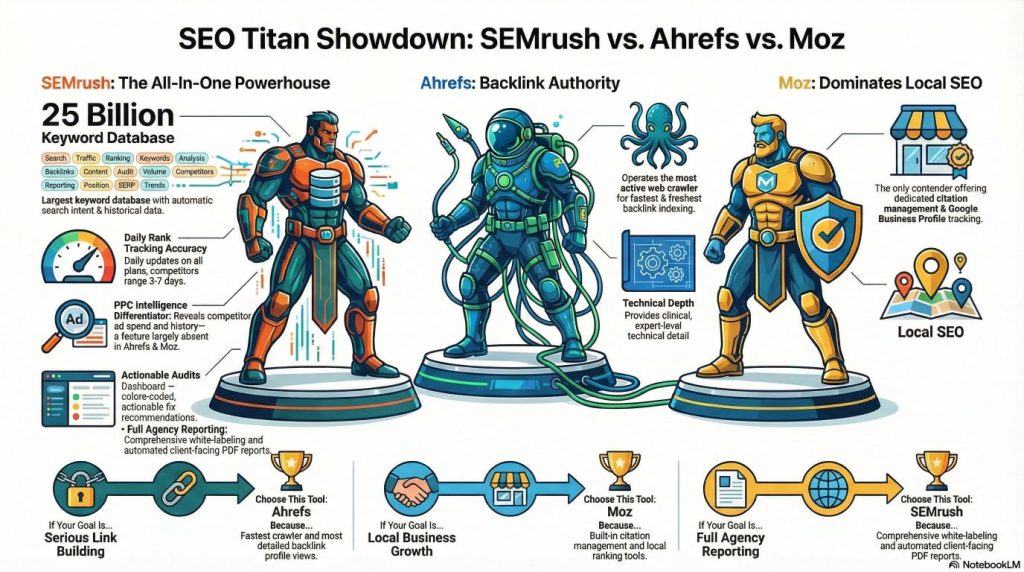
SEMrush leads here with a database of over 25 billion keywords and its Keyword Magic Tool — one of the most comprehensive keyword discovery interfaces available. It automatically tags keywords by search intent (informational, transactional, navigational), which saves a significant amount of manual filtering work. Historical data going back to 2012 is also a genuine advantage for understanding long-term trends.
Ahrefs holds its own with 10 billion+ keywords and arguably better accuracy in volume estimates. Its “Clicks” metric is unique — it estimates not just how many people search for a term, but how many actually click through to a result, accounting for SERP features like featured snippets and People Also Ask boxes. That’s a more realistic picture of the traffic you’d actually get.
Moz has the smallest keyword database at 500 million+ keywords and caps results at 1,000 suggestions per query regardless of plan. For competitive research in popular niches, that ceiling becomes a real limitation. Where it does stand out is keyword difficulty scoring — many users find Moz’s difficulty estimates particularly reliable for newer sites targeting easier opportunities.
Use it for keyword research if: You want the broadest coverage and intent tagging → SEMrush. You want the most accurate click-based data → Ahrefs. You’re a newer site targeting low-competition terms → Moz.
2. Backlink Analysis
🏆 Winner: Ahrefs
This is Ahrefs’ home turf, and it shows. The platform operates one of the most active web crawlers in existence, resulting in a backlink index that is consistently praised for both size and freshness. When a new link is built or lost, Ahrefs typically picks it up faster than its competitors.
The Site Explorer tool gives you a detailed view of any domain’s backlink profile — broken down by referring domains, anchor text, link type, and domain rating. It’s the go-to tool for link prospecting, disavow research, and competitive link gap analysis.
SEMrush has made significant improvements to its backlink database and is a credible second place. For most practical use cases — checking a competitor’s links, finding link building opportunities — the difference is not dramatic.
Moz’s backlink data has historically been its weakest area. Its index is smaller, and its link data tends to update less frequently. For casual backlink checks it works fine, but for serious link building campaigns, it’s not the first choice.
Use it for backlinks if: You’re serious about link building → Ahrefs. You want backlinks as part of a broader toolset → SEMrush.
3. Site Audit & Technical SEO
🏆 Winner: SEMrush
All three tools offer site audit functionality, but SEMrush goes the furthest in making the results actionable. Its audit doesn’t just list issues — it colour-codes them by severity, explains what each problem means, and links fixes to their likely SEO impact. For anyone presenting audit findings to a client or a non-technical team member, that built-in clarity is genuinely valuable.
Ahrefs’ Site Audit is thorough and clinically detailed. It assumes you already know what you’re looking at, which is fine for experienced SEOs but can be intimidating for beginners. The data is solid; the presentation just lacks the hand-holding that SEMrush offers.
Moz’s audit is the most straightforward of the three — a clean list of issues that’s easy to work through. It’s ideal for beginners who want to run a quick audit and act on obvious fixes. It doesn’t go as deep as the other two, but for smaller websites it covers the essentials well.
Use it for site audits if: You want detailed, actionable reporting → SEMrush. You want raw technical depth → Ahrefs. You want simplicity and ease of use → Moz.
4. Competitor Analysis
🏆 Winner: SEMrush
Competitor research is one of SEMrush’s strongest suits. You can uncover a competitor’s top-performing organic pages, their paid search keywords and ad copy history, their estimated traffic, and their content strategy — all from a single platform. The traffic analytics feature, while not perfectly precise, gives you a meaningful directional view of how competitors are performing across channels.
The PPC intelligence is a genuine differentiator. No other tool in this comparison shows you competitor ad spend data, historical ad copy, and landing page strategies as clearly as SEMrush does. If you run paid campaigns alongside your SEO work, this alone can justify the cost.
Ahrefs is strong for organic competitor analysis. The Content Gap tool is excellent — enter a few competitors and it shows you exactly which keywords they rank for that you don’t. But it stops at organic; there’s no paid data.
Moz offers basic competitor tracking but lacks the depth of the other two for serious competitive intelligence work.
Use it for competitor analysis if: You want organic and paid competitive data → SEMrush. You want organic-only competitor research → Ahrefs.
5. Rank Tracking
🏆 Winner: SEMrush
SEMrush updates rank tracking daily on all plans, supports multiple search engines (including Google, Bing, Baidu, and even ChatGPT Search), and includes local rank tracking at the city level. For agencies that send weekly reports to clients, daily updates make a real difference.
Ahrefs updates rankings every 7 days on the Lite plan and every 3 days on Standard — which is adequate for most use cases but less ideal for fast-moving campaigns. It does support tracking at the city level and offers clean, visual ranking reports.
Moz updates rankings weekly on most plans, which is the least frequent of the three. It supports Google, Bing, and Yahoo tracking. For stable, lower-competition niches where rankings don’t shift quickly, weekly updates are fine. For competitive industries, the lag can be frustrating.
Use it for rank tracking if: You need daily updates and multi-engine tracking → SEMrush. You want solid tracking at a reasonable price → Ahrefs. Your campaigns move slowly and budget is a priority → Moz.
6. Content Tools
🏆 Winner: SEMrush
SEMrush has invested heavily in its content suite. At Guru tier and above, you get a Topic Research tool, SEO Content Templates, and an AI writing assistant. What makes it particularly useful is the personalized keyword difficulty feature — instead of showing a generic difficulty score, it estimates how hard a keyword will be specifically for your domain, based on your backlink profile and existing content strength.
Ahrefs has been building out its content capabilities with Content Explorer and an AI Content Helper add-on, but these still feel like additions to the platform rather than a core feature set. Content Explorer — which helps you find top-performing content in any niche — remains genuinely excellent for ideation.
Moz’s content tools are lighter. You get keyword suggestions and basic on-page optimization guidance, but there’s no AI writing assistance or advanced content workflow tooling.
Use it for content if: You want a full content creation and optimization workflow → SEMrush. You want content research and ideation → Ahrefs.
7. Local SEO
🏆 Winner: Moz
This is where Moz genuinely pulls ahead. It offers dedicated local SEO tools including citation management, Google Business Profile tracking, and local rank tracking — capabilities that the other two tools either don’t offer or charge significant extra fees for. For businesses with a physical location or a service area, Moz’s local features are well worth the price of entry.
SEMrush offers local SEO features but typically bundles them as paid add-ons rather than core plan inclusions, which pushes the effective cost higher.
Ahrefs has limited local SEO functionality compared to the other two. It tracks local rankings but doesn’t offer the citation or GBP management tools that local businesses often need.
Use it for local SEO if: You’re managing a local business or local clients → Moz.
8. Reporting & Dashboards
🏆 Winner: SEMrush
SEMrush offers the most complete reporting suite, including white-label reports, customizable PDF exports, and scheduled automated reports — all features that agencies particularly appreciate. The My Reports tool lets you pull data from across the platform and build a single, cohesive client-facing report.
Ahrefs offers clean reporting with good data visualization but lacks white-label functionality, which limits its appeal for agencies. Reports are clear and professional but less customizable.
Moz’s reporting is straightforward and easy to share. It covers the essentials cleanly, though it doesn’t match the depth or white-label capability of SEMrush.
Use it for reporting if: You need white-label, automated client reports → SEMrush. You want clean data exports for internal use → Ahrefs. You need basic, easy-to-read reports → Moz.
Pricing Comparison (in INR)
All prices converted at approximately ₹84 to $1. Verify current pricing at each tool’s official website.
SEMrush
| Plan | Monthly | Annual (per month) |
|---|---|---|
| Pro | ₹11,750/month | ₹9,750/month |
| Guru | ₹20,996/month | ₹17,430/month |
| Business | ₹41,990/month | ₹34,860/month |
- 7-day free trial available
- Additional users: ₹3,780–₹8,400/month
- Local SEO, Trends, and Social features sold as add-ons
Ahrefs
| Plan | Monthly | Annual (per month) |
|---|---|---|
| Starter | ₹2,436/month | N/A |
| Lite | ₹10,836/month | ₹8,988/month |
| Standard | ₹20,916/month | ₹17,388/month |
| Advanced | ₹37,716/month | ₹31,332/month |
| Enterprise | ₹1,25,916/month | Custom |
- No free trial; Starter plan available for limited access
- Additional users: ₹3,360–₹6,720/month
Moz Pro
| Plan | Monthly | Annual (per month) |
|---|---|---|
| Standard | ₹8,316/month | ₹6,636/month |
| Medium | ₹15,036/month | ₹12,012/month |
| Large | ₹25,116/month | ₹20,076/month |
- 7-day free trial available
- Medium plan includes 2 user seats; Large includes 3
- Most team-friendly pricing structure of the three
Value takeaway: Moz is the clear winner on price at the entry level. For a two-person team, Moz’s Medium plan is significantly cheaper than adding an extra seat to SEMrush Guru or Ahrefs Standard. SEMrush offers the most features per rupee at higher tiers. Ahrefs’ Starter plan is useful for evaluation but too limited for active campaign management.
Ease of Use & Learning Curve
ꪜ Moz is the friendliest tool for newcomers. The interface is clean, uncluttered, and supported by an extensive library of beginner guides and a long-running community forum. If you’re new to SEO and don’t want to spend a week learning a tool before it becomes useful, Moz gets you productive faster.
ꪜ SEMrush has a steeper learning curve simply because it does so much. First-time users often find the sheer number of features overwhelming. That said, its onboarding process has improved significantly, and once you’re familiar with the layout, the breadth becomes an asset rather than a liability.
ꪜ Ahrefs sits in the middle. It’s less cluttered than SEMrush but assumes a reasonable level of SEO knowledge. Its interface is praised for being fast and well-organized, but there’s less explanatory context built in — you’re expected to know what the data means.
Who Should Use Which Tool?
👉 Beginners & bloggers → Start with Moz. The pricing is accessible, the interface won’t overwhelm you, and it covers everything you need to build an early SEO foundation — keyword research, rank tracking, basic site audits, and on-page optimization guidance.
👉 SEO professionals → Ahrefs for organic-first strategies, especially if link building and competitor research are central to your work. Pair it with SEMrush if you also run paid campaigns or need deeper content tooling.
👉 Digital agencies → SEMrush is the strongest fit. White-label reporting, multi-client management, daily rank tracking, and coverage across SEO, PPC, and content make it the most comprehensive agency platform of the three.
👉 Local businesses → Moz stands out with dedicated local SEO features at a price that makes sense for smaller operations. Its citation management and Google Business Profile tools address needs that Ahrefs and SEMrush only partially cover.
👉 eCommerce brands → SEMrush for its combination of keyword research, PPC intelligence, competitor analysis, and content tools — all relevant to running an online store. Ahrefs is a strong complement for link building and content gap analysis.
Pros & Cons Summary
| SEMrush | Ahrefs | Moz | |
|---|---|---|---|
| Pros | Most features of any tool, best competitor intelligence, daily rank tracking, strong content tools, white-label reporting | Best backlink database, most accurate keyword data, clean interface, generous project limits | Most affordable entry point, beginner-friendly, best local SEO tools, team-friendly pricing |
| Cons | Most expensive, feature overload for beginners, add-ons push costs higher | No free trial, limited content tools, no PPC data, charges per extra user | Smallest databases, weekly rank updates, lacks depth for advanced users |
Final Verdict
Category-by-Category Winners
| Category | Winner |
|---|---|
| Keyword Research | SEMrush |
| Backlink Analysis | Ahrefs |
| Site Audit | SEMrush |
| Competitor Analysis | SEMrush |
| Rank Tracking | SEMrush |
| Content Tools | SEMrush |
| Local SEO | Moz |
| Reporting | SEMrush |
| Best Value (Entry) | Moz |
Overall Winner by Use Case
👑 SEMrush wins on breadth. If you’re an agency, an in-house marketer managing multiple channels, or a business that wants one platform to handle everything, SEMrush delivers the most complete toolkit in 2026.
👑Ahrefs wins on depth for organic SEO. If your primary focus is ranking in Google, building links, and outranking competitors in search — and you don’t need PPC or social tools — Ahrefs is the more precise instrument.
👑Moz wins on accessibility. If you’re starting out, running a local business, or working with a tight budget, Moz gives you a professional-grade SEO foundation without the cost or complexity of the other two.
If you can only pick one: Most businesses will get the most mileage out of SEMrush. The breadth of features means you’re less likely to outgrow it, and the all-in-one nature means fewer additional subscriptions. That said, if your SEO work is primarily organic and backlink-focused, Ahrefs is a serious contender.
The best move before committing? Take advantage of the free trials. Both SEMrush and Moz offer 7 days free, and Ahrefs’ Starter plan lets you explore the platform at minimal cost. Spend a few days with each inside your own data — that hands-on experience will tell you more than any comparison article.
Last updated: March 2026. Prices are approximate and subject to change — always verify at each tool’s official pricing page before subscribing.