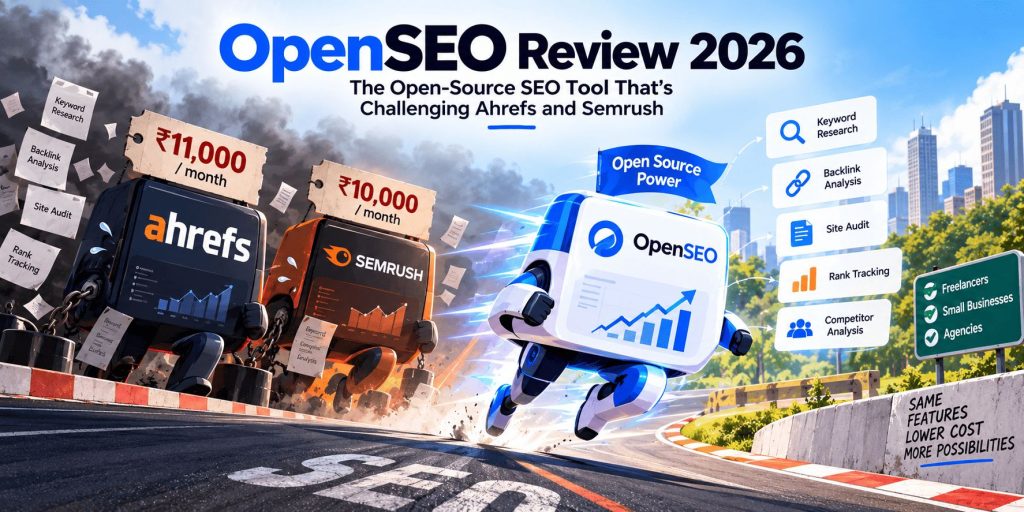
Let us start with the number that makes every digital marketer wince: ₹11,000 per month.
That is roughly what Ahrefs’ cheapest plan costs in Indian rupees in 2026. Semrush is not far behind. And for a freelancer, a small business owner, or an agency just starting to build its client base, that is a serious monthly commitment — especially when you are already paying for hosting, design tools, email platforms, and a dozen other subscriptions that have quietly colonised your credit card.
The argument for spending that much has always been: there is no real alternative. If you want quality keyword data, backlink analysis, rank tracking, and site auditing in one place, you pay the premium or you do without.
OpenSEO is making that argument much harder to defend.
We have been using OpenSEO at Digital Dawn for some time now, and this review is the honest account of that experience — what works, what doesn’t, where it beats its expensive competitors, where it doesn’t, and who it is genuinely the right tool for.
💡 Quick note upfront: OpenSEO has a free trial with $0.50 of credits. That is genuinely enough to run a few keyword searches and a competitor overview before committing anything. If you want to test it alongside reading this, go to openseo.so and sign up — no credit card required.
What Is OpenSEO, Exactly?
OpenSEO (openseo.so) is an open-source SEO platform built by Every App, Inc. as a direct, deliberate alternative to Semrush and Ahrefs. It covers all the core SEO workflows — keyword research, rank tracking, domain overview, backlinks, site audits — with a few features that its premium competitors don’t have at all: AI brand visibility tracking, a prompt explorer for AI search, and deep integration with AI agents through an MCP (Model Context Protocol) server.
It runs on DataForSEO as its data backend — the same underlying data source that powers many commercial SEO tools — so the data quality is solid. The GitHub repository sits at over 20,000 stars, which for an SEO tool is an extraordinary signal of community adoption. It took about eighteen months to get there.
The most important thing to understand about OpenSEO’s model: you pay for what you use, not for what you might use. The $10/month base plan includes $10 of usage credits. For most individual users and small businesses, that $10 covers an entire month of normal SEO work. You never pay for a seat at a table with a hundred features you never touched.
Getting Started — Easier Than You’d Expect for an Open-Source Tool
The word “open-source” sometimes makes non-technical users nervous. It conjures images of terminal commands, YAML files, and error messages at midnight. OpenSEO does not do that to you.
The hosted version at openseo.so works like any standard SaaS. You sign up, you get a clean dashboard, and you start using it within minutes. There is a setup guide for connecting AI agents, which takes about two minutes according to the documentation — and in our experience, that estimate is accurate.
If you are technical and want to self-host it on your own server (more on why you might want to do this later), it supports Docker and Cloudflare Workers. The GitHub documentation is thorough and actively maintained.
The onboarding is genuinely one of the better experiences in this category. Compared to Semrush’s initial dashboard, which presents you with about forty things to click immediately, OpenSEO is deliberately minimal. You see your projects, your workspace, and a clear set of tools. There is no feature bloat demanding your attention on day one.
Feature Deep Dive
1. Keyword Research
This is where most people spend most of their time in any SEO tool, and OpenSEO does it well.
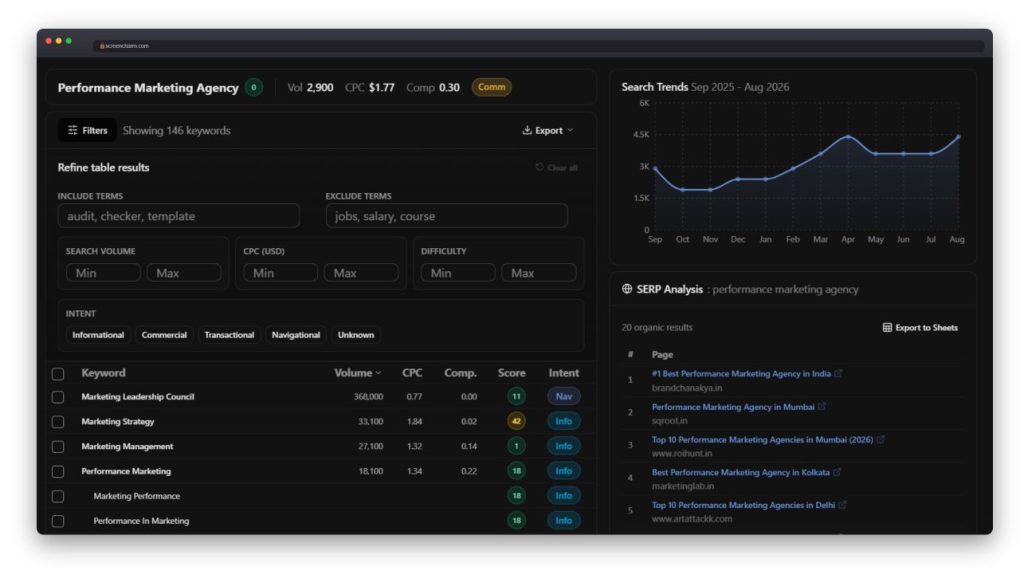
You enter a seed keyword and get back search volume, keyword difficulty, search intent classification, and live SERPs — the actual search results for that keyword right now. The difficulty scoring uses DataForSEO’s analysis, which correlates well with real competitive difficulty.
A few things stand out:
- The intent classification is actually useful. Most tools slap an “informational” or “commercial” label on keywords without much nuance. OpenSEO’s classification is noticeably more accurate on ambiguous queries, which matters a lot when you are deciding what kind of content to create for a keyword.
- The SERP preview is live. You are not looking at cached results from three weeks ago. When you pull the SERP for a keyword, you see who is actually ranking for it today. For competitive research, this is more valuable than it sounds.
- Pricing transparency within the tool. This is a small design detail but a meaningful one — the tool shows you exactly how much a query is going to cost before you run it. No surprises on your monthly usage.
A keyword search returning 150 results costs approximately $0.035. For context, running a hundred keyword searches in a month — more than enough for most projects — costs about $3.50. At Semrush, that same capability comes bundled into a plan that also charges you for the keyword clustering tool you never use, the content templates you forgot about, and the social media scheduler you activated once.
2. Domain Overview and Competitor Analysis
Enter any domain and OpenSEO gives you an estimate of its organic traffic, the keywords it ranks for, its top pages, and where it is gaining or losing visibility. This is your competitor intelligence view.
The traffic estimates are estimates — the same caveat applies to every SEO tool including Ahrefs and Semrush. The underlying data is identical (DataForSEO), so the quality is genuinely comparable. What changes is what each tool does with it.
OpenSEO presents it clearly and without the upsells. In Semrush, every domain overview has at least three suggestions to “unlock more data” with a higher-tier plan. In OpenSEO, what you see is what you get.
A standard domain overview costs approximately $0.04. You can analyse twenty-five competitor domains for $1.
3. Backlinks
See who links to any domain, which pages attract the most links, the quality of those links, and where links have been recently won or lost.
The backlink database comes from DataForSEO, which has been building its link index for nearly a decade. It is not quite as deep as Ahrefs’ proprietary link index — Ahrefs has one of the most comprehensive backlink databases ever built and that gap is real — but for practical day-to-day backlink research, the coverage is sufficient for most projects.
A domain overview including one year of backlink history costs approximately $0.08. For a freelancer doing monthly backlink audits for five clients, that is $0.40 a month versus the hundreds you would spend on the cheapest plan from a premium tool.
4. Rank Tracking
Track keyword positions over time across desktop and mobile, with SERP feature detection — knowing not just where you rank, but whether Google is showing a featured snippet, local pack, or other feature for that query.
Rank tracking pricing is volume-dependent. Tracking 50 keywords on weekly frequency on one device costs approximately $2 per month. Tracking 200 keywords weekly on both desktop and mobile costs about $8 per month. These numbers are deterministic — you know exactly what you will pay before you set it up.
One practical note: rank tracking is the one feature category where the frequency matters significantly to cost. Daily tracking is substantially more expensive than weekly. For most businesses, weekly tracking is more than sufficient — rankings do not move fast enough to justify daily checks in most niches.
5. Site Audit
Crawl your pages and surface technical SEO issues — broken links, missing meta descriptions, duplicate content signals, canonical problems, slow pages, and similar page-level issues.
The site audit in OpenSEO is powered by Lighthouse (Google’s own page quality tool), which means the output is credible and aligned with what Google itself evaluates. Cost is $0.01 per 20 pages — auditing a 200-page website costs $0.10.
This is the most dramatically cost-advantaged feature compared to premium tools. A site audit of a 1,000-page website in OpenSEO costs $0.50. The equivalent in Semrush requires a plan that starts at $129/month.
6. AI Brand Visibility — The Feature No Legacy Tool Has
This is where OpenSEO moves from “affordable alternative” to “actually ahead of the game.”
AI search is changing how people find businesses. When someone asks ChatGPT, Google’s AI Overview, or Perplexity to recommend a digital marketing agency in Indore, or a quick commerce consultant, or the best local SEO company in India — they get an AI-generated answer, not a list of ten blue links. Whether your business appears in those answers, gets cited as a source, or gets mentioned at all is the new frontier of visibility.
OpenSEO’s AI Brand Visibility feature lets you look up how your brand appears across AI search systems, including ChatGPT and Google’s AI Overview. You can see whether you are being mentioned, cited, or recommended — and where your competitors are appearing instead.
This feature does not exist in Ahrefs or Semrush at the same level. They are traditional web search tools built in a pre-AI era. OpenSEO was built after AI agents became dominant, and it shows.
For an agency like Digital Dawn that is actively advising clients on digital marketing strategy, having visibility into AI search presence is not a future consideration — it is a present one. And the fact that a $10/month tool has this while a $129/month tool does not is one of the more telling product development stories in the SEO space right now.
ChatGPT brand checks are priced at approximately $1.09 each — the most expensive feature in the platform, which is fair given the underlying API costs. For most businesses, running these checks once a month or once a quarter is sufficient.
7. Prompt Explorer
This is the companion to AI Brand Visibility. Instead of checking how your brand appears, the Prompt Explorer lets you explore what prompts people might use when asking AI tools for recommendations in your category — and compare how different AI models answer those prompts.
You can run the same prompt across ChatGPT, Google AI Overview, and other supported models and see who each model recommends. This is genuinely useful for understanding your AI search positioning relative to competitors.
For Indian businesses that are beginning to think about AEO (Answer Engine Optimization) alongside traditional SEO, this feature is a practical starting point for that work.
8. MCP and AI Agent Integration — The Most Unique Thing About OpenSEO
Model Context Protocol (MCP) is the technical standard that allows AI agents — Claude, ChatGPT, Cursor, and others — to use external tools during a conversation. OpenSEO is one of the first SEO tools to build a full MCP server.
What does this mean in practice?
You can connect OpenSEO to Claude (or another agent) and ask it, in plain conversation, to do your SEO research. The agent runs the actual keyword research, domain analysis, or SERP check through OpenSEO’s live data — not from its training data — and returns results that are current and grounded in real numbers.
The built-in skill commands include:
- /seo-coach — learn how to approach SEO for a specific project
- /seo-audit — identify the 1-2 highest-impact opportunities for more traffic
- /keyword-research — find topics worth targeting
- /competitor-analysis — understand what a competitor is doing and where they are vulnerable
The output is not just a raw data dump. Every piece of research the agent does gets saved as a structured report in your OpenSEO workspace — readable by humans, not just AI. This addresses one of the consistent frustrations with AI + SEO workflows: the agent produces great analysis in a conversation that disappears the moment you close the browser.
OpenSEO also has a separate Google Search Console MCP, which is free and does not consume your usage credits. Connecting it gives your AI agent direct access to your actual search performance data — clicks, impressions, CTR, position by query, and URL-level inspection. This combination — GSC data about what is happening on your own site, plus OpenSEO’s research data about the competitive landscape — is a genuinely powerful research environment.
9. Free Tools
OpenSEO also offers a suite of free tools that do not require an account or consume any credits:
- Backlink Checker
- Competitor Keyword Finder
- Keyword Generator
- Website Traffic Checker
- Competitor Analysis
- Spam Score Checker
- Domain Age Checker
- SERP Simulator
These are basic versions, but they are legitimately useful for quick checks. The SERP Simulator is particularly handy — it shows you how your meta title and description will appear in search results before you publish.
The Self-Hosting Option
This is the feature that makes OpenSEO genuinely unusual in the SEO tool market.
Because the entire codebase is open-source under an MIT licence, you can deploy OpenSEO on your own server. When you self-host, you bring your own DataForSEO API key and pay DataForSEO directly for usage — which is approximately 28% cheaper than the hosted version (the hosted version adds a margin on top of DataForSEO’s API costs, which is how the business sustains itself).
For developers, agencies building internal tools, or technical founders who already have server infrastructure, self-hosting is a compelling option. The Docker setup is documented clearly on GitHub.
For non-technical users, the hosted version at $10/month is the right choice — the self-hosting setup requires comfortable familiarity with deployment tools and is not appropriate for someone who has never set up a server environment.
Pricing — The Real Breakdown
OpenSEO’s pricing model is fundamentally different from every other SEO tool you have probably used.
Base Plan: $10/month
- Includes $10 of usage credits each month
- Everything is included — there are no feature tiers
- Works inside Claude, Cursor, ChatGPT via MCP
- Google Search Console data is free and doesn’t touch your $10
What does a typical month cost?
For a small business owner doing their own SEO:
| Task | Frequency | Cost/month |
|---|---|---|
| Keyword research (100 searches) | Monthly | ~$3.50 |
| Competitor domain overview (5 competitors) | Monthly | ~$0.20 |
| Backlink checks (5 domains) | Monthly | ~$0.40 |
| Rank tracking (50 keywords, weekly) | Ongoing | ~$2.00 |
| Site audit (200 pages) | Monthly | ~$0.10 |
| Total usage | ~$6.20 |
That $6.20 fits comfortably inside the $10 already included in the base plan. Most small business users will not exceed their included credits in a typical month.
For comparison: Ahrefs’ cheapest plan is $129/month. Semrush starts at $129.95/month.
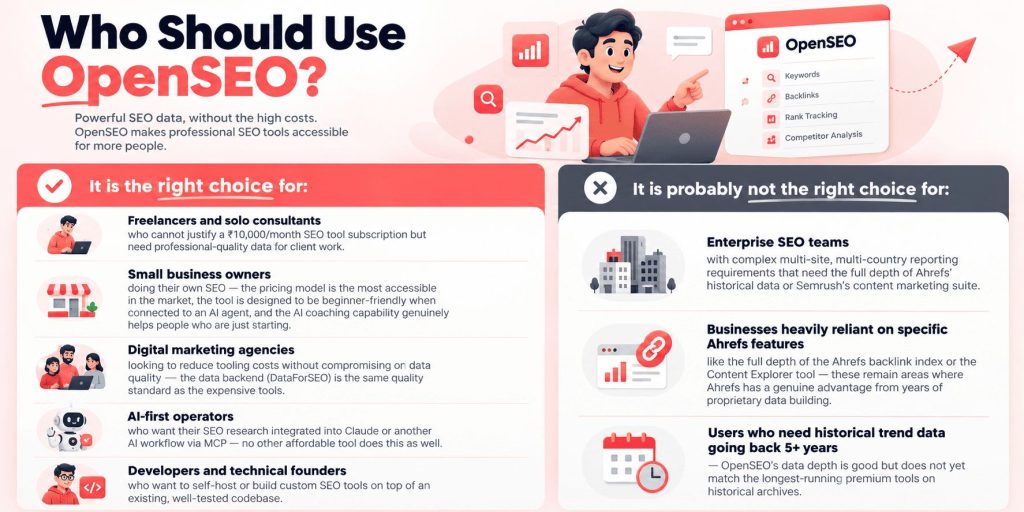
👉 Who pays more: Agencies managing multiple client projects will spend more. The ChatGPT brand checks at $1.09 each add up quickly if you run them at scale. High-volume keyword research across dozens of clients will push past the included $10. But even at 3x or 4x the base plan, OpenSEO remains substantially cheaper than any premium alternative.
👉 Top-up credits never expire. If you buy additional credits, they roll over indefinitely. This is a meaningful design choice for infrequent users — you are not punished for having a quiet month.