
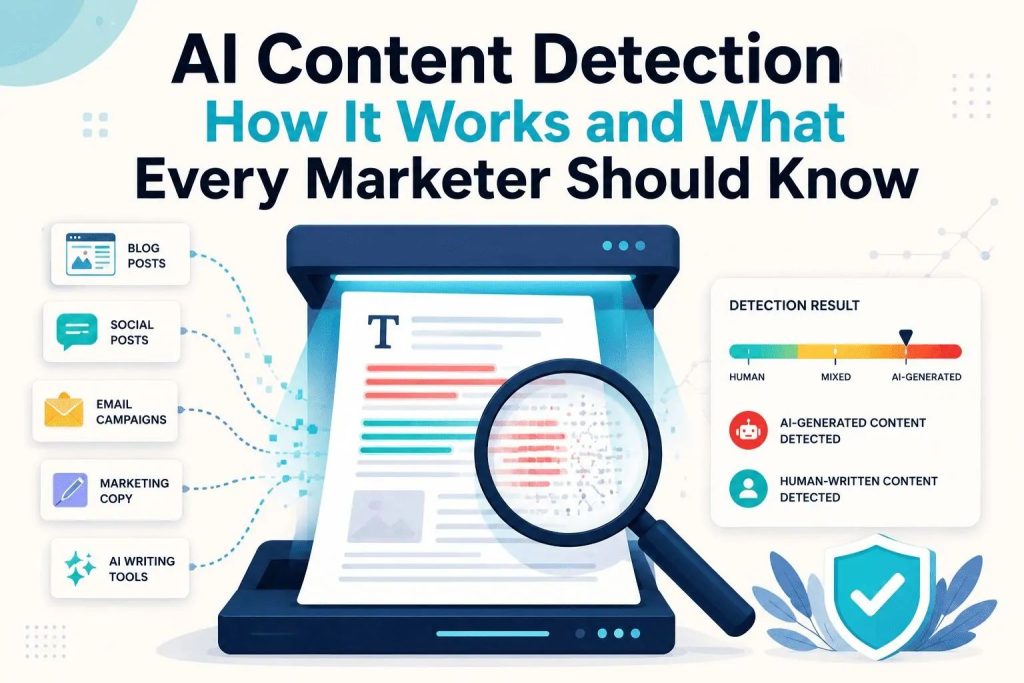
AI detectors don’t read your writing — they run it through math. Here’s exactly how they identify AI content, why they sometimes flag innocent writers, and what this means for your content strategy in India.
Every second article on the internet is now followed by a quiet question: “Will this get flagged as AI?”
And it’s a fair question. As of early 2026, ChatGPT alone has over 800 million weekly active users, with 40% of usage dedicated to writing and content tasks. Analysis of 65,000 English-language articles found that over 40% of new web content published since 2024 has at least 50% AI-generated text. The internet is shifting fast — and so is the technology built to detect it.
AI content detection tools are everywhere now. Clients ask for content to be checked before they approve it. Editors run submissions through them. Even HR teams scan job applications. And everyone seems to have a different opinion on whether they actually work.
The honest answer is: they work, but not perfectly. And if you’re writing content in India — or you’re not a native English speaker — there’s something important you need to know before you trust one of these tools, or let one judge your work.
Let’s break it all down.
What AI content detection actually is
AI content detection is the process of figuring out whether a piece of text was written by a human or generated by a tool like ChatGPT, Claude, or Gemini.
Tools like Originality.ai, GPTZero, Copyleaks, and Winston AI take your text, run it through their machine learning models, and return a probability score — “78% AI-generated” or “likely human-written.”
What most people don’t realize is that these detectors don’t read your content the way a human would. They don’t look for grammar errors or a robotic tone. They analyze it mathematically, using two core signals: perplexity and burstiness. Once you understand those two things, the whole system makes a lot more sense.
The two signals every AI detector measures
| Signal | Name | Description |
|---|---|---|
| Signal 1 | Perplexity | Measures how predictable the word choices are. AI tends to select the statistically “safest” next word, while humans often use unexpected phrasing, unusual metaphors, or indirect ways of expressing ideas. |
| Signal 2 | Burstiness | Measures how much sentence length varies. Humans naturally alternate between long and short sentences, whereas AI-generated text often maintains a more consistent and uniform sentence length, making it feel smooth but slightly robotic. |
📌 Perplexity: how surprising are your words?
Here’s a simple way to think about it. If you write: “The marketing campaign performed well last quarter” — every word there is exactly what you’d expect. Safe, predictable. That’s low perplexity.
But if you write: “The campaign flopped spectacularly, like a fish discovering it had been sold a treadmill” — that’s unexpected. Your brain paused at “fish” and “treadmill” because those words don’t usually appear in a sentence about marketing. That’s high perplexity.
AI models are trained to predict the most statistically likely next word. So AI-generated text tends to land in the low-perplexity zone — sensible, structured, unsurprising. Human writing wanders. We make odd word choices, use unexpected metaphors, throw in a reference that came to mind. Detectors use this gap to make their call.
📌 Burstiness: does your sentence length vary?
Humans write like this: a long sentence explaining a complex idea, then a short one. Then another long one that builds on it. One word. Then back to something longer.
AI tends to write every sentence at roughly the same length — 15 to 20 words, consistently, from beginning to end. That uniformity is mathematically detectable.
Detectors analyze the standard deviation of your sentence lengths across the full document. GPTZero considers burstiness scores below 0.30 as a strong AI signal. Human writing typically scores between 0.65 and 0.85. Combined with low perplexity, low burstiness is what triggers a high AI confidence score — one without the other usually isn’t enough for most tools to flag with confidence.
How accurate are AI detection tools?
Not as accurate as the companies selling them would like you to believe — and this matters.
| Statistic | Description | Source |
|---|---|---|
| 82% | Best real-world accuracy achieved by AI content detectors (tested across multiple AI models). | Digital Applied (2026) |
| 15–30% | Estimated proportion of AI-generated content that can evade detection even by the most advanced AI detectors. | Digital Applied (2026) |
| 61.3% | False positive rate for non-native English essays incorrectly flagged as AI-generated. | Stanford University / Liang et al. (2023) |
Lab-controlled studies sometimes show accuracy figures of 96–99% — but those tests use clean AI output from one model against clearly human writing. Real-world performance is far lower. When detectors are tested across GPT-4, Claude, and Gemini outputs simultaneously, no tool currently exceeds 85% accuracy. Accuracy also varies wildly depending on which AI model produced the text.
An arXiv study analyzing over a dozen popular detectors found that only five tools scored above 70% accuracy, with several misclassifying human writing as AI-generated due to overly formal phrasing or a neutral tone.
The false positive problem — and why Indian writers should pay attention
Here’s something that most global articles on AI detection don’t talk about: these tools are demonstrably biased against non-native English writers. And this is a real, researched, documented problem — not a theory.
In 2023, researchers from Stanford University’s departments of Computer Science, Electrical Engineering, and Biomedical Data Science published a peer-reviewed study evaluating seven widely-used GPT detectors. They tested the tools on two sets of essays: one from US eighth-grade students, and one from non-native English speakers via TOEFL (Test of English as a Foreign Language).
The results were stark. For native English (US student) essays, the detectors achieved near-perfect accuracy. But for the TOEFL essays — written by real humans, just not native English speakers — the average false positive rate across seven detectors was 61.3%. On nearly 20% of those essays, all seven detectors unanimously flagged them as AI-generated. The study found that 97.8% of TOEFL essays were flagged as AI by at least one detector.
What this means for Indian marketers:
A writer from Indore, Pune, or Bengaluru writing clean, correct, structured English business content can easily get flagged by Originality.ai or GPTZero — not because they used ChatGPT, but because their natural writing style scores low on perplexity and burstiness. Safe vocabulary, straightforward sentence structure, and formal tone are all traits of good non-native English writing. They’re also exactly what AI detectors are trained to flag.
The root cause, as the Stanford researchers put it: “The design of many GPT detectors inherently discriminates against non-native authors, particularly those exhibiting restricted linguistic diversity and word choice.”
More recent model updates from Originality.ai and GPTZero have made efforts to reduce this bias, and accuracy is improving. But the problem hasn’t gone away entirely. If you or your team is producing genuine content and getting flagged, this bias is almost certainly a contributing factor.
The main AI detection tools in 2026
Currently leads in real-world accuracy at around 82% across multiple AI models. Combines AI detection with plagiarism checking and fact-checking in one platform. Paid, but the most reliable option for content agencies vetting work before publishing. Has improved its handling of non-native English writers in recent updates.
One of the first widely available detectors, now with a user base of over 4 million. Provides sentence-level breakdowns showing exactly which parts triggered the flag — useful for editing rather than just a binary pass/fail score. Reports 86% accuracy in benchmark evaluations.
Used across 16,000+ academic institutions. Expanding into business content verification. Supports multiple languages, which makes it more relevant for teams working with Hindi or other regional Indian language content. Reports 77% accuracy on AI detection in independent evaluations.
Provides a confidence score with highlighted sentences. Popular with content agencies that want a quick review layer before publishing. Straightforward interface, no extra features. Good for spot-checking individual pieces but less reliable for large-scale content audits.
One important thing to know: run the same piece of content through all four of these tools and you’ll often get four different scores. That inconsistency tells you something important about how imprecise this space still is — and why you shouldn’t make high-stakes decisions based on any single tool’s output.
Does Google use AI content detection?
This is the question most Indian marketers actually care about, so let’s be direct.
Google has not publicly confirmed using any third-party AI content detection tool, nor has it revealed details of its internal detection methods. What it has said clearly and repeatedly is that it rewards high-quality content regardless of how it was produced — and penalizes low-quality, spammy content regardless of how it was produced.
Recent core updates have applied manual actions and algorithmic penalties to sites mass-publishing AI-generated content. But if you read Google’s actual documentation closely, the target isn’t “content written by AI.” It’s what Google calls “scaled content abuse” — content produced at volume with the primary goal of manipulating rankings, with no real editorial value behind it.
Passing an AI detection test is not the goal. Publishing content that genuinely helps your reader is. Those are different things — and chasing the former while ignoring the latter is where a lot of content strategies go wrong in 2026.
Sites like Bankrate, which have publicly disclosed using AI-assisted content workflows, have maintained stable rankings on competitive financial keywords — because they maintained editorial standards throughout. The tool used to write the draft isn’t what Google is targeting. The quality of what gets published is.
What actually triggers a high AI detection score
If you want to understand why content gets flagged — whether it’s your own writing or content you’re reviewing — these are the patterns that consistently trigger detection tools:
👉 Uniform sentence rhythm – If every paragraph reads at the same pace with roughly the same sentence lengths, that’s a low burstiness signal. Read your content out loud. If it sounds like a terms-and-conditions document without any variation, that’s a red flag for detectors.
👉 Safe, expected word choices throughout – If every phrase is the most obvious way to say something — no unexpected analogies, no conversational asides, no personality — the perplexity score drops. Human writers naturally take small detours. AI doesn’t.
👉 No original perspective or specific examples – AI doesn’t have opinions or lived experience. A 1,500-word article that doesn’t take a single position, reference an actual client situation, or include anything that couldn’t have been generated from a prompt — reads exactly like what it is.
👉 Templated heading structure – The “Intro → three H2s with bullet points → Conclusion” format appears in so much AI-generated content that detectors have started picking up on structural patterns, not just word-level signals. If your article looks like every other article on the topic, that’s a problem independent of the detection score.
👉 Overly formal tone for the context – AI defaults to a neutral, polished, professional register regardless of context. If a blog post reads like a white paper, or an email reads like a press release, detectors pick that up — especially when it’s consistent across the whole document.
The fix for all of these is not running your content through a “humanizer” tool. Those tools change words superficially without changing the underlying structure — and more sophisticated detectors catch them. The real fix is editing with genuine intent: making sure the content sounds like a person who actually knows the subject wrote it, added their own perspective, and gave a damn about whether it was useful.
A note on free AI detection tools
There are several free tools available — ZeroGPT, the free tier of Copyleaks, and others. They’re useful to know about, but treat their results with appropriate skepticism.
Free tools typically have older models, lower accuracy thresholds, and higher false positive rates than their paid equivalents. If you’re using one to get a rough sense of where your content sits, that’s fine. But don’t make professional decisions — like declining a writer’s invoice or rejecting a client deliverable — based purely on a free tool’s verdict.
If you’re running a content agency and a client wants content verified, use a paid tool and provide context alongside the score. A 68% detection score from Originality.ai on content written by an Indian writer doesn’t mean the content is AI-generated. It may mean the writer has a structured, formal English style — which is exactly what the Stanford research predicted.
QUICK SUMMARY
- AI detectors analyze perplexity (word predictability) and burstiness (sentence length variation) — not tone or grammar
- Real-world accuracy tops out at around 82% even for the best tools — and 15–30% of AI content slips past undetected.
- False positives are a documented problem: Stanford research found a 61.3% false positive rate for non-native English writers across seven major detectors
- Indian English writers are disproportionately at risk of being flagged for genuine human content due to formal, structured writing patterns
- Google targets low-quality, scaled content — not AI content specifically. Passing a detection test is not an SEO strategy
- The goal is content that genuinely helps the reader. That content will hold up to detection tools and rank better anyway
Need help with your content strategy?
We help Indian businesses create content that ranks, reads well, and doesn’t get flagged — for all the right reasons.