
Last updated – Aug 2026
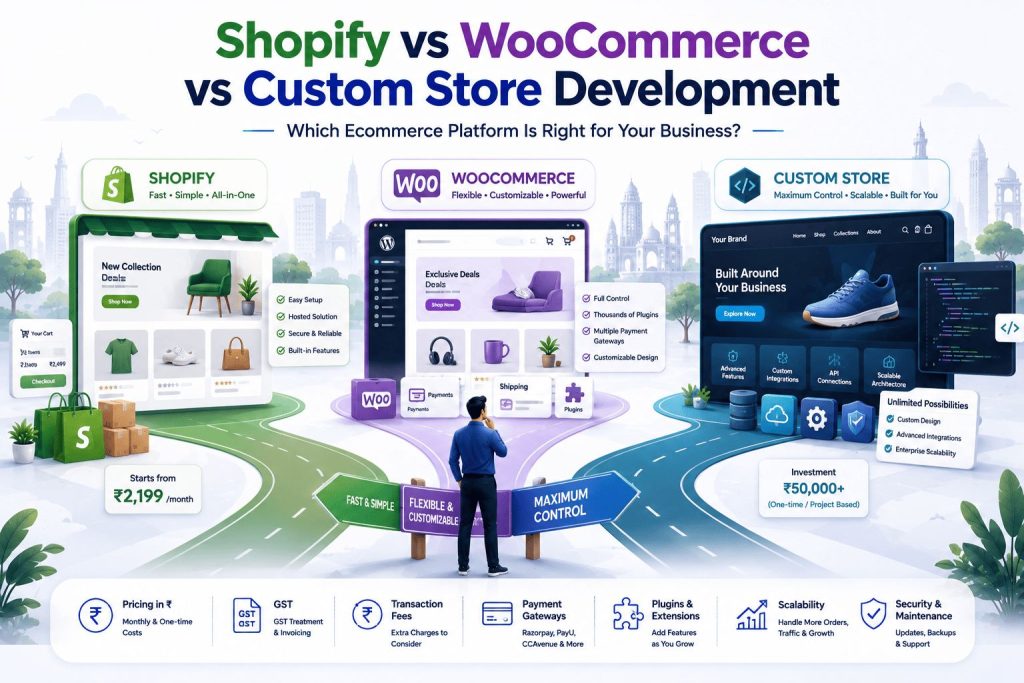
India’s ecommerce market crossed ₹7.5 lakh crore in 2024 and is projected to reach roughly $200 billion by 2026, with small and medium businesses now accounting for over 40% of digital commerce transactions. With that growth comes the same question thousands of Indian founders are typing into Google every month: Shopify, WooCommerce, or a custom build — which one is actually right for my business?
We’ve built on all three. This guide gives you the real 2026 numbers — pricing in rupees, GST treatment, hidden fees, and the platform-specific developments from the past year that most comparison articles still haven’t caught up on.
Understanding the Current Ecommerce Platform Landscape
Shopify continues to dominate globally with over 4.6 million live stores, while WooCommerce still powers close to a quarter of all online stores worldwide. Custom development remains the choice for businesses that need complete control and functionality no off-the-shelf platform can offer.
For Indian businesses specifically, the decision gets more complex because of GST compliance, multiple local payment gateways, regional language support, and cash-on-delivery optimisation — none of which are optional extras in this market, they’re baseline requirements.
Shopify: The Global Ecommerce Powerhouse
Overview
Shopify is a fully managed, hosted platform — hosting, security, checkout, and core functionality are all bundled in. For Indian founders who want to launch fast without hiring a developer, it remains the simplest path from zero to a working store.
2026 Pricing in India — and the GST catch
Shopify’s published India pricing for 2026:
- Basic: roughly ₹1,499–2,400/month depending on billing cycle, plus 18% GST
- Shopify (mid-tier): roughly ₹6,600/month, plus 18% GST
- Advanced: roughly ₹25,000/month, plus 18% GST
- Shopify Plus (enterprise): from roughly ₹1,65,000/month
💡 Important — most comparison articles skip this:
Shopify charges 18% GST on top of every subscription tier for Indian merchants. A ₹1,499 Basic plan is actually closer to ₹1,769/month once GST is added. Factor this into every price comparison you read, including this one.
The transaction fee stacking problem
Shopify Payments isn’t available in India. That means every Indian Shopify store pays a platform transaction fee (2% on Basic, dropping to 0.5% on Advanced) on top of a separate gateway fee from Razorpay, PayU, or whichever processor you use. For a store doing ₹10 lakh a month in sales on the Basic plan, that 2% platform fee alone works out to roughly ₹2,40,000 a year — money a WooCommerce store on the same revenue simply doesn’t pay, because WooCommerce has no platform-level transaction fee at all.
What’s new for Shopify in 2026
- Razorpay Magic Checkout is now deeply integrated with Shopify India — one-click checkout with pre-filled address and UPI auto-pay for returning customers, reportedly improving checkout conversion by 15–25% on Indian stores.
- Shopify added native AI features in 2026 — AI-generated product descriptions, smart inventory forecasting, and AI-powered on-site search — included in standard plans rather than requiring a separate app.
- Shopify POS was upgraded to version 11.0 in March 2026 with faster checkout flows, while WooCommerce shut down its own native POS entirely in February 2026 (see the WooCommerce section below).
Advantages for Indian businesses
Native support for Razorpay, PayU, CCAvenue, and Paytm. Seamless GST invoicing and tax calculation. Strong mobile performance, which matters enormously given over 80% of Indian ecommerce traffic is mobile. Multi-currency and international duty support for brands eyeing global expansion.
Limitations
Monthly costs plus GST plus transaction fees plus the average of 6 to 10 paid apps most Shopify merchants end up installing (each ₹800–₹8,000/month) can add up fast for a small business. Deep structural customisation usually means an expensive app or custom development, since theme editing alone won’t get you there.
WooCommerce: The WordPress-Powered Solution
Overview
WooCommerce turns a WordPress site into a full ecommerce store. It’s free, open-source, and appeals strongly to cost-conscious Indian founders — particularly ones who plan to grow through content and SEO rather than paid ads alone.
2026 Cost Breakdown
Cost item | Typical Indian range |
WooCommerce plugin | Free |
Managed hosting | ₹2,500 – ₹8,300+/month |
Domain | ₹800 – ₹1,200/year |
SSL certificate | ₹1,500 – ₹5,000/year |
Premium theme | ₹2,000 – ₹8,000 one-time |
Premium plugins | ₹4,000 – ₹16,600+/month |
Security & backups | ₹5,000 – ₹16,000/year |
All-in, expect ₹15,000–₹50,000 to set up and ₹30,000–₹1,20,000 a year to run — still meaningfully cheaper than Shopify for most stores once GST, transaction fees, and app subscriptions are factored into the Shopify side.
What’s new for WooCommerce in 2026
💡 Notable change: WooCommerce shut down its native point-of-sale system in February 2026. Brands needing in-person/retail checkout now have to use a third-party POS app at extra cost — a real gap versus Shopify’s improved native POS.
On the upside, WooCommerce’s core SEO advantage has only strengthened. Because it runs on WordPress, Yoast SEO and Rank Math give granular control over schema markup, breadcrumbs, canonical tags, and XML sitemaps — control Shopify’s more locked-down architecture still doesn’t fully match. For a business whose growth plan leans on organic search and content marketing, this remains WooCommerce’s clearest structural edge.
Strengths for Indian businesses
Unlimited customisation. A large, affordable pool of Indian WordPress developers. Superior content and blog-driven SEO. Flexible payment gateway integration with any provider offering an API. Strong handling of complex product catalogues — useful for B2B sellers with heavy variation and bulk pricing needs.
Challenges
You own security, backups, and performance — there’s no managed layer doing this for you by default. Hosting and maintenance quality directly affects site speed and, in turn, your search rankings and conversion rate.
Custom Ecommerce Development: The Bespoke Solution
Custom development means building a platform from scratch around your specific business logic. It’s the highest investment of the three, but for businesses with a genuinely unique model, it can be the only option that actually fits.
Tier | Investment (₹) | Typical scope |
Simple custom store | 3,00,000 – 8,00,000 | Basic ecommerce, mobile-responsive, payment gateway, admin panel |
Medium complexity | 8,00,000 – 25,00,000 | Multi-vendor, inventory management, CRM integration |
Enterprise | 25,00,000 – 1,00,00,000+ | Complex logic, multiple integrations, scalable architecture |
Ongoing maintenance typically runs 15–20% of the initial build cost annually. One real example: a Bengaluru-based skincare D2C brand grew from ₹3 lakh to ₹28 lakh in monthly revenue over 8 months after moving to a properly built store with conversion-focused custom development — the kind of jump that’s possible when the platform is built specifically around how a brand actually sells, not fitted into a generic template after the fact.
When custom development makes sense
Manufacturing businesses with complex B2B logic. Companies needing deep ERP or CRM integration. Businesses with a model that genuinely doesn’t fit a standard store — multi-location inventory, industry-specific compliance, or unusual pricing logic.
Risks
Timelines slip more often than not. Finding developers who understand both ecommerce best practice and your specific business is harder outside major cities. Security and updates become entirely your responsibility, with no managed platform layer to fall back on.
Platform Comparison Matrix — 2026
Feature | Shopify | WooCommerce | Custom |
Setup time | Hours | Days to weeks | Months |
Starting cost | ₹1,499–2,400/mo + 18% GST | ₹15,000–50,000 setup | ₹3,00,000+ |
Ongoing cost | Plan + txn fees + apps | ₹30,000–1,20,000/yr | 15–20% of build/yr |
Customisation | Limited without apps | High | Unlimited |
Technical skill needed | None | Moderate | High |
Native POS | Yes (v11.0, Mar 2026) | No (shut down Feb 2026) | Custom build |
SEO control | Good, less flexible | Best — full WP control | Fully custom |
India payment stack | Native, but 2 fees stack | Flexible, single fee | Custom integration |
2026 Trends Actually Shaping Platform Choice
AI is no longer a differentiator between platforms — it’s now baseline. What matters in 2026 is how deeply AI is built in versus bolted on. Shopify’s AI has direct access to your full store data out of the box; WooCommerce’s AI capabilities still depend on which plugins you’ve connected, which means more setup but also more choice in which AI tools you use.
Checkout experience has become a genuine differentiator, not a nice-to-have. Razorpay Magic Checkout’s integration with Shopify India — one-click, UPI auto-pay, pre-filled address — is reportedly lifting conversion 15–25% on stores that have switched it on. WooCommerce stores can get a similar Razorpay plugin, but without the same native, pre-integrated checkout experience.
Social commerce continues to matter enormously in India, with Instagram Shopping and WhatsApp Business driving real, measurable sales volume. Shopify has the more polished native social selling tools; WooCommerce covers the same ground through plugins, with more setup effort but no less capability once configured properly.
Making the Right Choice: Decision Framework
✅️ Startups and small businesses (revenue under ₹50 lakh)
WooCommerce usually offers the better value here — lower ongoing cost, and India has no shortage of affordable WordPress developers. If you have zero appetite for any technical involvement at all, Shopify’s managed simplicity is worth the extra cost despite GST and transaction fees eating into thin margins.
✅️ Growing businesses (₹50 lakh – ₹5 crore)
Shopify becomes genuinely attractive here — the platform fee stops being the dominant cost line, and the time saved not dealing with hosting, security, and plugin maintenance lets founders focus on growth. WooCommerce remains fully viable if you already have a reliable developer relationship.
✅️ Large enterprises (over ₹5 crore)
Custom development or Shopify Plus become the real options. At this scale, the question isn’t cost — it’s whether an off-the-shelf platform can actually accommodate your specific operational workflows without constant workarounds.
Still Deciding Between Shopify, WooCommerce, or Custom?
You don’t have to figure this out alone. We’ve built and migrated stores on all three platforms for Indian businesses — from a first Shopify launch to a fully custom build for complex catalogues. Tell us what you’re selling and how you sell it, and we’ll tell you honestly which platform fits, then build it for you.
