
If you sell on Amazon India or manage advertising campaigns for clients who do, you’ve probably come across the Amazon Sponsored Ads Certification at some point. Maybe someone in a seller group mentioned it. Maybe Amazon Ads Academy showed up in your dashboard. Or maybe you’ve been wondering whether it’s actually worth the time.
Here’s what most guides won’t tell you upfront: this certification is completely free, takes less than two weeks to prepare for even if you’re starting from scratch, and is increasingly being asked for by Indian agencies and brands before they hire or onboard ad managers.
This guide covers everything you need — what the certification actually tests, how to prepare for it properly, what the assessment looks like, and honestly, whether it’s worth pursuing based on where you are in your career or business right now.
What Is the Amazon Sponsored Ads Certification?
The Amazon Sponsored Ads Certification is an official credential issued by Amazon through its Amazon Ads Academy platform. It validates that you understand how to plan, set up, and optimize sponsored advertising campaigns on Amazon — specifically Sponsored Products, Sponsored Brands, and Sponsored Display.
It is not a course you enroll in and pay for. It is a free certification program where you study Amazon’s own training materials and then take an assessment. If you pass, Amazon issues you a certificate that you can share on LinkedIn, add to your resume, or use to demonstrate capability to clients.
Amazon Ads certifications are official credentials issued by Amazon that validate your knowledge of Amazon’s advertising platform. You can access all official training and take certification exams directly through the Amazon Ads Academy, also called the Learning Console. Only certifications earned here are officially recognized.
There are two levels of the Sponsored Ads Certification:
Sponsored Ads Foundations Certification — covers the fundamentals of how Amazon advertising works, the core ad formats, basic campaign setup, targeting options, bidding strategies, and campaign policies. Designed for people newer to Amazon advertising or those wanting a solid structured foundation.
Sponsored Ads Advanced Certification — goes deeper into campaign optimization, advanced bidding, reporting, attribution, and strategies for scaling spend profitably. The Sponsored Ads Advanced certification requires an 80% score on a timed assessment. You’ll gain earlier access to beta features, qualify for agency partner programs, and build systematic frameworks that compound margin gains quarter over quarter.
Both are free. Both are available on Amazon Ads Academy. And both expire after 12 months, so you need to renew annually.
Who Should Get This Certification?
Before spending time on any certification, it’s worth being honest about who it actually helps.
👉 Indian Amazon sellers managing their own ads
Today, Indian sellers spend over 35 percent of their Amazon revenue on ads. That number keeps rising every year. If you’re self-managing campaigns on Amazon.in and spending a meaningful amount — say ₹20,000 or more per month on ads — getting certified gives you a structured framework that most self-taught sellers never develop. The training covers things like proper keyword match types, bid optimization, negative keywords, and campaign structure that genuinely reduces wasted spend.
👉 Digital marketing professionals and freelancers
Many agencies now demand an Amazon Ads certified professional before onboarding clients. Brands trust certified experts more. If you’re a freelancer offering Amazon PPC management or a digital marketing professional looking to add ecommerce advertising to your skill set, this certification is a straightforward credential that signals competence to prospective clients.
👉 Agency teams handling Amazon advertising
For agencies managing Amazon advertising for multiple clients, having certified team members strengthens client proposals and pitches. It’s increasingly common for larger Indian D2C brands to ask whether an agency’s team is Amazon-certified before signing a contract.
👉 Students and freshers entering ecommerce marketing
Amazon offers it completely free. This makes it attractive for Indian students and freelancers. No hidden fees exist. You can retake exams if needed. Amazon encourages learning, not penalties. Paid courses cost between ₹15,000 and ₹50,000. Amazon certification costs nothing. Yet, it carries higher credibility because Amazon issues it directly, brands trust it more.
Who probably doesn’t need to prioritize this right now
If you’re a brand new seller who hasn’t launched products yet, getting certified before you have a live account to practice on is less effective. The certification content makes a lot more sense once you’ve actually run a few campaigns and hit real problems — like a campaign spending too fast, or auto-targeting eating your budget with irrelevant search terms. Context helps.
The Two Certifications Explained
🏅 Sponsored Ads Foundations Certification
This is the starting point. The Foundations certification covers everything a new-to-intermediate advertiser needs to understand about Amazon’s sponsored advertising ecosystem.
What it covers:
The exam tests your understanding across several core areas. Here’s what you should expect:
Amazon’s ad formats and when to use each
The three main formats covered are Sponsored Products, Sponsored Brands, and Sponsored Display. Each has a different purpose, different placement, and different ideal use case.
Sponsored Products are the most commonly used — these are the ads that appear in search results and on product detail pages, looking almost identical to organic listings. They are pay-per-click and work on a keyword or product targeting basis. If you’re a seller wanting to drive sales for specific ASINs, Sponsored Products is usually where you start.
Sponsored Brands appear as banner-style ads at the top of search results, showing your brand logo, a custom headline, and multiple products. They’re better suited for brand awareness and driving traffic to a brand store or a curated product selection.
Sponsored Display is a newer format that allows you to retarget shoppers who viewed your product but didn’t purchase, or reach audiences based on shopping interests. It can run both on and off Amazon, which makes it different from the other two.
Targeting options
The certification goes into depth on the two main targeting approaches.
Automatic targeting lets Amazon decide which search terms and products to show your ads against, based on the content of your product listing. It’s useful when you’re starting out and want to discover what search terms customers actually use.
Manual targeting gives you control — you specify exact keywords, phrase matches, or broad matches, or you target specific ASINs or product categories. Amazon recommends that candidates have at least six months of experience in advertising on Amazon before taking the certification exam. That recommendation exists precisely because understanding the difference between match types in practice is harder than understanding them in theory.
Bidding strategies
The exam covers three bidding approaches — dynamic bids (down only), dynamic bids (up and down), and fixed bids. Each one tells Amazon how to adjust your bid in real time based on the likelihood of a conversion.
Down-only means Amazon can reduce your bid if it thinks a click is unlikely to convert, but will never raise it above what you set. Up and down means Amazon can both raise and lower your bid based on conversion likelihood. Fixed bids mean Amazon uses your exact bid regardless of the situation.
Most new advertisers start with down-only bidding because it prevents overspending. Up and down is more aggressive and can work well on high-converting products where you want to maximize visibility.
Campaign structure and budgets
Understanding how campaigns, ad groups, and ads are organized is a core exam topic. The certification tests whether you know how daily budgets work, what happens when a campaign runs out of budget mid-day, and how to structure campaigns efficiently to make optimization easier.
Retail readiness
One topic many people don’t expect on this exam is retail readiness — whether your product listing is actually in good enough shape to convert the traffic your ads drive. A product with three reviews, a blurry main image, and a thin description won’t convert well no matter how well-optimized the campaign is. The exam covers what constitutes a retail-ready listing and why it matters before investing in ads.
Amazon’s advertising policies
The Foundations exam includes policy-related questions that catch many people off guard if they haven’t read through Amazon’s ad content guidelines. Key things to know: Amazon does not allow comparative advertising that directly names competitor brands, political content is not allowed in ad copy, and there are specific rules around pricing claims in ad creative.
🏅 Sponsored Ads Advanced Certification
The Advanced certification builds on the Foundations level and is intended for people actively managing campaigns who want to go deeper on optimization and strategy.
What it adds:
Advanced campaign optimization
The Advanced exam goes into detail on using advertising reports to identify and fix underperforming campaigns. This includes understanding the Search Term Report, the Campaign Performance Report, and how to use data to make systematic improvements rather than guessing.
ACoS and TACoS — understanding the difference
ACoS (Advertising Cost of Sales) is the most commonly tracked Amazon advertising metric — it’s your ad spend divided by your ad-attributed sales, expressed as a percentage. The Advanced certification goes deeper into why ACoS alone is an incomplete picture.
TACoS (Total Advertising Cost of Sales) divides your ad spend by your total revenue — not just ad-attributed revenue. This matters because as a brand grows, ads drive organic rank improvements that lead to organic sales. A campaign with a high ACoS might have a healthy TACoS if it’s also boosting organic performance. This is one of the concepts that genuinely separates experienced Amazon advertisers from beginners, and the Advanced certification covers it properly.
Budget management and scaling
How to scale spend profitably without simply increasing daily budgets and hoping for the best. The exam covers how to identify which campaigns and ad groups are ready to scale, how to manage budget distribution across a portfolio of campaigns, and how to use dayparting and placement adjustments strategically.
Attribution and measuring true impact
Amazon’s attribution tools allow advertisers to track how their advertising influences customer behavior beyond the immediate click — including brand halo effects where a customer clicks an ad for one product and ends up buying a different product from the same brand. The Advanced exam tests your understanding of these attribution models and how to use them in reporting.
How to Prepare for the Amazon Sponsored Ads Certification
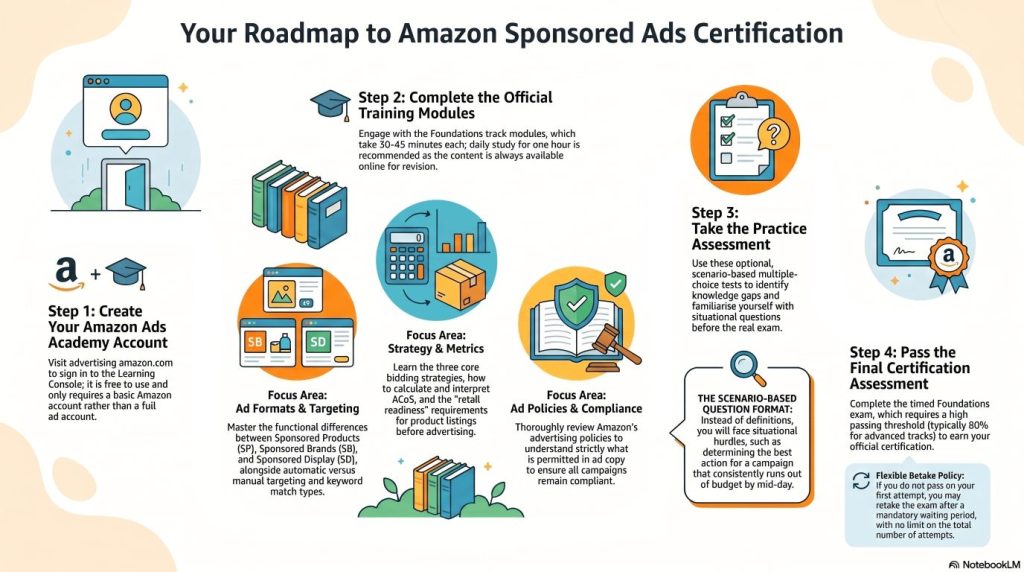
Step 1: Create an Amazon Ads Academy Account
Go to advertising.amazon.com and sign in. Navigate to the Learning Console (Amazon Ads Academy). The platform is free to use and doesn’t require an active ad account — you just need an Amazon account.
Once inside, you’ll find course modules organized by certification track. Start with the Sponsored Ads Foundations track.
Step 2: Go Through the Official Training Modules
Each module runs between 30 and 45 minutes. The Foundations track has several modules covering the core topics. Don’t skip any of them — even the policy modules that feel dry. Each module lasts 30 to 45 minutes. You can study at your pace because content stays online, revision becomes easy. Study daily for one hour.
Take notes as you go. The key concepts to focus on:
- The difference between Sponsored Products, Sponsored Brands, and Sponsored Display — and when each is appropriate
- Automatic vs manual targeting, and keyword match types
- The three bidding strategies and when each makes sense
- How ACoS is calculated and what it tells you
- What makes a product listing retail-ready before advertising
- Amazon’s ad policies — especially what is and isn’t allowed in ad copy
Step 3: Take the Practice Assessment
Amazon Ads Academy offers optional official practice assessments for select certifications to help you gauge your readiness before the final exam. Take the practice assessment before attempting the real one. It gives you a feel for the question format and helps identify gaps in your understanding.
The questions are multiple choice and scenario-based. Amazon doesn’t ask simple definition questions — they present a situation and ask what the right action is. For example: “A seller’s campaign is consistently running out of budget by noon. What is the most appropriate action?” Understanding the why behind each concept, not just the what, is what gets you through.
Step 4: Attempt the Certification Assessment
The Foundations assessment has a time limit and requires a passing score to earn the certification. The Sponsored Ads Advanced certification requires an 80% score on a timed assessment. The Foundations exam has a similar passing threshold.
If you don’t pass on the first attempt, you can retake it. Amazon doesn’t penalize retakes — there’s a waiting period between attempts but no limit on how many times you can try.
How Long Does Preparation Take?
For beginners, it takes two weeks. For experienced marketers, it takes five days.
If you have zero background in Amazon advertising, set aside 7 to 10 hours of study across two weeks — roughly an hour a day going through the modules, taking notes, and reviewing areas where you feel less confident. If you’ve been running Amazon ads for at least a few months, five focused hours of going through the official material is usually enough.
Is the Amazon Sponsored Ads Certification Worth It?
This is the question most people actually want answered, and the honest answer is: it depends on what you’re expecting from it.
What it genuinely does
✅️ Gives you a structured foundation. Most Indian sellers and marketers learn Amazon advertising through trial and error — spending money, watching what happens, adjusting. That works but it’s slow and expensive. The certification curriculum gives you the complete framework in a compressed, structured format. You’ll understand why things work, not just what to do.
✅️ Adds credibility when you’re pitching clients. If you’re a freelancer or agency professional, a certificate from Amazon itself carries more weight than a generic digital marketing certification. Clients who sell on Amazon understand that Amazon issued this credential — it’s not a third-party course certificate. That distinction matters.
✅️ It’s completely free. There is no financial downside to getting certified. The only investment is time. For Indian students, freshers, and professionals looking to add a credible credential without spending ₹15,000 to ₹50,000 on a course, this is a no-brainer.
✅️ Helps you stay current. Since the certification expires every 12 months, it gives you a structured reason to stay up to date with changes to Amazon’s platform annually.
What it won’t do
❌ It won’t make you an expert overnight. The certification validates foundational knowledge. Running profitable campaigns at scale requires experience — understanding how to read data, how different product categories behave differently, how to manage campaigns during peak seasons like Diwali or Prime Day. That comes from practice, not from passing an exam.
❌ It won’t guarantee clients or jobs on its own. The certification is a supporting credential, not the primary reason someone will hire you. Your ability to show real campaign results — ACoS improvements, revenue growth, case studies from actual accounts — matters more than the badge. The certification helps you get in the door; results are what keep you there.
❌ It won’t replace hands-on experience. If you’ve never run a campaign on Amazon, study the material and take the certification — but also try to run even a small test campaign on a live account. Everything in the exam makes more sense when you’ve actually seen it in Seller Central.
Amazon Sponsored Ads Certification for Indian Marketers: A Few Specific Things to Know
Amazon India vs Amazon Global
The certification curriculum is based on Amazon’s global advertising platform, which is largely consistent with Amazon India’s (Amazon.in) advertising console. The concepts, ad formats, bidding mechanics, and policies covered in the exam apply directly to advertising on Amazon India. You don’t need a separate India-specific certification.
Career Value in India
The Indian ecommerce advertising space is growing fast. More D2C brands are launching on Amazon India, more agencies are offering Amazon PPC as a service, and the demand for people who actually understand how to run profitable campaigns is increasing. In the Indian market, competition is intense. Certified professionals get better roles. They also manage higher budgets confidently.
For a fresher entering digital marketing in India, the Amazon Sponsored Ads Certification combined with hands-on practice on even a small seller account is a strong differentiator in job applications.
The Advanced Certification Is Underutilized in India
Most Indian Amazon marketers stop at the Foundations certification. Very few pursue the Advanced level. If you’re already comfortable with the fundamentals and actively managing campaigns, pursuing the Advanced certification gives you a genuine edge — both in knowledge and in how you position yourself to clients.
Key Concepts to Understand Before Your Assessment
These are the areas that trip up most candidates. Make sure you understand each one clearly before attempting the exam.
🔴 Match types and when to use them
Broad match — your ad can show for searches containing your keyword in any order, plus related searches. Widest reach, least control.
Phrase match — your ad shows when the search contains your keyword phrase in the correct order, with or without additional words before or after. Moderate reach, moderate control.
Exact match — your ad shows only when someone searches for your exact keyword or very close variations. Tightest control, lowest volume.
Knowing which match type is appropriate for a given objective is a core exam question.
🔴 Negative keywords
Negative keywords tell Amazon which searches you don’t want your ad to appear for. If you sell premium headphones and keep getting clicks from searches for “cheap headphones,” adding “cheap” as a negative keyword stops that spend. The exam tests whether you understand how to use negatives strategically to improve campaign efficiency.
🔴 Retail readiness criteria
Amazon expects a product to meet certain criteria before it can convert ad traffic effectively. The exam covers what these are: a minimum number of reviews, a certain star rating, high-quality images, complete listing content, and product availability. Running ads on a listing that doesn’t meet these criteria wastes budget.
🔴 The relationship between bids, budget, and ACoS
Understanding that ACoS is a result of bid levels, conversion rate, and product price — and that adjusting one affects the others — is core to the Advanced exam. A product with a ₹2,000 price point, a 10% conversion rate, and a ₹20 cost per click will have a specific ACoS. Knowing how to calculate this and what it means for campaign profitability is fundamental.
🔴 Campaign budget types
Daily budgets on Amazon are averages — Amazon can spend up to 10% above your daily budget on a given day but won’t exceed your monthly cap (daily budget × 30.4). The exam tests whether you understand this and can apply it to scenario-based questions.
After You Get Certified: What to Do Next
Getting certified is the beginning, not the end.
📌 Practice on a live account. Even a small seller account with a modest daily budget — even ₹300 to ₹500 per day — gives you a live environment to apply what you learned. Data from real campaigns teaches you things no exam can.
📌 Pursue the Advanced Certification. Once you’re comfortable with Foundations concepts, move directly to the Advanced track. The concepts build on each other and the Advanced material significantly deepens your understanding of campaign optimization.
📌 Explore other Amazon Ads certifications. Sponsored Ads Certification covers self-serve tools including Products, Brands, and Display, and is ideal for sellers. The DSP Certification focuses on programmatic, off-Amazon advertising and audience targeting, making it better suited for agencies and advanced advertisers. If you eventually want to work with larger brands or agencies managing Amazon DSP campaigns, the DSP Certification is the logical next step after the Sponsored Ads track.
📌 Add it to your LinkedIn profile. Amazon Ads certifications can be added directly to LinkedIn’s Licenses and Certifications section. When potential clients or employers search for Amazon advertising expertise, a current Amazon-issued certification on your profile is a visible signal.
📌 Renew annually. Certifications expire after 12 months to ensure professionals stay updated with platform changes. You must retake the assessment annually to renew your status. Set a calendar reminder a month before expiry so you’re not scrambling to renew at the last minute.
Digital Dawn is a digital marketing agency based in Indore helping Indian businesses grow through SEO, social media marketing, performance advertising, and ecommerce strategy. If you’re looking to grow your Amazon presence or need help with your digital marketing strategy, get in touch with our team.
