
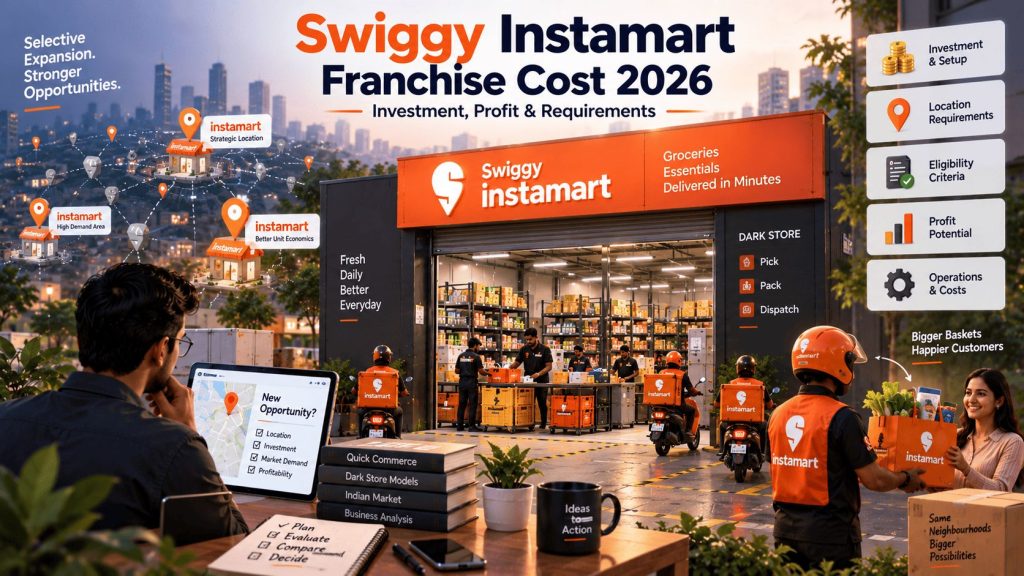
Here is a number that will tell you almost everything you need to know about the state of Swiggy Instamart’s expansion strategy in 2026:
In Q4 FY25, Swiggy added 316 dark stores in a single quarter. In Q4 FY26 — exactly one year later — they added 7.
This is not a company stumbling. Swiggy Instamart’s Q4 FY26 revenue grew 68.8% year-on-year. Its average order value climbed to ₹700 — the highest in the quick commerce sector, ahead of both Blinkit and Zepto. Its contribution margin improved from -5.6% to -1.8% in twelve months, on track for breakeven.
The dramatic slowdown in new stores was a deliberate strategic call. Swiggy’s CEO Sriharsha Majety said it directly: the next phase of Instamart will be defined by anticipating consumer needs rather than merely adding stores. They are building differentiation — through a clean-label private brand, larger basket sizes, and non-grocery category expansion — rather than racing Blinkit to a higher store count.
What does this mean if you want to be an Instamart dark store partner in 2026?
It means you are applying to a platform that is more selective than ever. It is not handing out approvals in bulk the way it did during the expansion blitz. But it also means that if your location gets approved, you are entering a less crowded, more profitable network — and you are partnering with a company that is listed on the BSE and NSE, has ₹15,053 crore in cash, and has earmarked ₹4,475 crore specifically for Instamart infrastructure.
That context matters. And you will not find it in most franchise articles.
If you want help evaluating whether your location and capital are a fit for Instamart — or whether Blinkit or Zepto might be a better match for your situation — our Quick Commerce & Dark Store Consulting team is available for exactly that conversation.
Swiggy Instamart in 2026 — The Numbers You Should Know
Swiggy is India’s second-largest quick commerce player with approximately 27% market share, operating 1,143 dark stores across 129 cities as of March 2026 — the widest geographic spread of any quick commerce platform in India, significantly ahead of Blinkit’s 30+ cities and Zepto’s 66 cities.
The full financial picture from Q4 and FY26 quarterly results:
- Dark stores: 1,143 across 129 cities, covering 4.8 million sq ft
- Orders per dark store per day (Q4 FY26): 1,093 — recovering from a post-expansion low of 985 in Q1 FY26
- Average order value (AOV): ₹700 in Q4 FY26, up 32.8% YoY — highest in the sector
- Instamart GOV Q4 FY26: ₹7,881 crore (+68.8% YoY)
- Contribution margin trajectory: From -5.6% (Q4 FY25) → -2.5% (Q3 FY26) → -1.8% (Q4 FY26) → -1.1% (March 2026 exit rate)
- Dark store capacity utilisation: 40%, up from 36% a year ago
- FY26 net loss (Instamart standalone): ₹3,835 crore
The ₹700 AOV stands out. It reflects a deliberate push into non-grocery categories — electronics, beauty, home essentials, apparel — through Swiggy’s “Quick India Movement” initiative. A platform where customers are spending ₹700 per order instead of ₹500 creates meaningfully better unit economics for dark store operators, because your commission on each order is larger even if the order volume is lower.
One number to understand clearly: Instamart’s standalone loss of ₹3,835 crore in FY26. This tells you that the quick commerce arm is still in investment mode. However, the loss-per-order trajectory is improving rapidly, the cash position is strong, and the contribution margin is weeks away from breakeven at time of writing. Swiggy without Instamart is already profitable. The quick commerce business is the growth bet, not a fundamental problem.
Is It Actually a Franchise?
Swiggy does not call it a franchise, and it is worth understanding why.
There is no branded outlet you are setting up. You are not buying territorial rights. There is no fixed royalty paid to Swiggy. What Instamart offers is a dark store partnership — you provide the space, the capital, and the operational management; Swiggy provides the technology, the customer base, the delivery infrastructure, and a revenue-sharing arrangement.
Swiggy runs Instamart through a combination of company-operated dark stores and partner-operated Instastores. The proportion varies by city. In some cities, most stores are company-operated. In others, partner-operated stores do the majority of the work.
For entrepreneurs evaluating this, the distinction matters because it affects how Swiggy decides whether to approve your application. If the company already operates dark stores in your area, the likelihood of them approving a competing partner store there is lower. Your strongest application comes from a city or zone where Instamart is expanding but hasn’t yet built its own store.
The Two Routes Into the Instamart Partner Programme
🫡 Route 1: Dark Store Operating Partner You invest in the warehouse infrastructure, stock inventory, hire and manage staff, and operate the day-to-day fulfilment. Swiggy handles tech, the app, order routing, and delivery. You earn on a revenue-share or commission basis on every order processed through your store. This is the primary model discussed in this guide.
🫡 Route 2: Property Rental You own a suitable commercial space that Swiggy wants to use as a company-operated dark store. Swiggy leases your property at a monthly rental — you are not involved in operations. This is a passive model with lower returns but zero operational involvement. If you are evaluating this specifically, our location assessment consulting helps you determine whether your space meets Swiggy’s size and location criteria before you approach them.
Investment Breakdown 2026 — What You Actually Need
Swiggy Instamart has the lowest entry investment of the three major quick commerce platforms in India. This is its most significant advantage for first-time entrepreneurs and those with limited capital.
| Cost Component | Tier 2 City | Metro City |
|---|---|---|
| Franchise / Onboarding Fee | ₹0 | ₹0 |
| Store Setup (shelving, storage, equipment) | ₹4 – 8 lakh | ₹10 – 18 lakh |
| Initial Inventory | ₹3 – 6 lakh | ₹8 – 15 lakh |
| Property Deposit (2–3 months rent) | ₹2 – 4 lakh | ₹3 – 8 lakh |
| Working Capital (first 3 months operations) | ₹2 – 4 lakh | ₹4 – 8 lakh |
| Miscellaneous (legal, civil work, utilities) | ₹1 – 2 lakh | ₹2 – 4 lakh |
| Total Estimated Investment | ₹12 – 24 lakh | ₹27 – 53 lakh |
💡 The critical difference from Blinkit and Zepto: no bank guarantee requirement.
Blinkit partners are typically required to provide a bank guarantee of approximately ₹30 lakh. Zepto’s COFO partners face a bank guarantee requirement of ₹50–70 lakh. Swiggy Instamart’s partnership model does not include this requirement in the way the other platforms structure it — which is why the total capital needed is substantially lower.
For a Tier 2 city entrepreneur with ₹15–20 lakh to invest, Instamart is the only major quick commerce platform where that investment level is realistic. For a metro investor, the ₹27–53 lakh range compares favourably to Blinkit’s ₹38–61 lakh and Zepto’s ₹89 lakh to ₹1.23 crore total capital requirement.
⚡ Important note on inventory ownership: Unlike Zepto’s COFO model, Swiggy Instamart’s partner model requires you to own and fund the inventory in your store. You buy the stock, and you earn the retail margin when Swiggy sells it to customers. This is fundamentally different from Zepto, where the platform owns the inventory. The implication: you carry inventory risk, including spoilage on fresh categories, but you also have more direct control over what you stock and how you manage it.
Space and Location Requirements
Swiggy Instamart is somewhat more flexible on space requirements than its competitors, which partly explains why it has been able to expand into 129 cities — many of which are smaller markets where premium warehouse space is not available.
Space requirements:
- 800 to 1,200 sq ft for compact formats in Tier 2 cities
- 1,000 to 3,000 sq ft for standard dark stores in metros
- Ground floor strongly preferred — rider pick-up access is critical
- Cold storage units for dairy, fresh produce, and medicines
- Basic three-phase electrical connection
Location requirements:
- Must be within a dense residential zone — Instamart’s delivery radius is 2–3 km
- Close proximity to residential apartments and high-density housing
- Easy two-wheeler access for delivery riders
- Operating in a city where Instamart is active (129 cities and growing)
- Ideally in a zone where Swiggy does not already operate a company-owned dark store
The Tier 2 city opportunity:
Instamart’s 129-city footprint is its single biggest structural advantage for entrepreneurs outside the eight metro cities. If you are in Indore, Bhopal, Jaipur, Lucknow, Coimbatore, Vizag, Rajkot, or dozens of other cities — there are Instamart opportunities that Blinkit has not yet entered and that Zepto is only beginning to explore. In these markets, being an early Instamart partner means lower property costs, lower competition from neighbouring dark stores, and higher visibility to the platform’s expansion team.
How You Earn — Revenue Model
Swiggy Instamart’s partner revenue model involves you purchasing inventory (from your own distributors or Swiggy’s supply chain partners), stocking your dark store, and earning the difference between what you paid for the stock and what Swiggy collects from the customer — minus Swiggy’s platform commission.
Commission structure: Swiggy charges partners a platform commission of approximately 15% to 25% of order value, varying by category. Grocery and staples typically attract the lower end of this range. Non-grocery categories — electronics, health, personal care — tend to attract higher commissions.
What this looks like in practice:
| Category | Typical Swiggy Commission | Your Gross Margin (on MRP) | Net Margin After Commission |
|---|---|---|---|
| Staples / Atta / Rice | 15% | 8–12% | Marginal or negative |
| Packaged FMCG | 18% | 12–18% | 1–5% |
| Dairy and fresh | 20% | 15–20% | 0–5% |
| Personal care | 22% | 20–30% | 5–10% |
| Electronics / accessories | 20–25% | 25–40% | 10–20% |
The single most important operational insight: your profitability depends heavily on your category mix. Dark store partners who rely too heavily on staples and low-margin FMCG struggle significantly. Partners who successfully stock and move higher-margin non-grocery categories — which is precisely what Swiggy’s strategy is designed to encourage — earn meaningfully better. Swiggy’s own ₹700 AOV reflects this shift. Higher-value baskets from non-grocery categories are where the economics work best.
Profit Projections — Real Numbers
Instamart dark stores process fewer orders per day than Zepto and Blinkit — the Q4 FY26 per-store average is 1,093 orders/day versus Zepto’s 2,140. However, the ₹700 AOV partially compensates for this volume gap.
| Monthly Orders | AOV | Gross GMV | Avg Net Margin (12%) | Operating Costs | Net Profit |
|---|---|---|---|---|---|
| 15,000 (500/day) | ₹700 | ₹1.05 Cr | ₹12.6 lakh | ₹9–11 lakh | ₹1.6–3.6 lakh |
| 24,000 (800/day) | ₹700 | ₹1.68 Cr | ₹20.2 lakh | ₹11–13 lakh | ₹7.2–9.2 lakh |
| 32,790 (1,093/day) | ₹700 | ₹2.3 Cr | ₹27.6 lakh | ₹12–15 lakh | ₹12.6–15.6 lakh |
The 1,093 orders/day is the Q4 FY26 per-store average from Swiggy’s published quarterly results — this is the network average, not a new store. New stores typically start at 100–300 orders/day and ramp over 3–6 months.
Metro partners with stabilised stores report net profit of ₹1.5 to ₹3 lakh per month — consistent with an investment payback of 12 to 24 months depending on entry investment and store ramp pace. This is faster payback than the Zepto COFO model and comparable to Blinkit for an equivalent investment level.
ROI and Payback Period
For a Tier 2 city investment of ₹15–20 lakh, an Instamart partner store reaching 400 orders/day by month 4 and clearing ₹1–1.5 lakh net profit monthly would see full payback in 12 to 18 months. This is the most accessible quick commerce investment by payback period in the current market.
For a metro investment of ₹30–50 lakh, a mature store averaging 800 orders/day and generating ₹3 lakh net monthly would see payback in 16 to 22 months.
These figures assume consistent operational performance and a good category mix. They are estimates — use our Dark Store Franchise ROI Calculator to model your specific investment, expected order volumes, and category mix before committing.
Eligibility — Who Instamart Is Looking For
Swiggy’s partner approval criteria have become more selective in 2026 as the platform shifts from aggressive expansion to quality-over-quantity.
Financial capacity:
- Ability to invest ₹12–50 lakh depending on city tier and store format
- Working capital to maintain inventory levels without straining cash flow
- No bank guarantee requirement — but adequate cash reserves for operational resilience
Operational profile:
- Retail, FMCG, or grocery industry experience is valued but not mandatory
- Ability to manage a team of 4 to 15 staff across shifts
- Basic technology literacy — Swiggy’s warehouse management system needs to be operated daily
- Willingness to personally manage or closely oversee operations, especially in the first six months
Space and location:
- Suitable commercial space in a city where Instamart is expanding or active
- Ground floor preferred, cold storage capable
- Location must pass Swiggy’s internal demand mapping
💡 Important signal: Swiggy’s partner team proactively reaches out to operators in cities on their expansion roadmap. Inbound applications from operators in well-served metro zones take longer to qualify and are less likely to be approved quickly. If you are in a Tier 2 or Tier 3 city, your application has a better chance of progressing in a shorter timeframe.
Documents Required
| Document | Requirement |
|---|---|
| GST registration certificate | Mandatory |
| FSSAI license | Mandatory for food product handling |
| Shop and Establishment license | Mandatory |
| PAN card | Mandatory |
| Bank account + cancelled cheque | Mandatory |
| Property ownership / lease agreement | Mandatory |
| Aadhar card | Identity proof |
| Business registration | If operating as a company or firm |
| Space photographs and floor plan | For location assessment |
One document that most Blinkit and Zepto articles mention but Instamart articles often skip: the FSSAI license is mandatory for Instamart partners from day one, because you will be handling food products including fresh produce and dairy. Get this started early in the application process — approval timelines vary by state and can take 30–45 days.
Application Process — What to Expect
From submitting your expression of interest to receiving your first order, here's what the typical Swiggy Instamart partner process involves.
Step 1: Submit Your Expression of Interest
Visit Swiggy's official partner page swiggy.com/instamart-partner and submit your expression of interest with your city, location, space details, and investment capacity.
Step 2: Partner Team Discussion
A Swiggy partner team representative contacts you. In cities on their active expansion roadmap, this can happen quickly. In saturated or lower-priority zones, follow-up timelines can be longer.
Step 3: Location Assessment
Swiggy evaluates your proposed location against their demand mapping and checks whether a company-operated or competing partner store already serves your zone.
Step 4: Formal Partnership Proposal
If the location qualifies, you receive a formal partnership proposal outlining the revenue share structure, your obligations, and the agreement terms.
Step 5: Agreement & Documentation
Sign the agreement with Bundl Technologies Pvt. Ltd., Swiggy's legal entity.
Step 6: Store Setup & Onboarding
Swiggy provides onboarding support including training on hygiene and FSSAI standards, inventory management protocols, and technology integration.
Step 7: Go Live
The store goes live. The full timeline from application to first order is typically three to five months for a well-matched applicant with a ready space and documentation in order.
Honest Risks You Should Know Before Applying
⚠️ Getting approved is harder than it was two years ago.
Swiggy added 7 dark stores in Q4 FY26. That is the mathematical reality of their current expansion pace. New partner approvals are being rationed towards the highest-quality opportunities. If your location is in a city Swiggy already serves well, your application may wait a long time or not progress at all. This is not a knock against the platform — it is just the reality of where they are strategically.
⚠️ You carry inventory risk.
Unlike Zepto’s COFO model, you own the stock. Perishable categories — fresh vegetables, fruits, dairy, bread — need to sell by their shelf life. Spoilage on these categories can run 1.5–3% of revenue per month. Your inventory management discipline directly affects your net profit. Poor stock rotation is one of the most common reasons Instamart partner stores underperform projections.
⚠️ Commission structures are not public and can change.
The 15–25% commission range comes from operator-reported data and third-party analysis, not a public rate card. Swiggy’s partner agreement terms are governed by a private contract. Commission rates by category, penalty structures for poor performance metrics, and exit terms are things you will only see when you receive a formal proposal. Do not commit on the basis of third-party estimates alone — verify every number directly with Swiggy’s partner team before signing.
⚠️ Lower per-store order volume than competitors.
At 1,093 orders/day, Instamart’s per-store order volume is roughly half of Zepto’s 2,140. The higher AOV (₹700 vs ₹500–525) partially compensates — but the volume gap is real and means your monthly revenue ceiling is lower for a given store than you might achieve with Blinkit or Zepto in the same location.
⚠️ Instamart is still loss-making at the corporate level.
Swiggy Instamart posted a ₹3,835 crore standalone loss in FY26. The platform is public, cash-rich, and improving its unit economics rapidly. But it has not yet turned profitable at the segment level. For partners signing multi-year agreements, the platform’s trajectory towards profitability is an important factor in long-term stability.
Swiggy Instamart vs Blinkit vs Zepto — The Decision Framework
We have covered both Blinkit and Zepto in dedicated guides. Here is how all three compare for a dark store partner:
| Swiggy Instamart | Blinkit | Zepto | |
|---|---|---|---|
| Franchise fee | ₹0 | ₹2–5 lakh | ₹0–3 lakh |
| Min. investment (Tier 2) | ₹12–24 lakh | ₹20–31 lakh | ₹66–94 lakh (incl. BG) |
| Bank guarantee | None | ~₹30 lakh | ₹50–70 lakh |
| Inventory ownership | You (your risk) | You (your risk) | Zepto (no spoilage risk) |
| Orders/store/day (Q4 FY26) | 1,093 | Not disclosed | 2,140 |
| Average order value | ₹700 | ~₹525 | ~₹500 |
| Cities | 129 | 30+ | 66 |
| Company status | Listed (BSE/NSE) | Owned by Zomato (listed) | Pre-IPO, loss-making |
| Expansion pace 2026 | Selective (7 stores in Q4) | Active (2,243 stores) | Active (1,139 stores) |
| Best for | Lower capital, Tier 2 cities | Strong operators with capital | Lower risk (no inventory) |
Our full comparison is in the Blinkit vs Zepto Dark Store Franchise guide. For individual platform deep-dives, see our guides on Blinkit Franchise Cost 2026 and Zepto Franchise Cost 2026.
Is a Swiggy Instamart Dark Store Right for You?
It probably is if:
👉 Your total available investment is ₹15–30 lakh — Instamart is the only major platform accessible at this level
👉 You are in a Tier 2 or Tier 3 city where Instamart is active but not yet saturated
👉 You can manage a 4–15 person team and handle daily inventory operations personally
👉 You prefer a publicly-listed, transparent corporate partner over a pre-IPO company
👉 You are comfortable carrying inventory risk in exchange for the lowest entry cost in the category
It probably isn’t right if:
👉 You want to avoid inventory ownership and spoilage risk — look at Zepto’s COFO model instead
👉 Your location is in a major metro zone that Swiggy already covers with company-operated stores
👉 You need more than 1,000+ orders/day quickly — Blinkit or Zepto may reach that volume faster in the right location
👉 You are looking for a passive investment with minimal operational involvement — the property rental model may be more appropriate
Before You Apply — One Conversation Worth Having
Choosing between three quick commerce platforms with meaningfully different investment requirements, risk profiles, and city coverage is not a decision that should rest on franchise articles alone.
At Digital Dawn, we help entrepreneurs cut through the noise — evaluating which platform is actually the right fit for their specific location, capital, and operational capacity. We are not affiliated with any platform. We have no referral arrangement. Our only interest is in helping you make a clear-eyed decision.
If you want to talk through your situation before you contact Swiggy, Blinkit, or Zepto, reach out to our consulting team. Or start by modelling the numbers yourself using our Dark Store Franchise ROI Calculator.
Digital Dawn is an independent consulting service and is not affiliated with, endorsed by, or officially partnered with Swiggy Instamart, Blinkit, Zepto, or any other quick commerce platform. Financial data in this article is drawn from Swiggy’s publicly available quarterly results and investor disclosures, FRANticc analysis, and partner-reported figures. Investment estimates are indicative — your actual costs will vary based on city, space condition, and negotiated terms. Always verify current terms directly with Swiggy Instamart before making investment decisions.
For personalised guidance on evaluating a dark store opportunity, speak with our team.