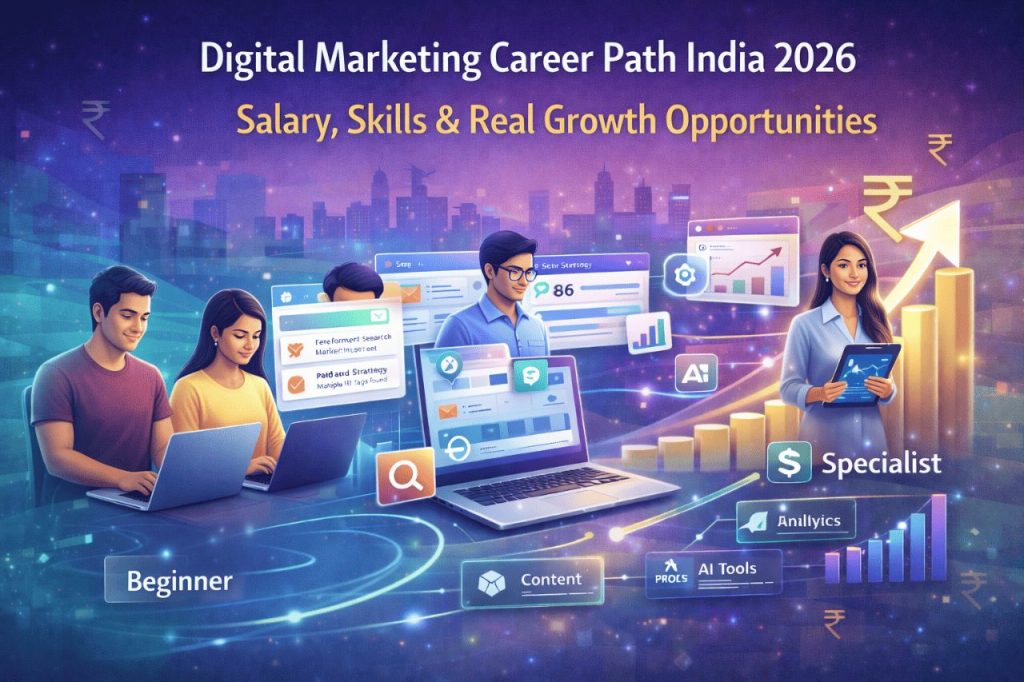
Priya quit her boring corporate HR job at 28. Six months later, she’s managing Instagram campaigns for a D2C brand, earning ₹8 lakhs annually, and working from her apartment in Pune. She never thought she’d love her job—until she discovered digital marketing.
Rahul was a struggling software engineer who hated coding. Today, at 26, he’s a performance marketing specialist earning ₹12 lakhs, using his analytical skills to optimize ad campaigns instead of debugging code. He works remotely for a Bangalore startup while living in his hometown, Indore.
These aren’t outliers. They’re the new normal in 2026.
Digital marketing has become one of India’s fastest-growing career paths—not because it’s easy money (it’s not), but because it offers something rare: the ability to build a meaningful career regardless of your background, location, or age. Whether you’re 22 and fresh out of college or 35 looking to switch careers, the door is wide open.
But here’s what nobody tells you: The digital marketing field in 2026 is completely different from even two years ago. AI tools have become mandatory, not optional. Remote work has destroyed location barriers. New specializations have emerged that didn’t exist in 2024.
This guide cuts through the noise to show you exactly what digital marketing careers look like in 2026—real salaries, actual skills that matter, honest career paths, and the truth about what it takes to succeed.
Why Digital Marketing Exploded in India (2026 Reality)
India now has over 850 million internet users. That’s more people online in India than the entire population of Europe. And they’re not just browsing—they’re buying.
The numbers that matter:
- E-commerce market: ₹14 trillion (nearly doubled since 2023)
- Digital ad spending: ₹65,000 crores (up 40% from 2024)
- Companies investing in digital: 94% (up from 67% in 2020)
- Remote marketing jobs: 60% of all digital marketing roles
- Expected job growth: 35% through 2028
What’s driving this explosion:
Quick Commerce Revolution Blinkit, Zepto, and Swiggy Instamart delivering in 10 minutes created entirely new marketing categories. Hyperlocal targeting, real-time inventory marketing, and dark store optimization require specialists who didn’t exist two years ago.
D2C Brand Boom Thousands of direct-to-consumer brands launched post-pandemic, each needing digital marketers who understand performance marketing, community building, and brand storytelling simultaneously.
AI Democratization AI tools made sophisticated marketing accessible to small businesses. A single marketer with AI tools can now do what previously required a team of five. This simultaneously increased demand for marketers (more businesses can afford marketing) and raised the skill bar (you must use AI effectively).
Global Remote Work Indian digital marketers now compete for—and win—international roles paying 2-3x Indian salaries. Location no longer limits your earning potential.
The Brutal Truth About Digital Marketing Salaries in 2026
Let’s talk money honestly. Too many career guides quote outdated or inflated numbers. Here’s what digital marketers actually earn in India in 2026, based on real salary data:
Entry-Level (0-2 Years Experience)
Digital Marketing Executive
- Metro cities: ₹3-5 lakhs annually
- Tier-2 cities: ₹2.5-4 lakhs annually
- Remote (Indian company): ₹3.5-5.5 lakhs annually
- What you’ll do: Execute campaigns, create content, manage social media, basic analytics
SEO Executive
- Average: ₹3-5 lakhs annually
- What you’ll do: On-page optimization, content optimization, link building, keyword research
Social Media Executive
- Average: ₹2.5-4.5 lakhs annually
- What you’ll do: Content creation, community management, basic analytics, influencer coordination
Content Writer
- Average: ₹2.5-4 lakhs annually
- What you’ll do: Blog writing, website copy, social media content, SEO content
Reality check: Entry-level salaries haven’t changed dramatically, but remote work has made better-paying opportunities accessible regardless of location.
Mid-Level (2-5 Years Experience)
Digital Marketing Specialist
- Metro cities: ₹5-10 lakhs annually
- With specialization: ₹6-12 lakhs annually
- Remote: ₹7-11 lakhs annually
SEO Specialist
- Average: ₹6-11 lakhs annually
- Technical SEO expert: ₹8-13 lakhs annually
- The difference: Specialists have proven results, manage campaigns independently, and often have AI tool expertise
Performance Marketing Specialist
- Average: ₹7-12 lakhs annually
- Top performers: ₹10-15 lakhs annually
- Why higher: Direct revenue impact, measurable ROI, high-demand skill
Content Marketing Manager
- Average: ₹7-12 lakhs annually
- With SEO expertise: ₹8-14 lakhs annually
Social Media Manager
- Average: ₹6-10 lakhs annually
- With video content skills: ₹7-12 lakhs annually
PPC Specialist (Google Ads, Meta Ads)
- Average: ₹6-10 lakhs annually
- Managing large budgets (₹50L+/month): ₹9-14 lakhs annually
Senior-Level (5+ Years Experience)
Digital Marketing Manager
- Average: ₹10-15 lakhs annually
- Large companies/agencies: ₹12-18 lakhs annually
- Responsibilities: Strategy, team management, budget oversight, stakeholder management
Performance Marketing Lead
- Average: ₹12-22 lakhs annually
- E-commerce companies: ₹15-25 lakhs annually
- Why premium: Direct P&L impact, revenue accountability
Growth Marketing Manager
- Average: ₹15-30 lakhs annually
- Startups with funding: ₹18-35 lakhs annually (plus ESOPs)
- The catch: High pressure, data-driven, experimental mindset required
Head of Digital Marketing
- Average: ₹15-25 lakhs annually
- Enterprise/MNC: ₹20-40 lakhs annually
- Top level: Strategy leadership, full department management
Marketing Director/VP
- Average: ₹25-50 lakhs annually
- Plus: ESOPs, bonuses, profit sharing
Emerging Roles (New in 2026)
AI Marketing Specialist
- Average: ₹8-15 lakhs annually
- Hot skill: Implementing AI tools, prompt engineering, AI ROI measurement
Creator Economy Manager
- Average: ₹6-12 lakhs annually
- Growth area: Managing influencers, UGC campaigns, brand partnerships
CRO (Conversion Rate Optimization) Specialist
- Average: ₹7-14 lakhs annually
- Impact: Direct revenue improvement, A/B testing expert
Marketing Data Analyst
- Average: ₹6-12 lakhs annually
- Essential: GA4 expert, attribution modeling, predictive analytics
Freelancing Reality Check
What freelancers actually earn:
- Beginners (first year): ₹15,000-40,000/month (inconsistent)
- Established (2-3 years): ₹50,000-1,50,000/month
- Top freelancers (5+ years): ₹2,00,000-5,00,000/month
The reality nobody mentions:
- First 6 months are often close to zero income
- Client acquisition is a full-time job itself
- Inconsistent income creates stress
- No benefits, no job security
- But: unlimited earning potential and complete flexibility
Salary by City (2026)
| Experience Level | Mumbai/Delhi | Bangalore | Pune/Hyderabad | Tier-2 Cities | Remote (Int’l) |
|---|---|---|---|---|---|
| Entry (0-2 yrs) | ₹3.5-5L | ₹4-5.5L | ₹3-4.5L | ₹2.5-4L | $15-25K/year |
| Mid (2-5 yrs) | ₹6-10L | ₹7-11L | ₹5.5-9L | ₹5-8L | $25-40K/year |
| Senior (5+ yrs) | ₹12-18L | ₹14-22L | ₹10-16L | ₹8-14L | $45-70K/year |
The remote work advantage: Living in Indore while earning Bangalore salary, or better yet, landing international remote work paying 2-3x Indian rates, has become the new career hack.
Skills That Actually Matter in 2026
Forget generic skill lists. Here’s what employers are actually hiring for right now, ranked by demand and salary impact:
Tier 1: Mandatory Skills (Everyone Needs These)
AI Tool Proficiency This isn’t optional anymore. If you can’t effectively use AI tools, you’re not competitive in 2026.
Must-know AI tools:
- ChatGPT/Claude/Gemini for content and strategy
- Midjourney/DALL-E for visual content
- Jasper/Copy.ai for marketing copy
- Surfer SEO/Clearscope/Frase for SEO content
- AI ad platforms (Meta Advantage+, Google Performance Max)
Why it matters: Marketers using AI are 3-5x more productive. Companies won’t hire those who can’t leverage AI.
Google Analytics 4 Universal Analytics is dead. GA4 is mandatory. If you don’t know GA4, you can’t prove ROI, which means you can’t get hired or promoted.
Core competencies:
- Event tracking setup
- Custom reporting
- Attribution analysis
- Audience building
- Integration with ad platforms
Social Media Platform Mastery Not just posting—actually understanding how each platform’s algorithm works and how to create native content.
2026 focus platforms:
- Instagram (Reels domination)
- YouTube (Shorts + long-form)
- LinkedIn (B2B growth hacking)
- Twitter/X (real-time engagement)
Basic Copywriting Every marketer needs to write. AI helps, but you need to know what good copy looks like to prompt AI effectively and edit its output.
Tier 2: Specialization Skills (Choose 2-3)
Search Engine Optimization (SEO) Still incredibly valuable despite AI changes.
2026 SEO essentials:
- Technical SEO (Core Web Vitals, structured data)
- Content optimization for AI Overviews
- E-E-A-T (Experience, Expertise, Authoritativeness, Trust)
- Local SEO (crucial for Indian businesses)
- Link building strategies
Paid Advertising (Performance Marketing) High-paying specialization with clear ROI.
Platforms to master:
- Google Ads (Search, Performance Max, Shopping)
- Meta Ads (Facebook, Instagram, Advantage+)
- LinkedIn Ads (B2B)
- YouTube Ads
Content Marketing Creating content that actually drives business results.
Beyond writing:
- Content strategy and planning
- SEO content optimization
- Video content creation
- Repurposing content across platforms
- Content analytics and optimization
Email Marketing & Automation One of the highest-ROI channels, still growing.
Key skills:
- Segmentation and personalization
- Marketing automation workflows
- A/B testing
- Deliverability optimization
- ESP platforms (Mailchimp, Klaviyo, HubSpot)
Video Creation & Editing Video is 80% of content consumption. Basic video skills are now essential.
Tools to know:
- CapCut (mobile editing)
- Adobe Premiere Rush (quick edits)
- Canva Video (simple videos)
- Basic live streaming
Tier 3: Advanced Skills (Senior/Specialized Roles)
Marketing Analytics & Data Science For those comfortable with numbers and analysis.
Tools and concepts:
- SQL basics for marketing queries
- Data visualization (Tableau, Google Data Studio)
- Attribution modeling
- Predictive analytics
- Customer lifetime value analysis
Conversion Rate Optimization (CRO) Highly specialized, well-paid skill.
Core competencies:
- A/B testing methodology
- Heatmap analysis (Hotjar, Microsoft Clarity)
- User behavior analysis
- Landing page optimization
- Funnel optimization
Marketing Automation Enterprise-level skill with premium pay.
Platforms:
- HubSpot
- Marketo
- ActiveCampaign
- Salesforce Marketing Cloud
Growth Hacking Startup-focused, experimental approach.
Mindset and skills:
- Rapid experimentation
- Data-driven decision making
- Product-led growth understanding
- Viral loop design
- Retention optimization
Soft Skills That Matter More Than You Think
- Data Storytelling Numbers mean nothing if you can’t explain them to stakeholders. This skill determines who gets promoted.
- Cross-Functional Collaboration Marketing touches sales, product, customer success—you need to work with everyone.
- Adaptability Platforms change algorithms weekly. AI tools launch monthly. You must love learning or you’ll become obsolete.
- Client/Stakeholder Management Whether in-house or agency, managing expectations and communicating results is critical.
- Project Management Marketing involves juggling multiple campaigns, deadlines, and stakeholders. Organization separates good from great marketers.
Career Paths: What Success Actually Looks Like
Path 1: The Specialist Route
Timeline:
- Year 0-1: Entry-level generalist (₹3-4L)
- Year 1-2: Choose specialization, get certified
- Year 2-4: Specialist with proven results (₹6-10L)
- Year 4-6: Senior specialist/consultant (₹10-18L)
- Year 6+: Expert consultant or agency founder (₹20L+)
Example: Anjali’s SEO Journey Started as content writer (₹3L). Learned SEO. Became SEO specialist at e-commerce company (₹7L) in 2 years. Now freelance SEO consultant (₹15L) working 4 hours daily.
Pros: Deep expertise, high demand, can freelance easily Cons: Can get boring, skill may become outdated
Path 2: The Generalist Manager Route
Timeline:
- Year 0-2: Digital marketing executive (₹3-5L)
- Year 2-4: Digital marketing specialist (₹6-9L)
- Year 4-6: Digital marketing manager (₹10-15L)
- Year 6-8: Senior manager/head (₹15-25L)
- Year 8+: Director/VP (₹25L+)
Example: Rahul’s Management Path Started in small agency (₹3.5L). Moved to startup as specialist (₹7L) after 2 years. Made manager (₹12L) at 5 years. Now Head of Digital at mid-size company (₹18L plus ESOPs).
Pros: Variety, leadership opportunities, structured growth Cons: Political dynamics, less hands-on work over time
Path 3: The Freelance/Agency Route
Timeline:
- Year 0-2: Build skills and portfolio (₹3-5L in job)
- Year 2-3: Start freelancing part-time
- Year 3-4: Full-time freelance (₹5-10L)
- Year 4-6: Scale to agency (₹15-30L)
- Year 6+: Established agency (₹30L-1Cr+)
Example: Priya’s Agency Story Started as social media executive (₹2.5L). Built portfolio, started freelancing on weekends. Quit job, went full-time freelance (₹8L first full year). Hired team, now runs 8-person agency (₹50L revenue, ₹20L personal income).
Pros: Unlimited earning potential, complete flexibility Cons: Unstable income initially, client acquisition stress, no benefits
Path 4: The Remote Global Route
Timeline:
- Year 0-3: Build skills in Indian market (₹3-8L)
- Year 3-4: Build international portfolio
- Year 4+: Land remote international role ($30-70K/year = ₹25-58L)
Example: Karthik’s International Jump Worked at Bangalore startup for 3 years (₹4L to ₹8L). Built strong portfolio. Applied to international remote roles. Now works for US SaaS company ($45K = ₹37L) while living in Mysore.
Pros: 2-3x Indian salary, better work culture, exposure to global practices Cons: Timezone challenges, cultural differences, less stability
Real Career Transitions: How People Actually Made the Switch
From Engineering to Digital Marketing
Rohit’s Story (26, Pune):
- Background: Computer engineering, hated coding
- Transition time: 6 months
- First role: Performance marketing executive (₹4.5L)
- Current: Performance marketing specialist (₹11L after 2 years)
- Key advantage: Technical background helped with analytics, tracking, automation
His advice: “Use your analytical skills. Data-driven marketing needs people who can work with numbers and code. Learn Google Tag Manager and SQL basics—it sets you apart.”
From Traditional Marketing to Digital
Sneha’s Story (32, Mumbai):
- Background: 7 years in print media advertising
- Transition time: 4 months of intensive learning
- First role: Social media manager (₹7L—lateral move)
- Current: Digital marketing manager (₹14L after 18 months)
- Key advantage: Understanding of brand messaging and creative concepts
Her advice: “Your traditional marketing knowledge is valuable—you understand positioning and messaging. Just add the digital execution skills. Don’t start from scratch salary-wise; negotiate based on total experience.”
Fresh Graduate Success
Ananya’s Story (24, Indore):
- Background: English literature graduate, no marketing knowledge
- Transition time: Started learning during final year
- First role: Intern, then content writer (₹3L)
- Current: Content marketing specialist (₹7L after 2 years)
- Key advantage: Strong writing skills, willingness to learn
Her advice: “Start with free certifications while in college. Build a portfolio blog. Show don’t tell—demonstrate your skills through your own content. I got hired because my personal blog ranked on Google.”
The 6-Month Digital Marketing Career Launch Plan
Month 1-2: Foundation Building
Week 1-2: Choose Your Focus
- Research different digital marketing roles
- Identify what interests you (creative? analytical? strategic?)
- Set realistic salary expectations
- Join 3-5 LinkedIn groups and communities
Week 3-4: Start Learning
- Complete Google Digital Garage fundamentals (free)
- Start HubSpot Content Marketing course (free)
- Create personal LinkedIn profile optimized for digital marketing
- Follow 20+ digital marketing leaders on Twitter/LinkedIn
Week 5-6: Platform Familiarity
- Create accounts on all major platforms
- Understand how each platform works as a user
- Start consuming marketing content (blogs, podcasts, YouTube)
- Sign up for marketing newsletters
Week 7-8: First Certification
- Complete Google Analytics 4 certification
- Finish first paid course (Udemy/Coursera – invest ₹500-1,000)
- Start personal blog or social media presence
Month 3-4: Skill Building & Specialization
Week 9-10: Choose 2 Specializations Based on month 1-2 exploration, pick 2 focus areas:
- SEO + Content Marketing (great combination)
- Paid Ads + Analytics (data-driven)
- Social Media + Video Content (creative)
Week 11-12: Deep Dive Learning
- Complete advanced courses in your chosen specializations
- Get 2-3 more certifications
- Start practicing with personal projects
Week 13-16: Portfolio Building Critical phase—you MUST have proof of skills:
If choosing SEO:
- Start a niche blog, get it ranking
- Document your process and results
- Offer to optimize a friend’s/family website for free
If choosing Paid Ads:
- Run small campaigns for local businesses (even ₹1,000 budgets)
- Document results and learnings
- Create case studies
If choosing Social Media:
- Grow your own following (even to 1,000)
- Create content calendar and post consistently
- Show engagement growth metrics
If choosing Content:
- Write 20+ blog posts on various topics
- Guest post on medium-size blogs
- Create portfolio website with best work
Month 5-6: Job Hunting & Interviews
Week 17-18: Resume & Portfolio Polish
- Create ATS-friendly resume
- Build online portfolio (free Notion page works)
- Get 3-5 LinkedIn recommendations
- Polish your LinkedIn profile
Week 19-20: Application Blitz
- Apply to 50+ relevant positions
- Target: 30 entry-level roles, 20 internships
- Customize each application
- Follow up after 1 week
Week 21-22: Networking
- Attend 2-3 virtual/in-person marketing meetups
- Connect with 50+ marketers on LinkedIn
- Reach out to 10 people for informational interviews
- Join relevant WhatsApp/Telegram groups
Week 23-24: Interview Preparation
- Practice common interview questions
- Prepare portfolio presentation (3-5 best projects)
- Research companies you’re interviewing with
- Have salary range ready (researched and realistic)
Expected Outcome: 5-10 interviews, 2-3 offers in ₹3-5L range
Where the Jobs Actually Are (2026)
Company Types
Startups (Best for Learning)
- Salary: Average for role
- Pros: Rapid learning, multiple responsibilities, potential ESOPs
- Cons: Unstable, long hours, limited resources
- Best for: Early career (0-3 years)
Digital Marketing Agencies (Best for Variety)
- Salary: 10-20% below in-house roles
- Pros: Multiple clients, diverse experience, fast skill building
- Cons: Client servicing stress, tight deadlines, billing pressure
- Best for: Building portfolio (1-4 years)
E-commerce Companies (Best for Performance Marketing)
- Salary: Above average
- Pros: Data-driven, clear ROI, growth opportunities
- Cons: High pressure, aggressive targets
- Best for: Performance-focused marketers
SaaS/Tech Companies (Best for Salary)
- Salary: 20-30% above average
- Pros: Better pay, modern tools, good work culture
- Cons: Competitive, requires strong skills
- Best for: Experienced marketers (3+ years)
Corporate/MNC (Best for Stability)
- Salary: Average to above average
- Pros: Job security, benefits, structured growth
- Cons: Slow-moving, bureaucratic, limited innovation
- Best for: Those prioritizing stability
Job Platforms That Work
Best for Entry-Level:
- Internshala (internships)
- LinkedIn (optimize profile, engage regularly)
- AngelList (startup jobs)
- Naukri.com (mass applications)
Best for Experienced:
- LinkedIn (networking is key)
- Cutshort (tech companies)
- Instahyre (curated matches)
- Direct company career pages
Best for Remote:
- Remote OK (international)
- We Work Remotely
- AngelList (remote filter)
- LinkedIn (remote filter)
Hidden Gems:
- Telegram job channels (very active)
- Twitter/X (follow #hiring hashtags)
- WhatsApp groups (ask for invites in communities)
- Direct outreach to companies
Common Mistakes That Kill Careers
Mistake #1: Certificate Hoarding Without Practice
The problem: Collecting 20 certificates but never executing a real campaign.
The fix: For every course completed, do one practical project. One project beats five certificates.
Mistake #2: Generalist Trap
The problem: Trying to be “good at everything” makes you hireable for nothing.
The fix: Master 2-3 related skills deeply. Be known for something specific.
Mistake #3: Ignoring AI
The problem: “I’ll learn AI later” means you’re already behind.
The fix: Start using ChatGPT/Claude TODAY for every marketing task. Prompt engineering is a skill—build it now.
Mistake #4: No Portfolio
The problem: “I learned everything” but can’t show proof.
The fix: Document everything. Blog posts, campaigns, results, screenshots—create a portfolio even before your first job.
Mistake #5: Working for Free Too Long
The problem: Doing “exposure” projects for months without getting paid.
The fix: 1-2 free projects maximum to build portfolio. Then charge—even ₹5,000 is better than free.
Mistake #6: Salary Negotiation Fear
The problem: Accepting first offer without negotiation, leaving ₹50,000-1,00,000 on the table.
The fix: Always negotiate. Research salary ranges. Ask for 20-30% more than you’d accept. They’ll meet in the middle.
Interview Preparation: What Actually Gets Asked
Common Interview Questions & How to Answer
“Walk me through your experience/portfolio.” Bad answer: Listing job duties. Good answer: Highlighting specific results with metrics. “I managed Instagram for XYZ, growing followers from 2K to 15K in 6 months, with engagement rate improving from 2% to 5.8%.”
“What’s your process for [SEO/PPC/Social/etc.]?” Bad answer: Generic textbook process. Good answer: Your specific framework with examples. “I start with competitive analysis using Ahrefs, then identify content gaps, prioritize based on search volume and difficulty, create optimized content, and track rankings weekly.”
“Tell me about a failed campaign.” Bad answer: Blaming others or circumstances. Good answer: Owning the failure and explaining learnings. “I ran Facebook ads targeting too broad an audience, spent ₹20K with poor results. I learned to test smaller audiences first, validate with ₹2-3K budgets, then scale winners.”
“What’s your approach to staying updated?” Bad answer: “I follow blogs.” Good answer: Specific sources and application. “I follow Google Search Central updates, test changes on my personal blog first, document results, then apply to client work. Recently tested AI Overview optimization and saw 15% traffic increase.”
“Why digital marketing?” Bad answer: “It’s growing” or “I like social media.” Good answer: Specific attraction and demonstrated commitment. “I love the immediate feedback loop—create campaign, see results, optimize, improve. The data-driven creativity combines my analytical and creative sides. I’ve been learning for 6 months and already see results in my personal projects.”
What to Bring to Interviews
Portfolio (Digital):
- 3-5 best projects with metrics
- Screenshots of results
- Case studies (even from personal projects)
- Link to online portfolio
Questions to Ask:
- “What does success look like in this role in 6 months?”
- “What’s the team structure and who would I work with?”
- “What tools and platforms does the team use?”
- “How do you measure marketing success here?”
- “What’s the approval process for campaigns?”
Red Flags to Watch For:
- Vague job description in interview
- Unwilling to discuss team size or structure
- No clear KPIs or measurement
- Excessive hours expected
- High turnover mentioned
The Remote Work Advantage: How to Access Global Opportunities
The 2026 reality: Remote work has permanently changed digital marketing careers. You can live anywhere and access opportunities anywhere.
How Indian Marketers Are Winning International Remote Roles
Advantages Indian marketers have:
- English proficiency
- Strong work ethic
- Cost-effective for foreign companies
- Technical comfort with digital tools
- Cultural adaptability
How to position yourself:
- Build portfolio that showcases international-standard work
- Get comfortable with timezone overlap (some late nights)
- Understand US/EU business communication styles
- Price yourself competitively but not too cheap ($25-50/hour for mid-level)
- Use platforms like Remote OK, We Work Remotely, AngelList
Rahul’s international remote story: Worked in Bangalore startup for 3 years (₹8L). Built strong Google Ads portfolio. Applied to 40+ international remote roles over 3 months. Got 3 interviews, 1 offer: US SaaS company, $45K/year (₹37L). Now works Bangalore hours (overlaps with US West Coast morning). Lives in hometown, saves ₹15L annually, better quality of life.
Your Action Plan: Start Today
If You’re a Complete Beginner
This Week:
- Sign up for Google Digital Garage
- Create LinkedIn profile optimized for digital marketing
- Join 3 LinkedIn groups
- Follow 10 digital marketing leaders
This Month:
- Complete first certification (Google Digital Garage)
- Start personal blog or Instagram
- Apply basic SEO/social media tactics
- Document what you’re learning
Next 3 Months:
- Get 3-5 certifications in chosen specializations
- Build portfolio with 5 projects
- Start applying for internships
- Network with 20+ marketers
If You’re Switching Careers
This Week:
- Identify transferable skills from current role
- Research digital marketing roles that align
- Join 5 LinkedIn groups
- Schedule 2 informational interviews
This Month:
- Complete 2 foundational courses
- Start building portfolio
- Update LinkedIn profile
- Begin part-time learning while employed
Next 3 Months:
- Get 5+ certifications
- Build substantial portfolio (8-10 projects)
- Apply to lateral roles that recognize prior experience
- Network aggressively
If You’re Experienced but Stagnating
This Week:
- Audit your current skills vs. 2026 requirements
- Identify 2-3 skill gaps (likely AI tools, GA4, video)
- Update LinkedIn with recent projects and results
- Research remote opportunities
This Month:
- Learn the identified skill gaps
- Update portfolio with recent wins
- Apply to senior roles (don’t undersell)
- Consider freelance/consulting
Next 3 Months:
- Master new skills
- Land next role with 30-50% jump
- Build personal brand (LinkedIn, Twitter)
- Explore international remote options
The Bottom Line
Digital marketing in 2026 offers real opportunities—not get-rich-quick schemes, but legitimate career paths with good salaries, flexibility, and growth potential.
You can succeed if:
- You’re willing to learn continuously (non-negotiable)
- You can embrace AI tools without fear
- You’re comfortable with data and analytics
- You enjoy creative problem-solving
- You can handle fast-paced change
You’ll struggle if:
- You want a “set it and forget it” career
- You hate learning new tools constantly
- Numbers and data intimidate you
- You need complete stability and predictability
- You can’t adapt to changing platforms
The field is wide open for those willing to put in the work. Your background doesn’t matter. Your location doesn’t limit you. Your age isn’t a barrier.
What matters is: Are you willing to start today?
Ready to accelerate your digital marketing career? Whether you’re looking to transition into digital marketing or upskill for your next role, our digital marketing training programs provide hands-on experience with real campaigns, industry-recognized certifications, and job placement support. Schedule a free career consultation to discuss your goals and create a personalized learning path.
Last Updated: January 2026 | Career data, salaries, and market insights current as of Q1 2026