
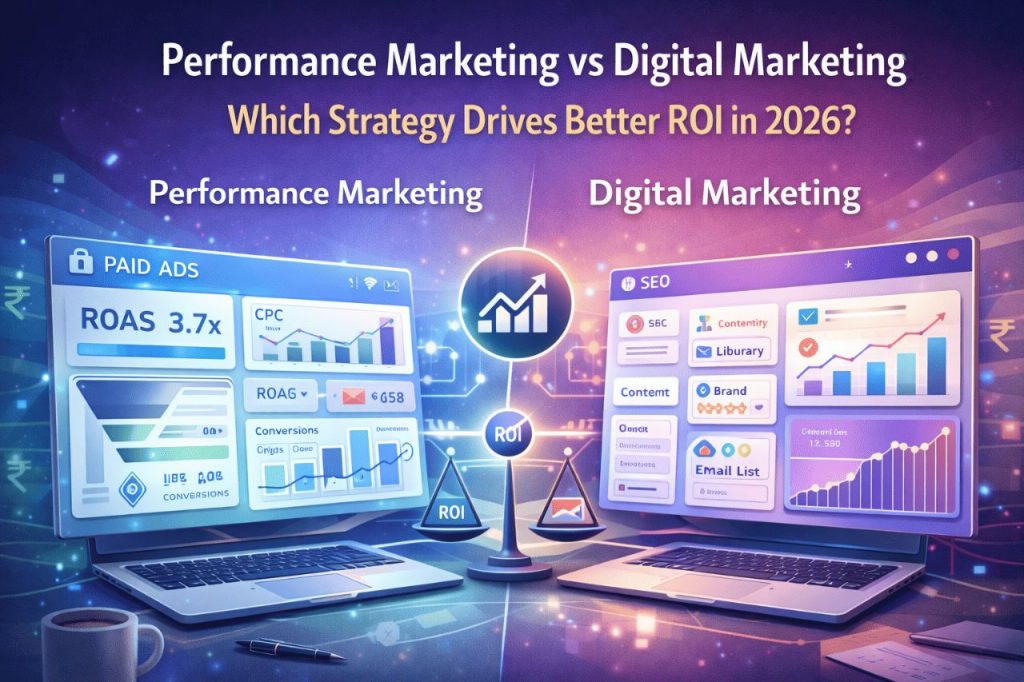
You’re staring at your marketing dashboard at 11 PM, watching ad spend climb while wondering: Should I invest more in performance campaigns for immediate results, or build long-term digital marketing assets that compound over time?
Here’s what most marketing guides won’t tell you: This isn’t an either-or decision. It’s a strategic integration problem.
The businesses winning in 2026 aren’t choosing between performance marketing and digital marketing. They’re using both—strategically allocated based on business goals, market position, and customer behavior. But the ratio matters tremendously.
In this guide, I’ll break down exactly what separates these approaches, when to use each, and how to create a budget allocation that maximizes ROI for your specific business stage. No fluff, just practical frameworks you can implement this week.
Let’s Clear Up The Confusion First
Before diving into strategies, we need to address the fundamental confusion that trips up most marketers.
What Actually Is Digital Marketing?
Digital marketing is the umbrella term for all marketing activities conducted through digital channels. It includes:
- Search engine optimization (SEO)
- Content marketing and blogging
- Social media presence and engagement
- Email marketing campaigns
- Brand building and awareness initiatives
- Influencer partnerships
- Community building
- Public relations and thought leadership
- Video marketing and YouTube
- Podcast creation and promotion
The key characteristic: Digital marketing focuses on building sustainable marketing assets and long-term brand equity. Results compound over time. A blog post written today can drive traffic for years. Brand awareness built this quarter influences purchase decisions next year.
What Actually Is Performance Marketing?
Performance marketing is a subset of digital marketing focused exclusively on measurable actions where you only pay when specific results occur.
It includes:
- Google Ads (Search, Display, Shopping)
- Facebook and Instagram Ads
- LinkedIn Ads
- Affiliate marketing programs
- Influencer campaigns with trackable codes
- Sponsored content with conversion tracking
- Retargeting and remarketing campaigns
- Native advertising platforms
The key characteristic: You pay only when a defined action happens—a click, lead, sale, or app install. Results are immediate and directly measurable. You can see exactly how much revenue each rupee spent generates.
The Critical Distinction
Digital marketing asks: “How do we build a sustainable marketing engine that drives growth over time?”
Performance marketing asks: “How do we generate measurable results today with clear attribution?”
Think of it this way: Digital marketing is like planting a fruit tree. You invest time and resources upfront, nurture it consistently, and eventually harvest fruit year after year. Performance marketing is like buying fruit from the market. You pay, you get fruit immediately, but you need to keep paying to keep getting fruit.
Neither approach is superior. The question is: What does your business need right now?
Side-by-Side Comparison: The Key Differences
| Factor | Performance Marketing | Digital Marketing |
|---|---|---|
| Primary Goal | Immediate, measurable conversions | Brand building + long-term growth |
| Payment Model | Pay-per-result (CPC, CPL, CPA, CPS) | Fixed costs (salaries, tools, content) |
| Time to Results | Hours to days | Weeks to months |
| Measurement | Direct ROI, conversion rates | Brand metrics, engagement, long-term value |
| Scalability | Highly scalable with budget | Limited by content production capacity |
| Risk Level | Lower (pay only for results) | Higher upfront investment |
| Best For | Proven products, clear conversion paths | New brands, complex sales cycles |
| Sustainability | Requires continuous investment | Creates compounding assets |
| Typical ROI Timeline | Immediate (within campaign) | 6-18 months for full maturity |
When Performance Marketing Makes Sense
You Should Prioritize Performance Marketing If:
1. You Need Revenue Yesterday
Your business needs cash flow now. You can’t wait 6 months for SEO to kick in or brand awareness to convert. Performance marketing delivers immediate results—launch a campaign Monday, see sales Tuesday.
Example: An e-commerce store launching a Diwali sale can’t rely on organic content. They need Google Shopping ads and Facebook campaigns driving traffic and sales within days.
2. You Have Proven Product-Market Fit
You know your product sells. You’ve validated pricing. Your conversion funnel is optimized. Now you just need more traffic. Performance marketing excels at scaling what already works.
Example: A SaaS company with 100 customers and 5% free-to-paid conversion knows their funnel works. Pumping ₹2 lakhs into Google Ads for high-intent keywords makes perfect sense.
3. Your Sales Cycle Is Short
If customers discover you and purchase within hours or days, performance marketing shines. Direct attribution is clear, and you can optimize rapidly.
Example: A meal kit delivery service where users browse, sign up, and place orders within the same session benefits massively from retargeting ads that capture immediate purchase intent.
4. You Can Clearly Track ROI
Your analytics setup is solid. You know exactly which campaigns drive which conversions. You can calculate customer acquisition cost (CAC) and lifetime value (LTV) confidently.
Example: A D2C beauty brand using Shopify with proper conversion tracking can see that their Meta ads generate ₹4 for every ₹1 spent—clear justification for budget increases.
5. You’re in a Competitive Market Where Visibility Matters
If you don’t appear when customers search, you lose to competitors who do. Performance marketing guarantees visibility for high-intent searches.
Example: A personal injury lawyer in Mumbai can’t rely solely on organic search against established firms. Google Ads for “accident lawyer Mumbai” ensures they’re visible when people need legal help urgently.
When Digital Marketing Makes More Sense
You Should Prioritize Digital Marketing If:
1. You’re Building a New Brand
Nobody knows who you are yet. Before people click your ads, they need to recognize and trust your brand. Digital marketing builds that foundation through content, social presence, and thought leadership.
Example: A new B2B SaaS startup can’t just run ads—they need case studies, blog content demonstrating expertise, and founder thought leadership to establish credibility before prospects will convert.
2. Your Sales Cycle Is Long and Complex
When decisions take weeks or months and involve multiple stakeholders, immediate conversion-focused ads don’t work. You need nurturing content that keeps you top-of-mind.
Example: An enterprise software solution with a 6-month sales cycle needs whitepapers, webinars, email nurture sequences, and industry event presence—not just conversion-focused ads.
3. Your Budget Is Limited But You Have Time
If you can’t afford ₹50,000/month in ad spend but you can invest time, digital marketing’s compounding returns make more sense. One great piece of content can drive traffic for years.
Example: A boutique consulting firm might not afford consistent paid ads, but publishing one high-quality article weekly for a year will build significant organic traffic and authority.
4. You’re in a Trust-Dependent Industry
Healthcare, finance, legal services, and education require significant trust before purchase. Digital marketing builds credibility through content, reviews, and thought leadership.
Example: A financial advisor needs blog content explaining complex topics, client testimonials, educational videos, and social proof before anyone will trust them with investments—performance ads alone won’t cut it.
5. Your Target Audience Researches Extensively
If your customers spend weeks researching before buying, they need multiple touchpoints with educational content. Digital marketing creates those touchpoints.
Example: B2B buyers researching project management software will read 10+ articles, watch demo videos, join community discussions, and consume comparison content before requesting a demo. Your digital presence must cover this entire journey.
The Integration Sweet Spot: How Top Performers Blend Both
The most successful businesses in 2026 don’t pick sides. They strategically integrate both approaches based on their specific situation.
The 70-20-10 Budget Allocation Framework
Here’s a proven framework used by high-growth companies:
- 70% – Proven Performance Channels Invest the majority in channels with established positive ROI. This keeps revenue flowing while you test and build.
- 20% – Digital Marketing Foundation Build sustainable assets: SEO content, email lists, brand presence, thought leadership. These compound over time and reduce dependence on paid channels.
- 10% – Experimental Budget Test new platforms, tactics, and channels. This keeps you ahead of competitors and identifies tomorrow’s opportunities.
Real Budget Examples by Business Type
E-commerce Store (₹1,00,000/month budget):
- 75% Performance Marketing (₹75,000)
- Google Shopping Ads: ₹35,000
- Meta Ads (Facebook/Instagram): ₹25,000
- Retargeting Campaigns: ₹10,000
- Affiliate Partnerships: ₹5,000
- 20% Digital Marketing (₹20,000)
- Content creation (product guides, blogs): ₹10,000
- Email marketing automation: ₹5,000
- Influencer gifting and UGC: ₹5,000
- 5% Experimental (₹5,000)
- Testing TikTok ads or new platforms
Why this works: E-commerce needs immediate sales to maintain inventory turnover. Performance marketing drives revenue while content supports SEO and email builds retention.
B2B SaaS Company (₹2,00,000/month budget):
- 55% Performance Marketing (₹1,10,000)
- Google Ads (high-intent keywords): ₹50,000
- LinkedIn Ads: ₹40,000
- Retargeting: ₹20,000
- 35% Digital Marketing (₹70,000)
- Content marketing (blogs, guides): ₹30,000
- SEO and technical optimization: ₹20,000
- Webinars and thought leadership: ₹20,000
- 10% Experimental (₹20,000)
- Testing Reddit communities, Quora ads, industry partnerships
Why this works: B2B SaaS has longer sales cycles requiring nurture. Digital marketing builds authority while performance marketing captures high-intent searches.
Local Service Business (₹50,000/month budget):
- 60% Performance Marketing (₹30,000)
- Google Local Services Ads: ₹15,000
- Google Search Ads: ₹10,000
- Facebook Local Awareness: ₹5,000
- 30% Digital Marketing (₹15,000)
- Google Business Profile optimization: ₹3,000
- Review generation campaigns: ₹5,000
- Local SEO and citations: ₹4,000
- Email newsletter: ₹3,000
- 10% Experimental (₹5,000)
- Testing neighborhood partnerships, local influencer collaborations
Why this works: Local businesses need immediate visibility when people search for services nearby, but reviews and local SEO create sustainable competitive advantages.
Real Results: What Success Looks Like
Let me share three real examples from Indian businesses (client confidentiality maintained, but numbers are accurate):
Case Study 1: D2C Fashion Brand (Mumbai)
Starting Situation: ₹15 lakh monthly revenue, 100% dependent on Meta ads, margins getting squeezed by rising CPMs
Strategy Shift: Moved from 90% performance / 10% digital to 70% performance / 30% digital
What They Did:
- Continued Meta and Google Shopping ads (performance)
- Started publishing 8 style guide articles monthly (digital)
- Built email list with welcome discount (digital)
- Launched influencer gifting program (digital)
- Created YouTube shorts showing styling tips (digital)
Results After 9 Months:
- Revenue increased to ₹42 lakhs monthly (+180%)
- Organic traffic grew from 2,000 to 18,000 monthly visitors
- Email marketing contributed ₹8 lakhs monthly revenue
- Customer acquisition cost decreased by 34% (organic offset paid costs)
- Brand search volume increased 6x
The Insight: Performance marketing drove immediate sales, but digital marketing created a moat that reduced dependence on expensive ads and improved overall profitability.
Case Study 2: B2B HR Tech SaaS (Bangalore)
Starting Situation: ₹8 lakh monthly revenue, struggling to scale beyond initial customer base, long sales cycles (4-6 months)
Strategy Shift: Moved from 40% performance / 20% digital / 40% outbound sales to 50% performance / 40% digital / 10% sales
What They Did:
- Launched LinkedIn Ads targeting HR directors (performance)
- Created comprehensive HRIS buying guide and comparison content (digital)
- Started weekly LinkedIn posts from founder (digital)
- Built retargeting funnel for website visitors (performance)
- Published 2 in-depth case studies monthly (digital)
Results After 12 Months:
- Revenue increased to ₹28 lakhs monthly (+250%)
- Inbound demo requests increased from 8 to 47 monthly
- Sales cycle shortened from 6 months to 3.5 months
- Content marketing generated 62% of new pipeline
- Cost per demo decreased from ₹12,000 to ₹4,200
The Insight: B2B buyers research extensively. Digital marketing built credibility and warmed prospects, making performance marketing dramatically more effective.
Case Study 3: Local Dental Clinic Chain (NCR)
Starting Situation: ₹25 lakh monthly revenue across 3 clinics, inconsistent lead flow, heavy competition
Strategy Shift: Implemented integrated approach with 65% performance / 25% digital / 10% experimental
What They Did:
- Google Local Services Ads for immediate visibility (performance)
- Optimized Google Business Profiles with regular posts (digital)
- Created patient education video series (digital)
- Launched review generation campaign (digital)
- Facebook ads targeting specific procedures (performance)
- Built email nurture sequence for consultation no-shows (digital)
Results After 6 Months:
- Revenue increased to ₹38 lakhs monthly (+52%)
- New patient appointments increased from 180 to 310 monthly
- Google Business Profile impressions increased 243%
- Cost per lead decreased from ₹850 to ₹520
- Patient retention improved by 28%
The Insight: Local businesses need immediate visibility (performance marketing) but trust-building content and reviews (digital marketing) dramatically improve conversion rates and reduce acquisition costs.
How to Decide Your Budget Split
Here’s a practical framework for determining your performance vs. digital marketing allocation:
Step 1: Assess Your Business Stage
Stage 1 – Startup (0-50 customers):
- 40% Performance Marketing
- 50% Digital Marketing
- 10% Experimental
- Why: You need brand awareness and credibility before scaling paid channels effectively
Stage 2 – Early Growth (50-500 customers):
- 60% Performance Marketing
- 30% Digital Marketing
- 10% Experimental
- Why: You’ve proven product-market fit and need to scale while building sustainable assets
Stage 3 – Scaling (500-5000 customers):
- 70% Performance Marketing
- 25% Digital Marketing
- 5% Experimental
- Why: Focus on scaling what works while maintaining brand presence
Stage 4 – Mature (5000+ customers):
- 50% Performance Marketing
- 40% Digital Marketing
- 10% Experimental
- Why: Balanced approach maintaining market share while exploring new growth channels
Step 2: Factor In Your Industry
- E-commerce / D2C: Start with 75% performance, 20% digital, 5% experimental
- B2B Services / SaaS: Start with 55% performance, 35% digital, 10% experimental
- Local Services: Start with 65% performance, 25% digital, 10% experimental
- Education / Healthcare: Start with 45% performance, 45% digital, 10% experimental
Step 3: Consider Your Available Resources
- High budget (₹2L+/month), small team: Favor performance marketing (faster to manage)
- Low budget (< ₹50K/month), willing to invest time: Favor digital marketing (better long-term ROI)
- Mid budget, balanced team: Use the 70-20-10 framework
Common Mistakes That Kill ROI
Mistake #1: All-In on Performance Without Foundation
The Problem: Pumping ₹5 lakhs into Google Ads without any digital marketing foundation means high CPCs because you have zero brand recognition, no content to support ads, and no email list to retarget.
The Fix: Build basic digital presence first—website with solid content, Google Business Profile optimization, basic SEO—then scale performance marketing.
Mistake #2: Only Digital Marketing When You Need Revenue
The Problem: Spending 6 months building “the perfect content strategy” while your runway depletes and you generate no revenue.
The Fix: Run small performance campaigns (₹10-20K/month) to generate immediate revenue while building digital assets. Revenue solves many problems.
Mistake #3: Not Tracking Performance Marketing ROI Properly
The Problem: Running ads without proper conversion tracking, attribution, or understanding of customer lifetime value.
The Fix: Before spending serious money on performance marketing, ensure you have:
- Google Analytics 4 properly configured
- Conversion tracking for all key actions
- Understanding of your customer acquisition cost (CAC)
- Knowledge of customer lifetime value (LTV)
- Clear ROAS targets
Mistake #4: Creating Digital Marketing Content That Nobody Wants
The Problem: Publishing blog posts that don’t match search intent or solve real customer problems, then wondering why traffic doesn’t convert.
The Fix: Do keyword research using actual customer questions. Interview sales teams about common objections. Create content that moves prospects from awareness to consideration to decision.
Mistake #5: Treating Them As Separate Silos
The Problem: Your performance marketing team runs ads with no connection to your content strategy. Your content team creates assets that ads never leverage.
The Fix: Integrate strategies:
- Use your best-performing blog content as landing pages for ads
- Retarget people who read your content but didn’t convert
- Create content that answers objections surfaced in ad campaigns
- Use performance marketing data to inform content topics
The Integration Playbook: Making Both Work Together
Here’s how to create synergy between performance and digital marketing:
1. Use Digital Marketing Assets to Lower Performance Marketing Costs
Strategy: Create high-quality content that ranks organically, then run performance ads to the same content for high-intent searches.
Example: Your blog post “Best Project Management Software for Indian Teams” ranks #5 organically. Run Google Ads for the same keyword sending traffic to that post. Your ad Quality Score is higher because your content is relevant, reducing CPCs by 30-40%.
2. Use Performance Marketing Data to Guide Digital Marketing
Strategy: Analyze which keywords, audiences, and messages perform best in paid campaigns, then create organic content around those insights.
Example: Your LinkedIn ads for “employee engagement tools” have 4x higher CTR than ads for “HR software.” This tells you to prioritize content about employee engagement over generic HR topics.
3. Build Retargeting Audiences Through Digital Marketing
Strategy: Drive traffic to valuable content (guides, tools, calculators) to build retargeting pools for performance campaigns.
Example: Create a “Startup Marketing Budget Calculator” that gets organic traffic. Retarget visitors with performance ads for your marketing services—conversion rates are 5-8x higher because they’ve already engaged with your brand.
4. Use Social Proof From Digital to Improve Performance Ad Conversion
Strategy: Collect reviews, testimonials, and UGC through digital marketing efforts, then feature them prominently in performance ad landing pages.
Example: Your review generation campaign (digital marketing) collects 200+ Google reviews. Your Google Ads landing pages feature these reviews, increasing conversion rates by 34%.
What to Do Starting This Week
Here’s your action plan based on your current situation:
If You’re Currently Doing Only Performance Marketing:
Week 1:
- Set up Google Business Profile if you haven’t (it’s free and crucial)
- Start collecting email addresses from customers
- Identify your 5 most common customer questions
Week 2:
- Create one comprehensive blog post answering your top customer question
- Set up basic email automation (welcome sequence)
- Claim all your social media profiles
Week 3:
- Write one more in-depth article targeting a high-intent keyword
- Ask happy customers for reviews
- Start posting once weekly on your primary social channel
Week 4:
- Analyze which performance campaigns are working best
- Create content supporting those high-performing campaigns
- Launch retargeting to website visitors
If You’re Currently Doing Only Digital Marketing:
Week 1:
- Set up Google Analytics 4 and conversion tracking properly
- Install Meta Pixel on your website
- Identify your highest-converting pages/offers
Week 2:
- Start a small Google Ads campaign (₹500/day) targeting your best-converting keyword
- Create a Facebook ad sending traffic to your best content
- Set up retargeting pixels
Week 3:
- Analyze initial performance data
- Optimize ads based on what’s working
- Increase budget on winning campaigns by 20%
Week 4:
- Create landing pages specifically for paid traffic
- Set up lead capture for ad visitors
- Build lookalike audiences from converters
The Bottom Line
Performance marketing and digital marketing aren’t competitors—they’re complementary forces that, when properly integrated, create compound growth effects neither could achieve alone.
The businesses crushing it in 2026 understand this. They use performance marketing to generate immediate revenue and capture high-intent prospects. They use digital marketing to build sustainable competitive advantages, reduce customer acquisition costs, and create assets that appreciate over time.
Your specific allocation depends on your business stage, industry, resources, and goals. But the pattern is clear: start with whatever drives immediate results (usually performance marketing), then systematically invest 20-30% of budget into digital assets that compound.
The mistake isn’t choosing one over the other. The mistake is not having a strategic framework for how both fit into your growth engine.
Start where you are. Use what you have. But build systematically toward an integrated approach that gives you the best of both worlds.
Ready to build a marketing strategy that combines the immediate impact of performance marketing with the compound returns of digital marketing? Our team has helped 200+ Indian businesses optimize their marketing mix for 3-5x ROI improvement. Schedule a free marketing audit to get a customized budget allocation strategy for your business.
Last updated on Jan 2026