
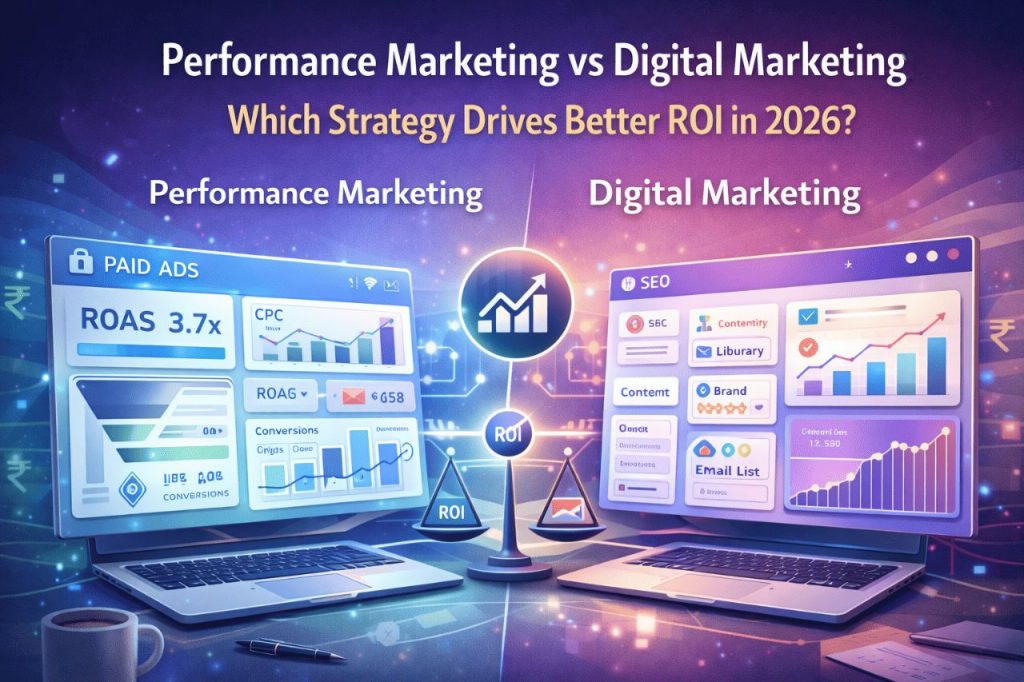
Every week, we get some version of the same question from business owners in Indore and across India.
“Should we be doing performance marketing or digital marketing?”
Sometimes it comes from a founder who just burned through ₹40,000 on Meta ads with almost nothing to show for it. Sometimes from a business that’s been blogging for a year but still gets zero organic traffic. And sometimes from someone who read a marketing article somewhere that made both sound equally important — without ever explaining which one to start with or why.
Here’s the honest answer: the question itself is slightly wrong.
Performance marketing is not the opposite of digital marketing. It is actually a part of it. But understanding the difference between the two — and more importantly, knowing when to lean on which one — is one of the most practically useful things any Indian business owner or marketer can figure out.
This article gives you that clarity. No jargon. No US-market frameworks that don’t apply to how businesses actually work in India. Just a clear breakdown of what each approach does, where each one earns its money, and how to think about combining them based on where your business actually is right now.
First, Let’s Settle What Each Term Actually Means
Digital Marketing
Digital marketing is the broad term for everything a business does to reach customers through digital channels. It includes:
- Search engine optimization (SEO)
- Content marketing and blogging
- Social media presence and community building
- Email marketing
- Video marketing on YouTube and Instagram
- Influencer partnerships
- Online reputation management
- WhatsApp marketing
The defining characteristic of digital marketing is that most of it is building something — an audience, a reputation, a body of content, a brand that people recognize and trust over time. The results compound. A blog post written today keeps bringing traffic three years from now. A YouTube channel built over 18 months keeps generating leads even when you’re not actively posting.
The downside is time. Digital marketing in its purest organic form requires patience that most businesses — especially those under revenue pressure — genuinely can’t afford to have.
Performance Marketing
Performance marketing is a specific type of digital marketing where you only pay when something measurable happens. A click. A lead form submission. A purchase. An app download.
It primarily covers:
- Google Search Ads and Shopping Ads
- Meta Ads (Facebook and Instagram)
- YouTube Ads
- LinkedIn Ads
- Affiliate marketing with commission-on-sale structures
- Retargeting campaigns across platforms
The defining characteristic here is accountability. Every rupee has a job. You can see — often within days of launching — whether a campaign is working or wasting money. You can pause what isn’t performing and scale what is.
The downside is dependency. The moment you stop spending, the traffic stops. You’re essentially renting attention rather than building it. And in India, where cost-per-click has been rising steadily on both Google and Meta over the last two years, that rent keeps going up.
The Relationship Between the Two
Think of it this way: digital marketing is the house. Performance marketing is one of the rooms in it.
Performance marketing cannot exist without digital infrastructure underneath it — landing pages, website content, brand presence, tracking setup. And digital marketing without any performance element tends to grow slowly for businesses that need revenue soon.
They are not rivals. They are different tools that solve different parts of the same problem.
The Real Difference That Matters for Indian Businesses
The distinction that actually changes decisions isn’t really about definitions. It is about what you are buying with your marketing budget.
Performance marketing buys results today. You spend ₹50,000 on Google Ads. You get a predictable number of leads or sales within the campaign period. You can calculate cost per lead and cost per acquisition. You know if it worked.
Digital marketing builds assets for tomorrow. You spend ₹50,000 on content, SEO, and social media over a month. Nothing dramatic happens this month. But three months from now, one of those articles starts ranking. Six months from now, you have 10 articles ranking and organic traffic that you no longer have to pay for every click on.
The question every Indian business owner needs to ask honestly is: do I need results this month or am I building for the next two years?
Most businesses need both — but in different proportions depending on their stage.
When Performance Marketing Makes Sense
You need revenue now and you have a product that sells
If you have validated that your product or service converts — people who try it like it, your pricing is right, your offer is clear — then performance marketing is the fastest way to pour fuel on that fire.
Running Google Search Ads for a service like “pest control Indore” or “chartered accountant Bhopal” puts you in front of people who are already searching for exactly what you offer. The intent is high. The conversion path is short. Done right, this is money in, money out — measurably.
Your sales cycle is short
The shorter the gap between discovery and purchase, the better performance marketing works. E-commerce, food delivery, local services, event bookings, courses with a clear enrollment window — these are performance marketing’s natural home.
When someone searches “buy noise-cancelling headphones under 3000” on Google Shopping, they are minutes away from buying. A well-placed ad at that moment is the most efficient spend in marketing.
You are running a time-sensitive campaign
Seasonal sales, Diwali offers, new product launches, limited-time enrollments for a course — these need immediate visibility. Performance marketing can be live within hours and paused just as quickly. Organic content cannot respond to a 10-day sale window.
You have solid tracking in place
This is a prerequisite most Indian businesses skip and then wonder why their ads aren’t profitable. Before spending serious money on performance campaigns, you need:
- Google Analytics 4 properly configured on your website
- Conversion events tracked (form fills, calls, purchases — whatever matters to your business)
- A clear understanding of what a customer is worth to you over their lifetime
Without this foundation, you are flying blind. You will spend money, see some activity on dashboards, and not be able to tell whether your campaigns are actually profitable.
When Digital Marketing Should Come First
You are a new brand that nobody has heard of
This is the reality many founders in India don’t factor in. Running ads for a brand nobody recognizes costs more and converts less. People scroll past unfamiliar names in their Instagram feed. They click on brands they’ve seen before or heard good things about.
Digital marketing — building content, getting active on social platforms, collecting early reviews, showing up consistently — creates the brand familiarity that makes your performance marketing significantly more effective later.
We’ve seen this pattern repeatedly with new clients: businesses that tried to run ads from day one, got poor results, gave up on “ads don’t work for us” — when the actual problem was that they hadn’t built enough brand presence for the ads to have something to work with.
Your sales cycle is long and involves multiple decision-makers
A factory owner considering a ₹15 lakh ERP software purchase is not clicking an Instagram ad and buying. They are reading articles, watching demo videos, asking people in their industry network, and spending weeks evaluating options.
For B2B businesses, professional services, high-ticket products, and anything involving institutional buyers — digital marketing does the heavy lifting. Your content educates. Your case studies build trust. Your thought leadership establishes credibility. By the time a prospect raises their hand and requests a demo, they already know who you are.
Trying to compress this journey into a paid ad click rarely works.
You have time and a tight budget
Performance marketing requires consistent spend to generate consistent results. If your budget is ₹15,000 to ₹20,000 a month, running paid campaigns on multiple platforms will spread it too thin to get meaningful data or results.
With that same budget applied to content and SEO over 12 months, you build compounding organic traffic that doesn’t require a monthly payment to maintain. It takes longer but it is far more sustainable and the ROI curve eventually crosses over.
You are in a trust-dependent industry
Healthcare, education, financial services, legal, and mental health — people in India do not buy these from brands they don’t trust. Content marketing that demonstrates genuine expertise, patient or client testimonials, educational videos, and a consistent online presence build that trust over time in a way that a paid ad simply cannot.
How to Think About Budget Allocation
There is no single formula here that works for every Indian business. But here is a practical framework based on what we see actually working across different business types.
New business, less than a year old
Spend more on digital marketing foundation. Claim your Google Business Profile and optimize it properly — this is free and for local businesses it generates real leads. Build your website content around the questions your customers actually ask. Get on two or three social platforms and be consistent. Run small, targeted performance campaigns (even ₹10,000 to ₹15,000 a month) to generate early revenue and test what converts — but do not expect ads alone to carry you at this stage.
Growing business, one to three years old, steady revenue
This is typically where the balance starts shifting toward performance marketing. You know your offer works. Your conversion rate is understood. Now it makes sense to scale leads through paid channels while simultaneously investing in content and SEO that will reduce your dependence on paid traffic 12 months from now.
A rough split for this stage: 60% of your marketing budget on performance channels that are working, 30% on digital marketing assets (content, SEO, email list growth), 10% experimenting with new channels.
Established business, strong brand, looking for efficiency
At this stage, digital marketing often starts delivering disproportionate returns. Your SEO is working, you have an email list, your organic social following refers business. The pressure on performance marketing for basic awareness reduces. You can focus paid spend on high-intent transactional keywords and retargeting — the most efficient performance marketing — while your organic presence handles much of the top-of-funnel work.
What Nobody Tells You About Performance Marketing in India
Rising costs are eating margins
Cost-per-click on Google Search for competitive Indian categories has risen significantly year over year. Categories like insurance, loans, real estate, and education have CPCs that make profitable acquisition genuinely difficult unless your margins and lifetime customer value are strong.
This is not a reason to avoid performance marketing — but it is a reason to go in with clear unit economics. Know your maximum acceptable cost per lead before you start. If your profit per customer is ₹3,000, spending ₹2,500 to acquire them leaves almost nothing. Know your numbers before the campaign starts, not after the budget is spent.
WhatsApp is India’s performance marketing secret weapon
Most performance marketing frameworks are written for Western markets where email does the conversion work. In India, WhatsApp is where conversions actually happen for a huge percentage of businesses.
The smartest Indian marketers are building funnels that run Google or Meta ads → landing page → WhatsApp chat for qualification → sale. The WhatsApp conversion step dramatically outperforms email in open rate, response rate, and speed to close. If your performance marketing funnel ends at a form submission and you follow up by email, you are leaving significant conversion on the table.
Brand recognition reduces your ad costs
Google and Meta both reward familiarity. When someone has seen your brand before — through organic content, social media, or word of mouth — they are more likely to click your ad and more likely to convert. This drives up your Quality Score on Google and your relevance score on Meta, both of which reduce your cost per click.
This is the hidden financial case for investing in digital marketing even when you mainly care about performance marketing results. Your organic brand-building directly subsidizes your paid campaigns.
What Nobody Tells You About Digital Marketing in India
Most organic content takes longer than people expect
Indian businesses frequently start content marketing expecting to see results in 30 to 60 days. The realistic timeline for a new piece of content to rank meaningfully on Google is 3 to 6 months for low-competition keywords, and 6 to 12 months for anything moderately competitive.
This is not a reason not to do it — compounding returns over years make it extremely worthwhile. But going in with wrong expectations leads to quitting before the results arrive.
Content that ranks in the US does not always rank in India
Search behaviour in India is different. Indian searchers add city names to queries far more often. They search for price information more explicitly (“fees,” “charges,” “cost in India”). They use more question-based searches on mobile. They increasingly search in Hindi and regional languages.
Generic English-language content lifted from US marketing blogs rarely ranks well for Indian audiences. Content written with genuine India-specific context, local examples, and an understanding of how Indian consumers actually phrase their searches has a significant advantage.
Consistency beats excellence in the early stages
Many Indian businesses invest weeks perfecting one piece of content, publish it, see modest initial results, and conclude that content marketing doesn’t work for them. The reality is that Google builds trust through consistency over time. Ten decent articles published consistently over six months will outperform two brilliant articles published and then nothing.
Start before you are ready. Improve as you go.
The Integration That Actually Works
The businesses we see generating the most consistent growth in India are not choosing between performance marketing and digital marketing. They are using both in a deliberate sequence.
The basic pattern looks like this:
Phase 1 — Build the Foundation (Months 1–3) Get the website right. Set up Google Business Profile. Start producing content around your core keywords. Set up proper conversion tracking. Run a small, tight performance campaign to generate early revenue and test what converts.
Phase 2 — Scale What Works (Months 4–9) Double down on the performance channels showing positive ROI. Use data from your paid campaigns (which keywords convert, which audiences respond) to guide your organic content strategy. Start building your email list or WhatsApp broadcast list from organic traffic.
Phase 3 — Build the Moat (Months 10–24) By now, organic traffic is meaningful. Retargeting audiences from your content visitors gives you much cheaper paid conversion rates. Your brand recognition is reducing your cost per click. Your email or WhatsApp list is generating revenue at nearly zero marginal cost. Performance marketing is more efficient because it is operating on top of a brand people recognize.
This is the compounding effect. Most businesses never reach Phase 3 because they quit performance marketing after a bad month in Phase 1 or quit content marketing after four months of low traffic. The ones that stay consistent and move through all three phases end up with a marketing engine that gets cheaper and more effective over time.
A Quick Decision Guide
Use this if you are trying to figure out where to focus right now:
Focus on performance marketing first if:
- You have a working product and need leads or sales now
- You have clear conversion tracking set up
- Your sales cycle is short (days, not months)
- You have at least ₹30,000–₹50,000 per month to spend consistently
- You are running a time-limited offer or seasonal campaign
Focus on digital marketing first if:
- You are a new brand with limited budget and time to build
- You are in B2B or high-ticket services with long decision cycles
- Your industry requires trust-building before purchase (healthcare, education, finance)
- You want to reduce long-term dependence on paid ad spend
- You have content expertise or can produce it cost-effectively
Do both if:
- You have the budget to run at least ₹25,000–₹30,000/month on paid while also investing in content
- You have validated product-market fit and want to build sustainable growth
- You are post-revenue and thinking about the next 12 to 24 months
Digital Dawn is a digital marketing and performance marketing agency based in Indore. We help Indian businesses across industries build marketing strategies that combine sustainable organic growth with measurable paid results. If you want a clear view of what your business specifically needs — and what it doesn’t — get in touch with our team.