
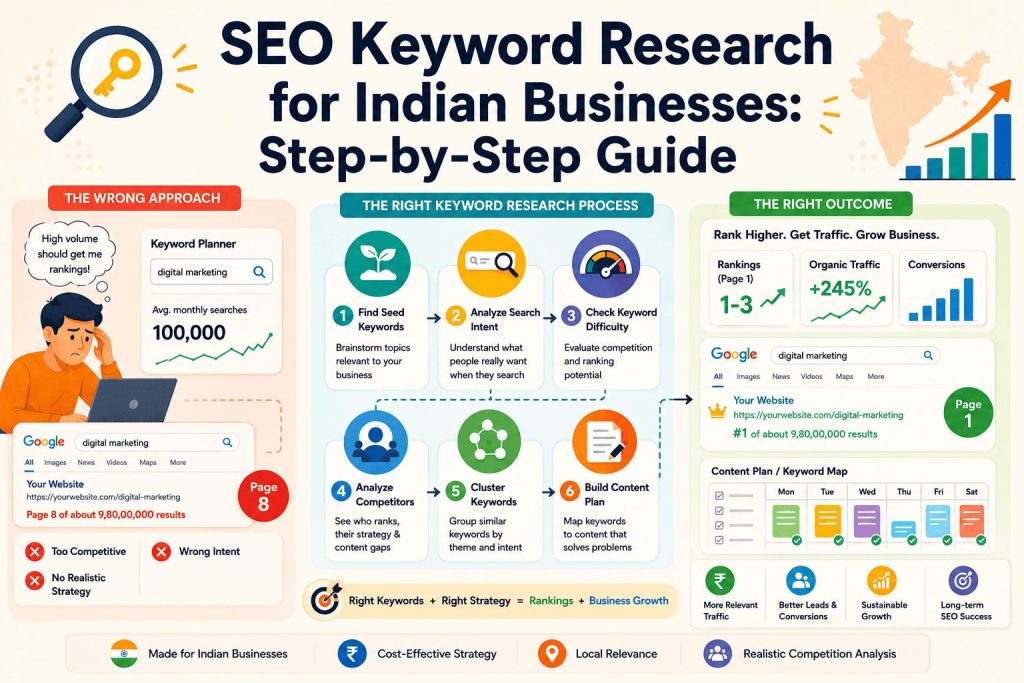
Most businesses approach SEO keyword research the wrong way. They open Google Keyword Planner, type in a broad term like “digital marketing,” see that it gets 100,000 searches a month, and decide to target it.
Six months later, nothing has moved. The page sits somewhere on page 8. Traffic is zero.
The problem isn’t the tool. It’s the approach. Targeting a high-volume keyword without understanding why people search for it, who else is targeting it, and whether your website can realistically compete for it — that’s not keyword research. That’s guessing with extra steps.
This guide walks you through how keyword research actually works in 2026 — specifically for Indian businesses and marketers. We’ll cover the full process from finding your first seed keywords to building a content plan that gives every piece you publish a real chance of ranking.
No fluff. No generic advice that applies equally to a Fortune 500 company in the US and a boutique clothing brand in Indore. Just a practical, step-by-step system you can start using today.
What Is SEO Keyword Research (And Why Most People Get It Wrong)
SEO keyword research is the process of identifying the exact words and phrases your target audience types into Google when they’re looking for something — and then deciding which of those terms are worth creating content around.
Simple enough in theory. But here’s where most Indian marketers go wrong:
They treat keyword research as a one-time task rather than a strategic foundation. They pick keywords based on search volume alone, ignoring search intent, keyword difficulty, and whether they can actually compete. And they research keywords in isolation — without thinking about how those keywords connect to their business goals.
In 2026, Google’s algorithm is significantly better at understanding context than it was even two years ago. It doesn’t just match keywords — it evaluates whether your content genuinely addresses what the searcher is trying to accomplish. This means keyword research today isn’t just about finding popular terms. It’s about deeply understanding what your audience wants and creating content that satisfies that need better than anyone else does.
Get this right and keyword research becomes the foundation of everything — your blog strategy, your service page copy, your internal linking structure, and your content calendar. Get it wrong and you end up publishing content nobody searches for, or content that can’t rank because you’re competing with HubSpot and Ahrefs for the same term.
The Four Types of Search Intent You Must Understand First
Before you research a single keyword, you need to understand search intent — the reason behind a search query. Google groups search intent into four categories, and knowing which one applies to your keyword determines what kind of content you need to create.
1. Informational Intent
The person wants to learn something. They’re not ready to buy. They’re in research mode.
Examples:
- “how to do keyword research”
- “what is SEO”
- “why is my website not ranking”
Best content format: Blog posts, guides, tutorials, explainers.
2. Navigational Intent
The person is looking for a specific website or brand. They already know where they want to go.
Examples:
- “Google Search Console login”
- “Ahrefs keyword explorer”
- “Digital Dawn Indore”
Best content format: Your homepage or brand page. You can’t rank someone else’s navigational queries.
3. Commercial Intent
The person is comparing options before making a decision. They’re close to buying but not quite there.
Examples:
- “best SEO tools for Indian businesses”
- “Ahrefs vs Semrush India”
- “digital marketing agency Indore reviews”
Best content format: Comparison posts, reviews, listicles, case studies.
4. Transactional Intent
The person is ready to take action — buy, sign up, download, or contact.
Examples:
- “hire SEO agency Indore”
- “buy Ahrefs subscription India”
- “digital marketing course Indore fees”
Best content format: Service pages, product pages, landing pages with a clear CTA.
Why this matters: If you create a blog post targeting a transactional keyword, you’ll struggle to rank because Google expects a service page or product page for that query. Mismatching content format to search intent is one of the most common and costly keyword research mistakes.
Before you do anything else with a keyword, ask: what does someone actually want when they search for this?
Step 1: Start With Seed Keywords
A seed keyword is a broad, short term that describes your business, product, or service. It’s the starting point — not something you target directly, but something you use to generate more specific keyword ideas.
Think of your seed keywords as the trunk of a tree. Every branch that grows from it is a potential keyword to target.
How to find your seed keywords:
Start by writing down the core topics your business covers. For a digital marketing agency like Digital Dawn in Indore, that might look like:
- SEO
- Social media marketing
- Google Ads
- Content marketing
- Digital marketing course
- Ecommerce marketing
Each of these becomes a seed keyword. From “SEO” alone, you can generate hundreds of more specific keyword ideas — “SEO services Indore,” “how to do SEO for small business India,” “SEO tools free India,” “local SEO Indore,” and so on.
India-specific tip: Think about how your Indian audience phrases things. Indian searchers often use slightly different language than US or UK searchers. “Digital marketing course fees” is searched far more in India than “digital marketing course cost.” “Best SEO tool free” is more common than “free SEO software.” Pay attention to how your clients and customers actually phrase questions in conversations — those phrases are often your best seed keywords.
Step 2: Use the Right Keyword Research Tools
You don’t need to pay for every tool on this list. A combination of free tools gets you 80% of the way. Here’s what works, what each tool is best for, and how to use them practically.
Google Keyword Planner (Free)
Best for: Getting accurate search volume data for India, finding keyword ideas directly from Google’s own data.
How to use it:
- Sign in to Google Ads (you don’t need to run ads to use the Keyword Planner)
- Go to Tools → Keyword Planner → Discover New Keywords
- Enter your seed keyword
- Set the location to India (or a specific state or city if you’re doing local SEO)
- Look at the monthly search volume, competition level, and suggested bid
The suggested bid column is actually useful for SEO even if you’re not running ads — a higher bid means higher commercial intent, which tells you advertisers consider this keyword valuable.
One important thing to know: Google Keyword Planner shows search volume in ranges (like 1K–10K) rather than exact numbers on the free tier. It’s enough to understand relative popularity, but for more precise data you’ll need a paid tool.
Google Search Console (Free)
Best for: Finding keywords your website already ranks for (even weakly), identifying pages with ranking potential you haven’t fully optimised yet.
How to use it:
- Go to Search Console → Performance → Search Results
- Look at queries where your average position is between 8 and 20
- These are pages on the edge of page 1 — a targeted content update can push them onto page 1 and significantly increase clicks
This is one of the highest-ROI activities in SEO and most Indian businesses completely ignore it.
Google Suggest and People Also Ask (Free)
Best for: Finding long-tail keywords and understanding exactly how people phrase searches.
How to use it: Start typing your seed keyword into Google’s search bar and pay attention to the autocomplete suggestions. These are real searches people are making right now. Every suggestion is a potential keyword.
Then look at the “People Also Ask” box that appears in search results. Each question there is a keyword opportunity — and content that directly answers one of these questions has a strong chance of appearing in Google’s featured snippets and AI Overviews.
India-specific tip: Search from an Indian IP address (or use a VPN set to India) for more locally relevant suggestions. The autocomplete suggestions in India are often different from what you’d see in a US-based search.
Ubersuggest (Free tier available)
Best for: Getting keyword ideas, basic difficulty scores, and competitor keyword data without paying for a premium tool.
Neil Patel’s Ubersuggest gives you a solid amount of keyword data on the free plan — enough for a small business or blogger to do meaningful research. The India-specific data has improved significantly in recent years.
Ahrefs or Semrush (Paid — from ~₹8,000–₹10,000/month)
Best for: Deep competitor analysis, accurate keyword difficulty scores, backlink research, and finding content gaps.
If you’re a digital marketing agency or a business investing seriously in SEO, one of these tools is worth the cost. The competitor analysis features alone can save weeks of guesswork — you can see exactly which keywords your competitors rank for and find the gaps where they’re weak.
For Indian businesses on a budget: Start with the free tools until you’re publishing content consistently. Invest in a paid tool once you’re producing at least 4 to 6 pieces of content per month and need to scale your research.
Google Trends (Free)
Best for: Understanding seasonal trends in India, comparing keyword popularity across states, spotting rising topics before they become competitive.
Google Trends is massively underused by Indian marketers. You can filter data by country, state, and even city — which means you can see whether “digital marketing course” is trending more in Indore, Bhopal, or Nagpur this month. For local businesses, this hyper-local data is invaluable.
Step 3: Analyse Keyword Difficulty and Search Volume Together
Here’s a mistake that kills keyword strategies: choosing keywords based on search volume alone.
A keyword with 50,000 monthly searches means nothing if every result on page 1 is from HubSpot, Neil Patel, Ahrefs, and Moz — all with domain authorities above 80 and thousands of backlinks. A newer Indian website simply cannot compete for those terms yet, no matter how good the content is.
The smart approach is to evaluate three metrics together:
1. Search Volume
How many people search for this term per month in India? Higher is better, but only if the other two metrics also work in your favour.
2. Keyword Difficulty (KD)
How hard is it to rank on page 1 for this term? Tools like Ahrefs and Semrush give this as a score from 0 to 100. As a rough guide:
| KD Score | Difficulty | Good for |
|---|---|---|
| 0–20 | Easy | New websites, local businesses |
| 21–40 | Moderate | Sites with some authority |
| 41–60 | Hard | Established sites with backlinks |
| 61–80 | Very Hard | High-authority sites |
| 81–100 | Extremely Hard | National/global brands only |
If you’re a new or mid-authority Indian website, focus primarily on keywords with a KD below 40. You’ll rank faster, build confidence, and accumulate authority that eventually lets you compete for harder terms.
3. Business Relevance
Will ranking for this keyword bring the right people to your site — people who might actually become customers or clients?
A digital marketing agency in Indore ranking for “how to make chai at home” would get traffic, but zero business value. Every keyword you target should connect to something your business actually offers.
The sweet spot for most Indian small businesses and agencies: keywords with moderate search volume (500 to 5,000 searches/month in India), low to moderate difficulty (KD below 40), and high business relevance.
Step 4: Understand the Keyword Landscape in India
Indian search behaviour has some specific characteristics that change how you do keyword research here.
Hindi and Regional Language Searches Are Growing
A significant and growing percentage of Indian searches happen in Hindi, Tamil, Telugu, Marathi, and other regional languages. If your business serves a vernacular audience, ignoring regional language keywords is a major missed opportunity. Google Keyword Planner allows you to research keywords in Hindi and other Indian languages — use it.
Even for English-language content, being aware of how Indian users phrase things matters. Common differences:
- Indians often use “how to” at the start of queries more frequently
- Price-related searches are very common (“digital marketing course fees Indore,” “SEO services cost India”)
- City-specific searches are high-intent — “digital marketing agency Indore” has much lower competition than “digital marketing agency India”
Mobile-First Searches
Over 70% of Indian internet users primarily access the internet on mobile. This means voice search queries, shorter searches, and conversational phrasing are more prevalent than in desktop-heavy markets. Include question-based keywords in your research — “how do I do SEO for my website” is a real mobile voice search in India.
Local Intent Is Strong
Indian searchers frequently add city names to their searches — “SEO services Indore,” “best digital marketing course Bhopal,” “ecommerce agency Nagpur.” These local keywords often have low competition and very high intent. For a local agency, these are often easier to rank for and convert far better than generic national terms.
Step 5: Do Competitor Keyword Research
You don’t need to start from scratch. Your competitors have already spent months or years figuring out which keywords work in your niche. All you need to do is learn from their work — then do it better.
How to do competitor keyword research:
Using Ahrefs or Semrush
- Enter a competitor’s domain into the tool
- Go to their “Organic Keywords” report
- Filter for keywords where they rank in positions 1 to 10
- Look for keywords that are relevant to your business but where their content is weak or outdated
Using Google Search Console (Your Own Site)
- Go to Performance → Search Results
- Filter by pages that rank between position 11 and 30
- These are your “near miss” keywords — pages almost on page 1 that could rank with targeted improvements
Manual Competitor Research (Free)
- Search for your target keyword in Google
- Open the top 5 results
- Read them carefully — what are they covering that you aren’t? What questions do they leave unanswered? Where are they thin or outdated?
- Your content should cover everything they cover, plus answer the questions they leave open
The content gap strategy: This is where real keyword wins happen for Indian businesses. Find keywords your competitors rank for where their content is outdated, thin, or doesn’t address the Indian context specifically. Write a better, more current, more India-relevant version. This is how smaller Indian sites regularly outrank larger ones.
Step 6: Categorize Keywords by Search Intent and Funnel Stage
Once you have a list of keywords, organize them before you start creating content. This stops you from creating duplicate content and ensures you’re covering every stage of the customer journey.
A simple way to organize your keywords:
| Funnel Stage | Search Intent | Keyword Examples | Content Type |
|---|---|---|---|
| Top of funnel | Informational | “what is keyword research,” “how does SEO work” | Blog posts, guides |
| Middle of funnel | Commercial | “best SEO tools India,” “SEO agency vs in-house” | Comparison posts, case studies |
| Bottom of funnel | Transactional | “SEO agency Indore,” “hire SEO expert India” | Service pages, landing pages |
Map each keyword to a specific page on your website — or a page you plan to create. This “keyword map” ensures every page has a clear primary keyword and no two pages are competing for the same term.
Step 7: Prioritize Keywords Using the ICE Framework
You’ll end up with more keywords than you can immediately create content for. Use the ICE framework to decide what to work on first.
ICE = Impact × Confidence × Ease
Score each keyword from 1 to 10 on three factors:
- Impact: How much would ranking for this keyword move the needle for your business?
- Confidence: How confident are you that you can rank for it given your current domain authority?
- Ease: How quickly can you create quality content for this keyword?
Multiply the three scores together. Keywords with the highest ICE scores get prioritized first.
Practical example for a digital marketing agency in Indore:
| Keyword | Impact | Confidence | Ease | ICE Score |
|---|---|---|---|---|
| digital marketing agency Indore | 10 | 7 | 6 | 420 |
| content repurposing strategy India | 7 | 9 | 8 | 504 |
| SEO services India | 6 | 3 | 5 | 90 |
| keyword research tools free India | 7 | 8 | 7 | 392 |
In this example, “content repurposing strategy India” scores highest — not the most glamorous keyword, but the most achievable with high business impact. “SEO services India” sounds attractive but scores low because it’s extremely competitive.
Step 8: Long-Tail Keywords — The Fastest Path to Ranking
If you’re a newer website or a local Indian business, long-tail keywords are your best friend.
Long-tail keywords are longer, more specific phrases — usually three to five words or more. They have lower search volume individually, but several important advantages:
Lower competition. Because they’re specific, fewer websites target them. A new website can realistically rank on page 1 for a long-tail keyword within weeks, whereas a broad term might take 12 to 18 months.
Higher conversion rate. Someone searching “digital marketing course Indore for beginners under 10000 rupees” is much closer to enrolling than someone searching “digital marketing course.” The specificity signals intent.
They add up. Ranking for 50 long-tail keywords each getting 100 searches a month gives you 5,000 monthly visitors — often more consistent and valuable than chasing one high-volume term.
How to find long-tail keywords:
- Use Google’s “People Also Ask” and autocomplete suggestions
- Look at keyword ideas in Ubersuggest or Google Keyword Planner filtered for low competition
- Check forums like Quora and Reddit India for the exact language people use when asking questions in your niche
- Read comments on competitor blog posts — the questions in comments are long-tail keyword ideas
India-specific long-tail opportunities: City-specific keywords, price-related keywords (“cost,” “fees,” “charges”), comparison keywords (“X vs Y India”), and how-to keywords with India context (“how to do SEO for Indian website”) all tend to be lower competition and higher intent in the Indian market.
Step 9: Keyword Research for AI Tools and Google’s AI Overviews
This is new and most Indian SEOs are not thinking about it yet. In 2026, a growing percentage of searches are answered by Google’s AI Overviews — the AI-generated summary that appears above organic results. ChatGPT, Perplexity, and Gemini also directly answer questions that people used to Google for.
To get your content cited in these AI answers, you need to do one additional step in your keyword research: identify question-based keywords.
AI tools are designed to answer questions directly. Content that is structured around questions — with clear, concise answers followed by deeper explanation — is significantly more likely to be pulled into AI Overviews and cited by Perplexity or ChatGPT.
How to find question-based keywords:
- Take any keyword and type it into Google — look at the “People Also Ask” box
- Use a tool like AnswerThePublic.com to generate question variations of your seed keywords
- Check Quora for questions in your niche — if people are asking it on Quora, they’re searching it on Google too
How to structure content for AI citations:
- Answer the main question directly in the first 2 to 3 sentences of each section
- Use H2 and H3 subheadings written as questions
- Include a dedicated FAQ section at the end with concise, direct answers
- Use structured data (FAQ schema in Rank Math or Yoast) to signal the Q&A structure to search engines
This approach doesn’t just help with AI tools — it also improves your chances of ranking in Google’s featured snippets, which can drive significant traffic even for keywords where you’re not in position 1.
Step 10: Build a Keyword Map for Your Website
Once you’ve completed your keyword research, the final step is organizing everything into a keyword map — a document that assigns a primary keyword to every existing and planned page on your website.
A basic keyword map looks like this:
| Page | Primary Keyword | Secondary Keywords | Intent | Status |
|---|---|---|---|---|
| Homepage | digital marketing agency Indore | digital marketing services Indore | Navigational/Transactional | Existing |
| SEO Services page | SEO services Indore | SEO company Indore, best SEO agency Indore | Transactional | Existing |
| Blog: Keyword Research | SEO keyword research India | keyword research tools India, how to do keyword research | Informational | Update needed |
| Blog: Content Repurposing | content repurposing strategy India | repurpose blog posts India | Informational | Planned |
This document becomes your content calendar. Every new piece you publish has a clear target keyword, clear intent, and a defined purpose. No more publishing and hoping — every piece of content is a planned investment.
Common Keyword Research Mistakes Indian Businesses Make
Targeting Only High-Volume Keywords
Volume is vanity. A keyword with 100,000 monthly searches that you can’t rank for drives zero traffic. A keyword with 800 monthly searches that you rank #2 for drives meaningful, consistent traffic every month. Build volume through multiple ranked pages, not by chasing one impossible term.
Ignoring Search Intent
If someone searches “best SEO tools” and you write a blog post trying to sell them your SEO services, you’ve misread the intent. That search wants a comparison or list post — not a sales pitch. Mismatched intent means low rankings, high bounce rate, and wasted effort.
Keyword Cannibalism
This happens when two pages on your own website target the same keyword. They end up competing against each other instead of reinforcing each other. Google doesn’t know which one to rank and often ranks neither well. Your keyword map prevents this.
Skipping Local Keywords
For any Indian business with a physical location or serving a specific city, local keywords are almost always lower competition and higher intent than national terms. “Digital marketing agency Indore” is far more winnable than “digital marketing agency India” and converts much better because the searcher is looking for someone local.
Doing Research Once and Never Updating It
Keyword research is not a one-time activity. Search behaviour changes. New competitors enter the market. Google updates its algorithm. Topics that were low competition six months ago may be flooded now. Revisit your keyword research every three to six months and update your content accordingly.
Copying Competitor Keywords Blindly
Your competitor’s keyword strategy was built for their website, their domain authority, and their audience. A keyword that works well for an established Mumbai agency may be completely out of reach for a newer Indore agency. Always filter competitor keywords through your own difficulty and relevance assessment.
Keyword Research Checklist (Save This)
Use this checklist every time you research keywords for a new piece of content:
- [ ] Identified seed keywords related to the topic
- [ ] Used at least 2 tools to generate keyword ideas
- [ ] Checked search volume specifically for India
- [ ] Verified keyword difficulty against your site’s current authority
- [ ] Identified search intent (informational / commercial / transactional)
- [ ] Checked what’s currently ranking on page 1 for this keyword
- [ ] Confirmed no other page on your site already targets this keyword
- [ ] Identified 3 to 5 related/secondary keywords to include naturally
- [ ] Found 2 to 3 “People Also Ask” questions to answer in the content
- [ ] Added the keyword to your site’s keyword map
Need help building a keyword strategy for your business? Digital Dawn is a digital marketing agency based in Indore helping Indian businesses grow through SEO, content marketing, and performance campaigns. Get in touch with our team to discuss your SEO goals.