
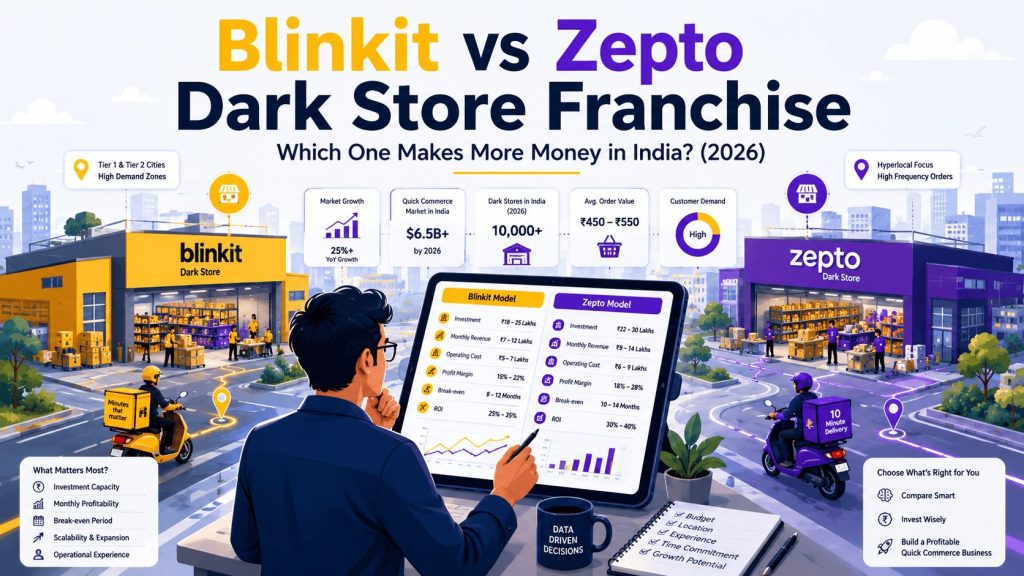
Both Blinkit and Zepto are actively signing up dark store partners across India. The investment numbers, profit models, and risk profiles are very different. Here is exactly what each pays, what each demands, and who should choose which.
If you have been researching quick commerce business opportunities in India, you have probably landed on the same two names: Blinkit and Zepto. Both are growing aggressively. Both need dark store partners in cities across India. And both are actively recruiting right now.
But they are not the same opportunity. The investment required is different, the profit model is different, the risk you carry is different, and the kind of entrepreneur each model suits is very different.
This article goes through the real numbers — not the optimistic projections you will find on franchise aggregator sites, but the actual figures from investor disclosures, operator interviews, and financial analysis. By the end, you will know exactly which platform makes more sense for your budget, your experience level, and your city.
Zomato / Eternal Group
Blinkit
FOFO model. You own inventory and operations. Higher risk, higher reward. Market leader with 46% share.
Standalone / VC-backed
Zepto
COFO model. Zepto owns inventory. You run operations. Lower risk, capped upside. Fastest-growing challenger.
The quick commerce opportunity in 2026: why this matters now
India’s quick commerce market crossed ₹25,000 crore in 2026 and is growing at over 75% annually. More than 67% of all online grocery orders in India now go through quick commerce platforms — a fundamental shift in how urban India shops. The sector is projected to hit $65–70 billion by 2030.
46%
29%
6,000+
Both Blinkit and Zepto are expanding their dark store networks aggressively. Blinkit crossed 2,000 stores and is targeting 3,000 by March 2027. Zepto operates 1,000+ stores across 25+ cities. Both need partners in new locations — which is exactly the opportunity.
But before you get into the application process, understand what you are actually signing up for.
How each model actually works
The biggest mistake most people make when researching these opportunities is assuming they work the same way as a traditional franchise. They do not. And more importantly, Blinkit and Zepto work very differently from each other.
- You own the dark store space
- You own and fund the inventory
- You hire and manage all staff
- Blinkit provides tech, app, branding
- You earn commission per order fulfilled
- You bear spoilage and theft risk
- Higher investment, higher potential returns
- Zepto owns the inventory
- You provide warehouse space
- You hire and manage all staff
- Zepto provides tech, supply chain, app
- You earn 10–12% of net store revenue
- You are shielded from spoilage risk
- Lower investment, capped upside
The key difference is inventory ownership. With Blinkit, you buy the stock. When something spoils or gets stolen, that is your loss. With Zepto’s COFO model, Zepto owns the stock — you just manage the operations of picking, packing, and dispatching orders. Your risk is lower, but so is your maximum earning potential.
💡 Think of it this way:
Blinkit is closer to owning a business. Zepto is closer to running one for someone else. Both can make money. Which one suits you depends on your capital, your risk appetite, and how much control you want over the operation.
What does each actually cost to set up?
Investment figures for dark store franchises vary widely across the internet — some sources quote ₹10 lakh, others quote ₹1 crore. The variation is real because it depends on city tier, store size, and which cost components you include. Here is an honest breakdown of what you actually need.
| Cost Component | Blinkit (FOFO) | Zepto (COFO) |
|---|---|---|
| Franchise / Brand Fee | ₹2–5 lakh (city-dependent) | ₹1–3 lakh (one-time) |
| Store Setup (racks, freezers, fit-out) | ₹7–12 lakh | ₹5–10 lakh |
| Security Deposit | Not applicable | ₹50–70 lakh (refundable bank guarantee) |
| Rent Deposit (3 months) | ₹3–6 lakh | ₹3–5 lakh |
| Initial Inventory | ₹20–35 lakh (funded by you) | Inventory funded by Zepto |
| Working Capital (3 months) | ₹5–10 lakh | ₹3–5 lakh |
| Space Required | 2,000–3,000 sq ft | 1,500–3,000 sq ft |
| Staff Required | 15–25 people | 30–35 people |
| Total Estimated Investment (Metro Cities) | ₹40–80 lakh | ₹60–80 lakh |
| Total Estimated Investment (Tier 2 Cities) | ₹20–40 lakh | ₹30–50 lakh |
📌 The Zepto bank guarantee is important to understand:
Zepto requires a refundable security deposit or bank guarantee of ₹50–70 lakh in most metro city setups. This money is not “spent” — it comes back to you at the end of the contract if you meet all terms. But it does mean your capital is locked up. Factor this into your liquidity planning, not just your investment calculation.
The real profit numbers: what each pays per month
This is what everyone really wants to know. Let’s go through the math for a mature, well-located dark store doing reasonable order volumes — not best-case projections, but what actually works out in practice.
| Metric | Blinkit FOFO – Mature Metro Store | Zepto COFO – Mature Metro Store |
|---|---|---|
| Daily Orders (Average) | 1,000–1,200 orders | 400–600 orders |
| Average Order Value (AOV) | ₹450–500 | Not publicly disclosed |
| Monthly Gross Revenue | ₹50–60 lakh | ₹35–60 lakh |
| Platform Commission / Revenue Share | Blinkit Commission: 2.5% (₹1.25–1.5 lakh) | Your Revenue Share: 10–12% of net revenue (₹3.5–7.2 lakh) |
| Rent, Electricity & Salaries | ₹8–12 lakh | ₹6–10 lakh |
| Royalty / Platform Fees | Royalty, Tech & Marketing Fees: 8–15% (₹4–9 lakh) | Royalty Fee: 5–7% (₹1.75–4.2 lakh) |
| Spoilage & Shrinkage | 1.5–3% (₹75,000–1.8 lakh) | ₹0 (Zepto owns the inventory) |
| Estimated Net Monthly Profit | ₹2–6 lakh | ₹1.5–4 lakh |
On paper, a well-run Blinkit FOFO store makes more money. But it also requires more capital, carries inventory risk, and demands closer operational involvement. Zepto’s COFO store makes less at the top end but requires no inventory management and has a lower risk floor.
A detailed financial analysis of the Zepto COFO model — factoring in the refundable bank guarantee and the full 5-year revenue picture — found an XIRR of approximately 23.5% annually. For context, a fixed deposit in India currently yields 6.5–7.5%. Quick commerce wins on returns, but the comparison is not entirely fair because of the significantly higher operational involvement and risk.
How long to break even and get your money back?
| Metric | Blinkit (FOFO) | Zepto (COFO) |
|---|---|---|
| Break-even (Revenue vs. Costs) | 6–12 months | 6–12 months |
| Full ROI (Recover Total Investment) | 18–24 months | 18–24 months |
| Annual Return Potential | 25–35% (Higher) | 20–25% (≈23.5% XIRR modeled) |
| Monthly Profit Floor (Bad Month) | ₹50,000–1 lakh | ₹75,000–1.5 lakh (More Stable) |
| Monthly Profit Ceiling (Great Month) | ₹5–8 lakh (Higher) | ₹3–5 lakh |
| Inventory Spoilage Risk | Yes, 1.5–3% revenue loss | No, Zepto absorbs the inventory risk |
| Can You Open Multiple Stores? | No, typically one store per city per operator | Yes, multiple stores are allowed |
Blinkit prohibits franchisees from operating multiple stores within the same city. Once your store hits approximately 1,500 orders on weekdays or 2,500 on weekends, Blinkit opens a new store nearby — under a different owner. Your order volume gets split. This puts a hard ceiling on how much any single Blinkit store can earn, and limits your scaling potential. Zepto does not have this restriction.
The risks nobody talks about upfront
Every franchise aggregator website lists the benefits. Very few list the actual risks in plain language. Here they are.
⚠️ Platform algorithm risk — applies to both
The platform’s algorithm decides how many orders your store gets. A new dark store opening 500 metres from yours can cut your volume overnight. You have no say in this. Blinkit and Zepto both make location and order allocation decisions unilaterally. Franchisees have very limited leverage in these decisions.
⚠️ Perishables loss — Blinkit only
Under the Blinkit FOFO model, you own the inventory. High-perishable items like fruits, vegetables, and dairy that do not sell are your loss. Shrinkage from spoilage typically runs 1.5 to 3% of revenue in a well-managed store — and higher in a poorly managed one. A ₹50 lakh monthly revenue store losing 2% to spoilage is ₹1 lakh gone every month before you count anything else. In the Zepto COFO model, Zepto absorbs this risk entirely.
⚠️ Staffing intensity — both
Running a dark store is operationally demanding. Pickers must pack orders within 2.5 minutes for a 10-minute delivery to be possible. Staff attrition in this segment is very high. Both Blinkit and Zepto require 15 to 35 staff depending on store size. Finding, training, and retaining reliable people — especially pickers and delivery riders in smaller cities — is consistently cited as the hardest part of the business by existing operators.
⚠️ Platform dependency — both
Your entire revenue depends on one platform’s decisions on pricing, commissions, and order allocation. Both Blinkit and Zepto can change commission structures, payout timelines, and operational requirements at any time. Your contract gives you limited protection against this. Before signing, read the partner agreement carefully — specifically the clauses around commission changes, store closure, and exit terms.
⚠️ Funding risk — Zepto specifically
Zepto is not yet publicly listed and is still VC-funded. Blinkit is backed by Zomato (Eternal Limited), which is a publicly traded and profitable company. If Zepto’s funding situation changes or its growth trajectory slows, operational and payment continuity could be affected. This is not a prediction — Zepto is well-funded and growing — but it is a risk that does not exist with Blinkit to the same degree.
Which cities and locations work best?
🇮🇳 Location is everything in dark store economics
Location quality affects Blinkit profitability by 35–40%. High-density urban areas with residents in the ₹50,000+ monthly income bracket generate 28% higher average order values than lower-income zones. Population density matters too — every additional 10,000 people within your delivery radius increases order volume by approximately 15%.
For Blinkit specifically, tier 1 metro locations (Delhi, Mumbai, Bengaluru) see franchise fees of ₹4–5 lakh and higher investment but also the highest order volumes. Tier 2 cities (Pune, Indore, Chandigarh, Jaipur) see fees of ₹3–4 lakh with lower investment and increasingly competitive order volumes as both platforms expand.
For Zepto, tier 2 expansion is particularly attractive right now. Real estate costs are 40–60% lower than metros, operational costs are lower, and competition from other dark stores is less intense. Zepto’s net margins in tier 2 cities are often higher than in metros even though gross revenues are lower.
How to apply for each program
Visit Blinkit’s official partner page at blinkit.com/partner or go through the Blinkit app. Look for the Partner with Us section. Fill in the application form with your personal details, proposed location, financial capacity, and business experience. Blinkit’s business development team will review your application and conduct a feasibility assessment of your proposed location based on demand density and existing coverage.
If your location clears feasibility, you will get a call from the BD team. They assess the specific site — accessibility, floor space, loading bay access — before issuing a Letter of Intent. After signing and paying the franchise fee, Blinkit provides a store setup guide and operational support for the first 30 days.
You will need: GST registration, PAN card, proof of property ownership or lease agreement, and proof of investment capacity. Blinkit does not publicly advertise a waiting list — in practice, approval timelines range from 4 to 12 weeks depending on your city and the current expansion pace.
Visit Zepto’s official website and look for the Growth Partners or Dark Store Partner section. You can also email merchantsupport@zeptonow.com or enquire through darkstoresfranchise.com. Fill in the application with your proposed location, investment capacity, and operational background. Zepto specifically looks for partners with prior business management experience — running a team of 30+ people is a significant requirement and they prefer applicants who have done it before.
Zepto’s approval process includes a location feasibility check, a financial background review, and an in-person meeting with the local BD team. After approval, you sign the Growth Partner Agreement, arrange the bank guarantee, and Zepto provides construction and setup manuals to guide the store buildout.
Training runs for 2–3 weeks and covers operations, technology, inventory management, and SLA compliance. The store typically goes live 6–10 weeks after signing, depending on construction time and location-specific factors.
Blinkit or Zepto: who should choose which?
You have ₹50–80 lakh in capital ready to invest and are comfortable with inventory risk. You have prior experience in retail, FMCG distribution, or warehouse operations. You want to be fully in charge of the business rather than operating on someone else’s terms. You are in a dense metro neighborhood with 50,000+ people within 2 km. You are not planning to scale to multiple stores — you want to optimise one location and run it well. The Blinkit brand is the strongest in quick commerce right now and that matters for your location’s order density.
You are relatively new to running a warehouse or fulfilment operation and want to learn without betting your working capital on inventory. You have the bank guarantee capital (₹50–70 lakh refundable) but want lower operational risk on a day-to-day basis. You are in a tier 2 city where Zepto is expanding and real estate costs make the economics more attractive. You want the flexibility to scale to multiple stores over time — Zepto’s model allows this, Blinkit’s does not. The COFO model’s predictability suits you better than the higher-variance Blinkit model.
THE SHORT VERSION
- Blinkit uses a FOFO model — you own inventory and operations. Higher risk, higher reward, investment of ₹40–80 lakh in metro cities
- Zepto uses a COFO model — Zepto owns inventory, you run operations. Lower risk, capped earnings, but a large refundable bank guarantee required (₹50–70 lakh)
- A mature Blinkit store earns ₹2–6 lakh net profit per month. A mature Zepto COFO store earns ₹1.5–4 lakh net profit per month
- Both platforms show break-even in 6–12 months and full ROI recovery in 18–24 months for well-located stores
- Key Blinkit risk: you bear spoilage losses and cannot own multiple stores in one city. Key Zepto risk: it is VC-funded and not publicly listed
- Tier 2 cities offer better margins for both platforms due to lower real estate and operational costs
- First-timers with limited capital should consider Swiggy Instamart first — lower investment, no franchise fee, faster ROI
Selling on Blinkit, Zepto, or any quick commerce platform?
We help Indian brands grow their sales across quick commerce channels with ecommerce marketing, performance advertising, and listing optimisation.