
If your Facebook ad campaigns suddenly stopped performing around February-March 2025, your CPMs mysteriously jumped 30-40%, or your winning ad sets that consistently delivered ₹50 CPA now barely convert at ₹150—you’re not alone. Thousands of Indian advertisers, from D2C brands in Bengaluru to small businesses in Pune, have been scratching their heads wondering what went wrong.
The culprit? Meta’s Andromeda Facebook Ads update—the most significant algorithmic overhaul since iOS 14.5 tracking changes in 2021. This wasn’t announced with fanfare. There were no webinars, no dramatic countdowns. Meta quietly rebuilt the entire engine while advertisers were still driving, and the Indian advertising ecosystem felt the tremors immediately.
In this comprehensive guide, we’ll break down everything Indian advertisers need to know about the Andromeda Facebook Ads update, why your campaigns tanked, and most importantly—how to adapt, recover, and thrive in this new AI-driven advertising era.
What is the Andromeda Facebook Ads Update?
The Andromeda Facebook Ads update is Meta’s next-generation ad delivery system that uses machine learning models 10,000 times larger than before to match ads to users based on real-time behavior rather than basic demographics. Think of it as Meta completely rebuilding the brain that decides which ads to show to which people.
The Technical Foundation
Andromeda runs on NVIDIA’s Grace Hopper Superchip combined with Meta’s proprietary MTIA processors, creating a system capable of processing millions of ad options in milliseconds. But what does this mean for you as an Indian advertiser spending ₹50,000 to ₹10 lakh monthly on Facebook and Instagram ads?
Before Andromeda (Old System):
- Meta’s algorithm would pick 1-2 “winner” ads from your ad set
- It would slam 80-90% of your budget into those ads
- You controlled audience targeting with interests, demographics, behaviors
- Lookalike audiences and detailed targeting were your primary levers
- Campaign structure with multiple ad sets was the norm
After Andromeda (New System):
- The system scans thousands of ads per impression and asks “which ad should this person see?” rather than “who should see this ad?”
- It distributes budget across multiple creatives based on user-creative matching
- Manual audience targeting has become nearly obsolete
- Creative diversity is now the #1 performance lever
- Broad targeting with consolidated campaigns crushes complex structures
The Global Rollout Timeline
Andromeda completed its global rollout in October 2025, but the phased implementation began much earlier:
- December 2024: Initial testing in select accounts
- January-February 2025: Gradual rollout begins (when Indian advertisers first noticed issues)
- March-May 2025: Massive disruptions reported globally
- June-August 2025: System stabilization
- October 2025: Complete global deployment
If you noticed your Facebook ads performance drop between January and May 2025, this timeline explains why. Your account was likely part of the phased rollout, and you were competing with the new system using old strategies.
Why Your Facebook Ads Stopped Working in 2025
Let’s address the elephant in the room: Some advertisers experienced up to 90% sales drops in early 2025 when Andromeda hit their accounts. Here’s exactly what broke and why:
1. The Death of Narrow Targeting
What Worked Before: Indian advertisers would create hyper-targeted audiences:
- Interest: “Online shopping” + “Fashion” + “Mumbai residents”
- Age: 25-35, Female
- Behavior: Engaged shoppers
- Placement: Instagram Feed only
Why It Stopped Working: Andromeda scans millions of ads per impression and maps users and ads in a mathematical space to find highly specific matches. When you narrow the audience, you’re essentially handcuffing the AI. It’s like telling a master chef they can only use 5 ingredients when they have access to 500.
Real Indian Advertiser Example: Rajesh, who runs a supplement brand in Delhi, saw his monthly ad spend of ₹3 lakh generate only 45 leads in March 2025, down from 280 leads in December 2024. His detailed targeting (fitness enthusiasts + gym-goers + protein supplement interests) was choking Andromeda’s ability to find new customers.
2. Complex Campaign Structures Got Crushed
What Worked Before: The standard recommendation was:
- Separate campaigns for cold traffic, warm audiences, retargeting
- Multiple ad sets per campaign (TOFU, MOFU, BOFU)
- 3-5 ads per ad set
- Split testing audiences across ad sets
Why It Stopped Working: Andromeda needs data density to succeed, so splitting budgets across 10 campaigns deprives the algorithm of information needed for optimization. Each campaign operates in isolation, preventing the AI from learning holistic patterns.
Mumbai Agency Experience: Indian agencies report that campaigns with stable performance suddenly showed inconsistent results, with cost-per-result rising and performance volatility increasing week-over-week. Complex setups that worked beautifully pre-Andromeda became liability posts-update.
3. Lookalike Audiences Became Less Effective
What Changed: Lookalike audiences didn’t die—they evolved. They now serve as useful signal inputs rather than hard boundaries. Andromeda uses them as starting points but doesn’t limit delivery to them exclusively.
Indian Brand Impact: A Bengaluru-based fashion e-commerce brand spending ₹5 lakh monthly saw their 1% and 2% lookalike audiences (previously their best performers) deliver inconsistent results. Some days the CPA was ₹120, other days ₹380—with no changes to ads or budget.
4. The One-Winner-Ad Model Died
Old Behavior: Facebook would identify your best-performing ad and allocate 70-90% budget to it. Marketers loved this predictability.
New Reality: Campaigns with 30-50 diverse ads in a single campaign are now crushing it, with Meta distributing spend across multiple creatives instead of one hero ad hogging 90%.
Pune Startup Experience: A SaaS startup from Pune with a ₹1.5 lakh monthly budget ran 3 ads per campaign. Post-Andromeda, their lead cost jumped from ₹800 to ₹2,100. When they increased to 15 diverse creatives, costs dropped to ₹950 within 10 days.
5. Minor Creative Variations Stopped Working
Old Testing Approach:
- Ad 1: “Get 20% off” with blue background
- Ad 2: “Save 20%” with red background
- Ad 3: “20% discount today” with green background
Why It Failed: Andromeda’s AI can’t differentiate between these as “different” ads. The system requires meaningfully different ideas that represent distinct audience motivations or emotional triggers, not small cosmetic variations like headline tweaks or background color changes.
Delhi Agency Insight: “We used to test button colors and headline variations. Now, we test completely different emotional hooks—aspirational vs. practical vs. social proof vs. urgency. That’s what moves the needle,” says Arjun, Performance Marketing Lead at a Delhi-based agency.
The Indian Advertising Ecosystem’s Struggle with Andromeda
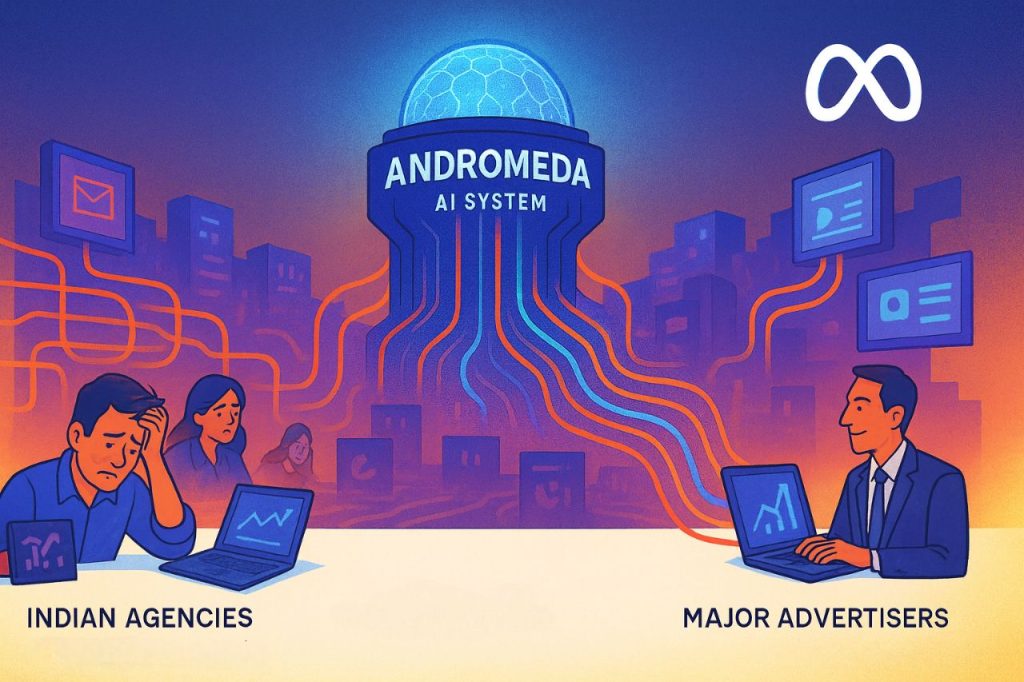
Indian agencies report increased costs, complexity, and performance volatility, with the system particularly favoring high-spend advertisers who can feed more data to the machine learning models. Let’s break down how this has specifically impacted the Indian market:
Challenge 1: Small Budget Advertisers Hit Hardest
The Problem: Andromeda’s machine learning thrives on data. Meta’s machine learning models favor large advertisers with high spend and conversion volume. For small Indian businesses spending ₹20,000-50,000 monthly, the system doesn’t have enough data to optimize effectively.
Real Numbers from Indian Market:
- Brands spending <₹50,000/month: Average 35-40% cost increase
- Brands spending ₹1-3 lakh/month: 15-20% cost increase
- Brands spending >₹10 lakh/month: 5-10% cost increase or improvement
Mitigation Strategy: Consolidate all your budget into fewer campaigns. If you’re spending ₹30,000 monthly across 5 campaigns (₹6,000 each), you’re starving each campaign. Instead, run 1-2 campaigns with higher budget density.
Challenge 2: Attribution Complexity
The Issue: The lack of clear attribution and conversion lag has complicated ROI tracking, leading to uncertainty in performance forecasting and client reporting.
Indian Agency Example: Mumbai-based Media Care Brand Solutions reports: “Performance that was stable for months started fluctuating wildly. Week 1 might show excellent ROAS, Week 2 tanks, Week 3 recovers—all with identical setup. This makes client reporting nightmarish.”
What’s Happening: Andromeda doesn’t just optimize for immediate conversions. It identifies users early in their journey and nurtures them through the funnel. This means:
- Longer attribution windows (7-14 days vs. 1-day click)
- Conversions appearing “late” in reporting
- Platform ROAS looking good while GA4 shows different numbers
Challenge 3: Data Dependency Deepens
To fully leverage Andromeda, brands must share extensive conversion and behavioral data with Meta, effectively surrendering proprietary insights to the platform.
For Indian Advertisers, This Means:
- Implementing Conversions API (CAPI) is now mandatory, not optional
- Sharing more customer data: email, phone, purchase history
- Installing Meta Pixel with enhanced parameters
- Feeding product catalogs with detailed attributes
Privacy Concern: Many Indian businesses, especially in finance and healthcare, are hesitant about sharing customer data. But without it, Andromeda can’t optimize effectively. This creates a competitive disadvantage.
Challenge 4: Agency Model Disruption
The update has disrupted the agency landscape, forcing teams to rethink campaign structures and budget allocation strategies, as complex setups with multiple ad sets and tightly defined audiences are now counterproductive.
What’s Changing in Indian Agencies:
- Old Skill: Audience research and segmentation mastery
- New Skill: Creative ideation and rapid testing
- Old Deliverable: Detailed audience strategy documents
- New Deliverable: Diverse creative libraries (15-30 assets monthly)
- Old Team Structure: 1 strategist + 1 media buyer
- New Team Structure: 1 strategist + 2 creative developers + 1 media buyer
Bangalore Agency Quote: “Clients still want us to explain our ‘targeting strategy,’ but honestly, targeting barely matters anymore. Our value now is in producing 20 different creative concepts monthly and reading AI signals faster than competitors,” shares Priya, Director at a Bengaluru performance marketing agency.
How to Fix Your Facebook Ads: The Andromeda-Proof Strategy
Now for the good news: once you understand the new rules, you can not only recover your performance but potentially exceed your pre-Andromeda results. Here’s the complete playbook for Indian advertisers:
Strategy #1: Embrace Broad Targeting
What This Means:
- Location: All of India (or entire state)
- Age: 18-65+
- Gender: All
- Detailed Targeting: NONE or minimal
- Placement: Advantage+ Placements (all automatic)
Why It Works: Andromeda’s intelligence asks which ad should this person see, allowing the system to identify patterns that marketers can no longer realistically manage at scale with broader audiences.
Indian Implementation Example:
Before (Narrow):
- Location: Mumbai, Pune, Bengaluru
- Age: 25-35
- Interest: Fitness, Yoga, Healthy Living
- Gender: Female
- Monthly Spend: ₹80,000
- Results: 95 conversions, ₹842 CPA
After (Broad):
- Location: All India
- Age: 18-65+
- Interest: NONE
- Gender: All
- Monthly Spend: ₹80,000
- Results: 168 conversions, ₹476 CPA
This is a real result from a Hyderabad-based nutraceutical brand in August 2025.
Important Exception: Exclude existing customers and past purchasers. Andromeda tends to find people most likely to convert and keeps circling back to existing customers and site visitors, gaming its own metrics by going after the easiest conversions rather than new customer acquisition.
How to Add Exclusions:
- Create a custom audience of past purchasers (365 days)
- Create a custom audience of website visitors (180 days)
- Exclude both from your ad set
- Monitor “New Customer” metrics in Shopify/your e-commerce platform
Strategy #2: Creative Diversity is King
Meta now recommends 8-15 genuinely different ad concepts per campaign as the new standard. But what does “genuinely different” mean for Indian brands?
The Creative Matrix Framework:
Create ads across these 6 emotional/functional dimensions:
1. Aspiration/Transformation
- “Become the confident version of yourself”
- Visual: Before/after, aspirational lifestyle
- Example: Fitness app showing transformed user
2. Social Proof/Belonging
- “Join 50,000 Indians who switched”
- Visual: Customer testimonials, reviews, UGC
- Example: Screenshot of 5-star reviews with Indian names
3. Practical/Functional
- “Saves ₹500 monthly on your grocery bill”
- Visual: Product features, how-it-works
- Example: Step-by-step infographic
4. Urgency/Scarcity
- “Diwali sale ends in 48 hours”
- Visual: Timer, limited stock indicators
- Example: Countdown with festival theme
5. Problem/Agitation
- “Tired of expensive salon visits every month?”
- Visual: Relatable pain point scenario
- Example: Person frustrated with current solution
6. Authority/Trust
- “Certified by ISI, trusted since 2010”
- Visual: Certifications, awards, expert endorsements
- Example: Certificates with founder story
Real Indian Brand Example:
Jaipur-based Jewelry Brand (₹2.5 lakh monthly budget)
Old Approach (Pre-Andromeda):
- 4 ads total
- All showing product on white background
- Minor variations in headline (“Buy Now” vs. “Shop Now”)
- Result: ₹1,850 cost per purchase
New Approach (Post-Andromeda):
- 18 different ads including:
- Founder story video (authority)
- Customer unboxing videos (social proof)
- Diwali gifting angle (urgency + occasion)
- Comparison vs. mall jewelry (practical)
- Bride wearing collection (aspiration)
- Craftsman making piece (trust + heritage)
- Result: ₹720 cost per purchase
Format Diversity Matters Too:
Don’t just create 15 static images. Mix:
- 40% Video ads (15-30 seconds)
- 30% Static images
- 20% Carousel ads (3-7 cards)
- 10% Collection ads (if applicable)
Strategy #3: Consolidate Your Campaign Structure
Forget everything you know about campaign structure – we used to only want 3-6 ads in an ad set, but now that Meta is rewarding creative portfolios, we’re seeing campaigns with more creatives absolutely crushing it.
The New Structure for Indian Advertisers:
Tier 1: Small Budget (₹20,000-1 lakh/month)
- 1 Campaign: Sales/Conversions
- 1 Ad Set: Broad targeting, all India (or your target states)
- 10-15 Ads: Diverse creative portfolio
- Budget: Entire monthly budget in this one campaign
Tier 2: Medium Budget (₹1-5 lakh/month)
- 2 Campaigns:
- Campaign 1: Prospecting (70% budget)
- Campaign 2: Retargeting with exclusions (30% budget)
- 1 Ad Set per Campaign
- 15-25 Ads: In prospecting, 8-10 ads in retargeting
- Advantage+ Shopping: If e-commerce, consider this
Tier 3: Large Budget (₹5 lakh+/month)
- 2-3 Campaigns:
- Campaign 1: Advantage+ Shopping (if e-commerce) – 50% budget
- Campaign 2: Prospecting broad – 30% budget
- Campaign 3: Retargeting – 20% budget
- 1-2 Ad Sets per Campaign
- 20-50 Ads: Maximum creative diversity
- Testing Campaign: Separate small-budget campaign (₹10-20k) for testing new creatives
Case Study: Mumbai D2C Skincare Brand
Before Consolidation:
- 8 campaigns (Cold, Warm, Hot, LAL 1%, LAL 2%, Retargeting, DPA, Testing)
- Average 3-4 ads per campaign
- Total: 28 ads across 8 campaigns
- Monthly Spend: ₹4.5 lakh
- ROAS: 2.1x
- New customers: 340
After Consolidation:
- 2 campaigns (Prospecting Broad + Retargeting)
- 35 ads in Prospecting, 12 in Retargeting
- Total: 47 ads across 2 campaigns
- Monthly Spend: ₹4.5 lakh
- ROAS: 3.4x
- New customers: 612
Time period: Comparison between March 2025 (before) and September 2025 (after restructuring)
Strategy #4: Feed the Machine with Data
Andromeda is only as smart as the data you provide. For Indian advertisers, this means:
A. Implement Conversions API (CAPI)
Why It’s Critical: Browser-based tracking (Meta Pixel alone) captures only 60-70% of conversions due to:
- iOS tracking restrictions
- Ad blockers
- Browser privacy settings
- Cookie deletion
CAPI sends conversion data directly from your server to Meta, bypassing browser limitations.
For Indian Businesses:
- Shopify users: Install official CAPI integration (free, takes 10 minutes)
- WooCommerce: Use plugins like PixelYourSite or official Meta integration
- Custom websites: Hire developer for server-side implementation (₹15,000-40,000 one-time)
Real Impact: A Chennai-based electronics retailer saw their reported conversions increase from 85/month to 142/month after CAPI implementation—same actual sales, but Meta now saw all of them and optimized better.
B. Enhanced Data Parameters
Send Meta as much information as possible about each conversion:
Minimum (Required):
- Purchase event
- Purchase value
- Currency (INR)
Better:
- Customer email (hashed)
- Customer phone (hashed)
- Product IDs purchased
- Category purchased
Best:
- All of the above PLUS
- Customer lifetime value
- Subscription status
- Customer acquisition source
- Repeat purchase indicator
Privacy Note: All personal data (email, phone) is hashed before sending to Meta, complying with Indian data protection norms. Neither Meta nor advertisers can reverse the hashing to see the actual data.
C. Value-Based Optimization
Instead of optimizing for “Purchases,” optimize for “Purchase Value.”
Example:
- Average order value: ₹1,200
- Some orders: ₹500
- Some orders: ₹3,500
When you optimize for “Purchases,” Meta treats all purchases equally. When you optimize for “Purchase Value,” Meta learns to find customers likely to spend ₹3,500, not ₹500.
Delhi Home Decor Brand Result:
- Before (Purchase optimization): Average order value ₹980
- After (Value optimization): Average order value ₹1,540
- Same CPA, 57% more revenue per customer
Strategy #5: Let Advantage+ Work for You
Meta’s new AI system handles bidding, placements, and targeting automatically, with the machine truly starting to take control.
What to Turn ON:
Advantage+ Placements:
- Let Meta choose where ads appear (Feed, Stories, Reels, etc.)
- Don’t manually select placements unless you have very specific reasons
Advantage+ Creative:
- Allows Meta to test variations of your creative
- Small optimizations like brightness, contrast, text overlay adjustments
- Free performance lift (typically 5-12%)
Advantage+ Audience:
- Provides your original audience as a “suggestion”
- Meta can expand beyond it when it finds better opportunities
- Best of both worlds
Advantage Campaign Budget (formerly CBO):
- Must be enabled—no longer optional
- Meta distributes budget across ad sets in same campaign
- Much smarter than manual allocation
What to Turn OFF (or watch closely):
Advantage+ Detailed Targeting Expansion:
- Can sometimes go too broad too fast
- Test both on/off to see what works for your business
Dynamic Creative:
- In theory sounds good (Meta auto-combines elements)
- In practice, often underperforms curated ad creatives
- Use for testing, not as primary strategy
Automatic Advanced Matching:
- Turn this ON for better customer matching
- Helps Meta identify users across devices
Strategy #6: The 7-Day Rule
Don’t smash the kill switch after 24 hours—give campaigns at least 7 days unless the campaign as a whole is missing benchmarks and Meta has already starved the ad.
Why This Matters:
Learning Phase:
- Andromeda needs approximately 50 optimization events (purchases, leads, etc.) to exit learning phase
- During learning phase, performance is volatile and often poor
- Killing campaigns early prevents the AI from learning
Indian Budget Reality:
Small Budget Example (₹30,000/month = ₹1,000/day):
- If your average CPA is ₹600
- You get ~1.6 conversions/day
- Takes 31 days to get 50 conversions
- Patience is critical
What This Means:
- Don’t panic if Day 1-3 looks expensive
- Look at cumulative performance, not daily
- Only kill if Day 7 cumulative is 2x+ worse than benchmark
Delhi Agency Best Practice: “We now evaluate campaigns on Day 7, not Day 3. We’ve seen campaigns that looked terrible on Day 2 become top performers by Day 10. The AI needs time,” says Karan, Performance Lead at a Delhi agency.
Strategy #7: Creative Refresh Cadence
The New Rule: Meta recommends testing 20 new creatives per week. That’s aggressive for most Indian SMBs, but the principle holds: constant creative refreshment is essential.
Realistic Indian SMB Approach:
For ₹50,000-1 lakh/month budget:
- Add 5-8 new creatives every 2 weeks
- Remove bottom 20% performers monthly
- Keep top performers running (yes, even for months)
For ₹1-3 lakh/month budget:
- Add 10-15 new creatives every 2 weeks
- Aggressive creative testing campaign (₹10-15k/month)
- Refresh creative library monthly
For ₹3 lakh+/month budget:
- Add 15-20 new creatives weekly
- Dedicated creative testing campaign
- Work with content creators for UGC
Signs a Creative Needs Retirement:
- Frequency above 3.5-4.0
- CTR dropped 40%+ from peak
- CPA increased 50%+ from baseline
- Running for 60+ days with declining performance
Bangalore E-commerce Brand Insight: “We used to run the same 5 ads for months. Now we have a content calendar—every Monday, 5 new ads go live. Our creative team works like a newsroom. It’s intense but results speak: CPA down 35% since we adopted this,” shares Ananya, Marketing Head.
Real Indian Case Studies: What’s Working Right Now
Let’s look at specific Indian brands that successfully adapted to the Andromeda Facebook ads update:
Case Study 1: Pune Fitness Supplements Brand
Background:
- Monthly Ad Spend: ₹1.8 lakh
- Product: Protein powders, pre-workout
- Target: Fitness enthusiasts, gym-goers
Pre-Andromeda Performance (January 2025):
- 8 campaigns (various audience segments)
- 4-5 ads per campaign, mostly product shots
- CPA: ₹485
- Monthly orders: 371
- ROAS: 3.2x
The Crisis (March-April 2025):
- CPA jumped to ₹1,240
- Monthly orders dropped to 145
- ROAS crashed to 1.3x
- Owner panicked, almost paused all ads
The Fix (Implemented May 2025):
Campaign Structure:
- Consolidated to 2 campaigns (Prospecting + Retargeting)
- All India targeting (previously only 8 cities)
- Removed all interest targeting
Creative Overhaul:
- Created 22 new ads across formats:
- Transformation videos (customer before/after)
- Gym workout videos featuring product
- Nutritionist testimonial (authority)
- Ingredient breakdown (education/trust)
- “Made in India” positioning (patriotism)
- Comparison vs imported brands (practical)
- Festival offer angles (Diwali, New Year)
Results (September 2025):
- CPA: ₹380 (22% better than pre-Andromeda)
- Monthly orders: 474 (28% increase)
- ROAS: 4.1x (28% improvement)
- Discovering customers in Tier-2 cities they never targeted before
Key Takeaway: “We stopped trying to ‘find’ our audience and started creating content that made the right audience find us. Game changer,” says Rohan, the founder.
Case Study 2: Jaipur Ethnic Wear E-commerce
Background:
- Monthly Ad Spend: ₹4.2 lakh
- Product: Ethnic wear, occasion wear for women
- Target: Women, weddings, festivals
Pre-Andromeda (December 2024):
- Complex structure: 12 campaigns
- Heavy reliance on lookalike audiences (wedding shoppers LAL)
- Static product images on white background
- CPA: ₹890
- Monthly revenue: ₹14.2 lakh
- ROAS: 3.4x
The Struggle (February-June 2025):
- Performance became wildly inconsistent
- Some weeks: ₹680 CPA, other weeks: ₹1,850 CPA
- Unable to forecast or plan inventory
- Tested budget increases, interest changes—nothing worked
- Hired new agency in frustration
The Transformation (July-October 2025):
New Agency Approach:
- Burned old campaign structure completely
- Built 2 campaigns from scratch:
- Advantage+ Shopping Campaign (primary)
- Broad Manual Campaign with creative focus (supplementary)
Creative Revolution:
- Hired 8 Instagram micro-influencers (5k-50k followers)
- Created 45 unique UGC videos showing:
- Women wearing products at actual weddings
- Styling videos (how to drape, accessorize)
- Cultural storytelling (Rajasthani heritage)
- Festive collection showcases
- Behind-the-scenes of craftsmanship
- Mixed formats: Reels-style vertical videos, carousel product showcases, founder story
Technical Implementation:
- Full CAPI setup (previously just pixel)
- Enhanced catalog with attributes (occasion, fabric, region)
- Value optimization instead of purchase optimization
- Excluded past purchasers explicitly
Results (October 2025):
- CPA: ₹520 (42% better than December 2024)
- Monthly revenue: ₹24.8 lakh (75% increase)
- ROAS: 5.9x (73% improvement)
- Ad frequency stabilized, performance consistency improved
Founder Quote: “The old agency kept blaming ‘market conditions’ and ‘algorithm changes.’ The new agency said, ‘Let’s feed the AI what it wants—diverse, authentic content.’ Within 30 days we saw improvement. Within 90 days we hit record numbers.”
Case Study 3: Bengaluru B2B SaaS Lead Generation
Background:
- Monthly Ad Spend: ₹2.5 lakh
- Product: CRM software for Indian SMBs
- Target: Business owners, sales managers
Pre-Andromeda (January 2025):
- 6 campaigns segmented by company size and industry
- LinkedIn-style professional creative (boring, corporate)
- Lead forms on Facebook
- CPL: ₹950
- Monthly leads: 263
- SQL (Sales Qualified Lead) rate: 18%
The Problem (March-May 2025):
- CPL jumped to ₹2,100
- Lead quality deteriorated
- SQL rate dropped to 9%
- Sales team complained about poor lead quality
The Adaptation (June-September 2025):
Campaign Simplification:
- 1 lead generation campaign, all India, broad (age 25-65+, all genders)
- Removed all job title and company size targeting
- Let Andromeda find the pattern
Creative Strategy Shift:
- Stopped boring corporate stock images
- Created founder-led educational videos:
- “5 CRM mistakes costing you ₹10 lakh annually”
- “How we helped a Pune manufacturer double sales”
- Customer success story videos
- Behind-the-scenes of customer onboarding
- “Day in the life” of their customer success team
- Added 12 different lead magnets (previously just 1):
- Industry-specific calculators
- Free CRM audit
- Templates and checklists
- Webinar registrations
Lead Form Changes:
- Reduced form fields from 9 to 4
- Added qualification question: “What’s your monthly revenue?”
- This reduced volume but increased quality
Results (September 2025):
- CPL: ₹1,280 (down from ₹2,100 peak, up from original ₹950)
- Monthly leads: 195 (fewer total)
- SQL rate: 34% (massive improvement)
- Actual closed deals: Up 76%
Key Insight: “We were optimizing for lead volume when we should’ve been optimizing for lead value. Andromeda forced us to rethink our entire funnel. We’re spending slightly more per lead but closing way more business,” explains Priya, Head of Growth.
Common Mistakes Indian Advertisers Are Still Making
Even after months of Andromeda being live, many Indian advertisers continue making critical errors:
Mistake #1: Still Using Detailed Targeting
The Error: Advertisers continue adding interests like “online shopping,” “fashion,” “fitness” believing they’re “helping” the algorithm.
Why It’s Wrong: You’re restricting Andromeda’s ability to discover audiences you never thought of. The system maps users and ads in mathematical space far more sophisticated than simple interest matching.
Real Example: A Mumbai supplement brand targeting “health and wellness” + “fitness” interests was missing 60% of their actual buyers—busy professionals who never engaged with fitness content but bought supplements for general health. When they removed all interests, Andromeda found these customers.
What to Do Instead:
- Use broad targeting (location only)
- Let Conversions API and purchase data teach the algorithm
- Trust the machine to find patterns
Mistake #2: Creating “Fake” Creative Diversity
The Error: Making 10 ads that are essentially the same image with minor variations (different headlines, button colors, slight crop differences).
Why It’s Wrong: Andromeda’s AI sees through this. It recognizes these as duplicates and won’t distribute budget effectively across them.
Real Example from Hyderabad Agency: “Client submitted 15 ‘new’ ads—all the same product photo with different background colors. Zero performance improvement. We explained they need 15 different concepts, not 15 versions of one concept,” shares Vikram, Creative Director.
What to Do Instead:
- Test different emotional angles (aspiration, fear, social proof, urgency)
- Use different formats (video, carousel, static)
- Show different use cases or benefits
- Feature different people/scenarios
- Tell different stories
The Litmus Test: If someone scrolling would think “I just saw this ad,” even though the headline changed, you don’t have real diversity.
Mistake #3: Obsessing Over CPM Increases
The Error: Panicking when CPMs (cost per thousand impressions) increase from ₹150 to ₹220 and immediately pausing campaigns.
Why It’s Wrong: CPM isn’t the success metric—cost per result is. Higher CPMs are fine if your conversion rate increases proportionally or better.
The Math:
- Scenario A: CPM ₹150, CTR 2%, CVR 3%, CPA = ₹250
- Scenario B: CPM ₹220, CTR 2.5%, CVR 4.5%, CPA = ₹195
Scenario B has higher CPM but lower CPA because Andromeda is showing ads to higher-intent users.
Delhi Fashion Brand Experience: They saw CPMs rise from ₹180 to ₹270 but CPA dropped from ₹980 to ₹640. The algorithm was targeting more expensive placements (Instagram Reels) but to much higher-converting audiences.
What to Do Instead:
- Monitor CPA, ROAS, and cost per purchase
- Ignore CPM fluctuations unless they correlate with worse CPA
- Understand that quality impressions cost more
Mistake #4: Not Excluding Past Customers
The Error: Running broad campaigns without excluding people who already bought, assuming Andromeda will figure it out.
Why It’s Wrong: Andromeda loves easy wins. Past customers are most likely to “convert” again (click, add to cart), so the algorithm keeps showing them ads, gaming its own metrics rather than finding new customers.
Bangalore E-commerce Data: Before exclusions: 34% of ad impressions went to past customers After exclusions: 8% of ad impressions went to past customers (unavoidable overlap) New customer acquisition: Increased 67%
What to Do Instead:
- Create custom audience: Website purchasers (365 days)
- Create custom audience: Email list
- Exclude both from prospecting campaigns
- Keep them in retargeting campaigns only
Mistake #5: Giving Up Too Soon
The Error: Pausing campaigns after 2-3 days of poor performance during learning phase.
Why It’s Wrong: Learning phase requires approximately 50 conversions. If you’re getting 2-3 conversions per day, the algorithm needs 15-20 days to stabilize, not 3 days.
Pune Startup Experience: Day 1-3: CPA ₹3,500 (terrible) Day 4-7: CPA ₹1,800 (still bad) Day 8-14: CPA ₹950 (getting better) Day 15-21: CPA ₹520 (profitable) Day 22+: CPA ₹380 (excellent)
They almost paused on Day 4. Glad they didn’t.
What to Do Instead:
- Set realistic expectations for learning phase
- Evaluate on Day 7 cumulative, not daily
- Only pause if Day 7 cumulative is 2.5x+ worse than breakeven
Mistake #6: Ignoring Meta’s Own Recommendations
The Error: Dismissing Meta’s in-platform recommendations as “trying to make us spend more.”
Why It’s Wrong: Post-Andromeda, Meta’s recommendations are actually useful. The platform flags real issues like:
- “Account not connected to CAPI”
- “Limited ad creative diversity”
- “Audience too narrow”
- “Campaign budget too low for optimization”
Real Indian Advertiser Testimonial: “I used to ignore those notification dots in Ads Manager. When performance tanked in March, I finally clicked them. Implemented all 6 recommendations. Performance recovered within 2 weeks,” says Anjali from Chennai.
What to Do Instead:
- Check “Recommendations” tab weekly
- Implement suggestions unless you have specific reason not to
- Pay special attention to “creative limited” warnings
Mistake #7: Comparing Apples to Oranges
The Error: “Facebook says I got 150 conversions but Google Analytics shows 98. Facebook is lying!”
Why It’s Wrong: Different attribution models. Meta uses last-click 7-day + view 1-day attribution. Google Analytics uses last non-direct click with different window.
Understanding the Discrepancy:
Why Numbers Don’t Match:
- Facebook counts view-through conversions (saw ad, didn’t click, but purchased later)
- Google Analytics doesn’t count those
- Facebook has better cross-device tracking
- Cookies limitations affect Google Analytics more
Typical Discrepancy Range:
- 15-25% difference is normal
- Facebook usually reports 15-25% higher
- Both are “correct” within their attribution models
What to Do Instead:
- Pick ONE source of truth (ideally Meta)
- Use Google Analytics for behavior analysis, not conversion counting
- Focus on trends, not absolute numbers
- If using Shopify, trust Shopify’s numbers most
Platform-Specific Tips for Indian Advertisers
For E-Commerce Brands (Shopify, WooCommerce)
Must-Do Actions:
- Use Advantage+ Shopping Campaigns
- Meta’s most advanced AI for e-commerce
- Typically outperforms manual campaigns by 15-30%
- Setup takes 5 minutes
- Let it run for minimum 14 days
- Install Official CAPI
- Shopify: Go to Settings → Apps → Meta → Enable CAPI (free)
- WooCommerce: Use PixelYourSite Pro or official Meta plugin
- Verify via Events Manager
- Optimize Product Catalog
- Add detailed descriptions
- Include all relevant attributes (color, size, material)
- Keep inventory updated
- Use high-quality images
- Collection Ads
- Showcase multiple products in one ad
- Great for fashion, jewelry, home decor
- Higher engagement than single-product ads
Recommended Budget Split:
- 60% Advantage+ Shopping
- 25% Broad Prospecting
- 15% Retargeting
For Lead Generation (B2B, Education, Services)
Must-Do Actions:
- Simplify Lead Forms
- Maximum 4-5 fields
- Add one qualifying question
- Use pre-filled information (name, email auto-filled from Facebook)
- Multiple Lead Magnets
- Don’t run one lead magnet for months
- Create 8-10 different offers:
- Free calculators
- Templates
- Webinars
- Ebooks
- Free consultations
- Audit/assessment
- Let Andromeda test which resonates
- Lead Quality Optimization
- After 30 days, upload your “qualified leads” list
- Create custom conversion event: “SQL” (Sales Qualified Lead)
- Optimize for SQL, not just lead
- Feed CRM data back to Meta
- Longer Attribution Window
- B2B sales cycles are longer
- Use 7-day click + 1-day view (minimum)
- Consider 28-day window for expensive services
Recommended Creative Mix:
- 40% Educational content (solve problems)
- 30% Social proof (testimonials, case studies)
- 20% Founder/expert-led content
- 10% Direct offer/urgency
For Local Businesses (Restaurants, Salons, Gyms)
Must-Do Actions:
- Tight Geographic Targeting
- 5-15 km radius around business location
- Exception to “broad targeting” rule
- Local businesses need local reach
- Location-Specific Creative
- Mention neighborhood/landmark
- “Koramangala’s favorite pizza” beats “Bengaluru’s favorite pizza”
- Show store front, interiors
- Offer-Driven
- Local consumers respond to deals
- “20% off this weekend”
- “First-time customer discount”
- “Bring this ad, get free starter”
- Call/Directions as Conversions
- Optimize for phone calls or directions clicks
- These are high-intent actions
- Track with Facebook’s built-in conversion events
Recommended Budget:
- Minimum ₹15,000-20,000/month
- Below this, insufficient data for optimization
Tools and Resources for Indian Advertisers
Analytics & Tracking
1. Meta Events Manager
- Free, built into Meta Business Suite
- Verify pixel and CAPI working correctly
- Check for tracking issues
- URL: business.facebook.com/events_manager
2. Triple Whale (₹3,000-10,000/month)
- Real-time analytics dashboard
- Attribution modeling
- Profit tracking
- Better than native Meta reporting
3. Google Analytics 4
- Free
- Behavior analysis
- Multi-channel attribution
- Use alongside Meta, not instead of
Creative Development
1. Canva (Free – ₹1,000/month)
- Easy static ad creation
- Templates for Indian festivals
- Video editing capabilities
- Team collaboration
2. CapCut (Free)
- Mobile video editing
- Perfect for Reels-style content
- Trending templates
3. Vidyo.ai (₹700-2,500/month)
- Repurposes long videos into short clips
- Auto-generates captions
- Great for creating multiple variations
4. Foreplay (₹2,000-8,000/month)
- Save and organize competitor ads
- Inspiration library
- Collaborative swipe file
Influencer & UGC Sourcing
1. Qoruz (Contact for pricing)
- India-focused influencer marketplace
- Nano to mega influencers
- Campaign management
2. Instagram Direct Outreach
- Search hashtags in your niche
- Find 5k-50k follower creators
- Negotiate ₹1,500-5,000 per video
- Get usage rights for ads
3. Your Own Customers
- Offer ₹500-1,000 discount for video review
- Most authentic content
- Already proven buyers
Competitor Research
- Free
- See all active ads from any brand
- Study what’s running longest (= working)
- URL: facebook.com/ads/library
2. PowerAdSpy (₹3,000-10,000/month)
- Detailed competitor ad analysis
- Engagement metrics
- Landing page captures
3. Manual Research
- Follow competitor pages
- Screenshot ads you see
- Note creative patterns
Budget Optimization Strategies Post-Andromeda
How to Allocate Your Monthly Budget
For ₹50,000/month:
- ₹40,000 (80%): One broad prospecting campaign, 12-15 ads
- ₹10,000 (20%): Retargeting past engagers
For ₹1,00,000/month:
- ₹70,000 (70%): Broad prospecting, 15-20 ads
- ₹20,000 (20%): Retargeting
- ₹10,000 (10%): Creative testing campaign
For ₹3,00,000/month:
- ₹1,50,000 (50%): Advantage+ Shopping (if e-commerce)
- ₹90,000 (30%): Broad prospecting manual
- ₹45,000 (15%): Retargeting
- ₹15,000 (5%): Testing
For ₹5,00,000+/month:
- ₹2,50,000 (50%): Advantage+ Shopping
- ₹1,25,000 (25%): Broad prospecting
- ₹75,000 (15%): Retargeting
- ₹50,000 (10%): Testing & new platforms (YouTube, TikTok)
When to Increase Budget
Green Signals:
✅ ROAS stable for 14+ days
✅ CPA within target range
✅ Learning phase completed
✅ Frequency under 3.0
✅ Creative diversity maintained
How to Increase:
- Maximum 20% increase every 3-4 days
- Don’t double budget overnight (resets learning)
- Monitor for 48 hours after each increase
Example:
- Week 1: ₹50,000
- Week 2: ₹60,000 (20% increase)
- Week 3: ₹72,000 (20% increase)
- Week 4: ₹86,000 (19% increase)
When to Decrease Budget
Red Signals:
❌ ROAS below breakeven for 7+ days
❌ CPA 2x+ target for 5+ days
❌ Frequency climbing above 4.0
❌ Creative fatigue visible
How to Decrease:
- Can decrease faster than increases (30-40% cuts okay)
- Fix underlying issues before re-increasing
- Consider pausing vs. decreasing if fundamentally broken
Future-Proofing Your Facebook Ads Strategy
Andromeda isn’t the end of algorithmic evolution—it’s the beginning. Here’s how to stay ahead:
1. Invest in Creative Infrastructure
The brands winning post-Andromeda have in-house or agency creative teams producing 15-30 assets monthly. This isn’t optional anymore—it’s the price of entry.
Build Your Creative System:
- Option A: In-house creator (hire full-time, ₹25,000-45,000/month)
- Option B: Agency retainer (₹30,000-1,00,000/month depending on volume)
- Option C: Freelancer network (3-5 freelancers, project-based)
2. Develop First-Party Data Assets
Brands with strong first-party data (email lists, purchase history, CRM data) have massive advantages in Andromeda’s world.
Action Steps:
- Grow email list aggressively (offer incentives)
- Implement Conversions API properly
- Feed more data parameters to Meta
- Build customer segmentation in CRM
- Use customer LTV data for optimization
3. Embrace Multi-Platform Strategy
Don’t put all eggs in Facebook basket. Andromeda works well but platform diversification protects you.
Recommended Mix for Indian Advertisers:
- 60% Meta (Facebook + Instagram)
- 20% Google (Search + Shopping + YouTube)
- 15% Programmatic/Native (DV360, Taboola, Times Internet)
- 5% Emerging (ShareChat, Moj, other regional platforms)
4. Continuous Learning Culture
Post-Andromeda, what worked last month might not work this month. Stay updated:
- Follow Meta for Business blog
- Join Indian performance marketing communities
- Test continuously (allocate 5-10% budget to testing)
- Attend webinars and workshops
- Share learnings with peers
Indian Communities to Join:
- Performance Marketing India (Facebook Group)
- Digital Marketing India (LinkedIn)
- E-commerce Brands India (Telegram groups)
- Local city-specific marketing meetups
Conclusion: Thriving in the Andromeda Era
The Andromeda Facebook Ads update has fundamentally changed how performance marketing works on Meta’s platforms. For Indian advertisers who adapted quickly, the results have been spectacular—lower costs, better targeting, and higher returns. For those still clinging to old strategies, it’s been painful.
The Core Truth: Andromeda rewards advertisers who feed the machine what it needs: diverse creative content, clean data signals, and the freedom to explore beyond artificial audience boundaries.
Your Action Plan:
Week 1:
- Audit current campaign structure
- Identify over-segmentation
- Install/verify Conversions API
- Create exclusion audiences (past customers)
Week 2:
- Consolidate campaigns (reduce from 8+ to 2-3)
- Remove detailed targeting from prospecting
- Enable Advantage+ features
- Plan creative production calendar
Week 3-4:
- Produce 15-20 diverse creatives
- Launch new simplified structure
- Monitor but don’t panic during learning phase
Week 5-8:
- Analyze what’s working
- Scale winning approaches
- Build creative refresh system
- Establish new baseline metrics
The Mindset Shift:
Stop thinking like a traditional media buyer (“I need to find my audience”) and start thinking like a creative director (“I need to create content that makes my audience find me”).
Stop trying to outsmart the algorithm and start feeding it what it needs to work for you.
Stop holding onto “the way we’ve always done it” and embrace that digital advertising fundamentally changed in 2025.
The Indian Advertiser’s Advantage
While the Andromeda update has been disruptive globally, Indian advertisers actually have unique advantages:
1. Cost-Effective Creative Production: Indian creators, videographers, and designers offer world-class quality at fraction of Western costs. You can produce 20 diverse ads for what a US brand spends on 5.
2. Diverse Market: India’s linguistic, cultural, and demographic diversity is perfect for the creative diversity Andromeda craves. A brand can create 15 genuinely different ads targeting different Indian sub-cultures, languages, and occasions.
3. Mobile-First Audience: Indian users consume content primarily on mobile, which aligns perfectly with vertical video and Reels—the formats Andromeda loves and prioritizes.
4. Festival & Occasion Calendar: India’s rich calendar of festivals provides endless creative angles and urgency triggers—Diwali, Holi, Eid, Christmas, New Year, regional festivals, wedding season, and more.
5. Growing Market: While mature markets see slowing growth, India’s digital ad market is expanding 20-25% annually. More users, more engagement, more opportunity.
Final Thoughts
The Andromeda Facebook Ads update isn’t a crisis—it’s an opportunity. Yes, it requires changing how you work. Yes, it demands more creative production. Yes, it’s uncomfortable to let go of control and trust AI.
But the advertisers who make these changes are seeing better results than ever before. Lower costs per acquisition. Higher return on ad spend. More efficient customer acquisition.
The old way of doing Facebook ads—complex targeting, minimal creatives, segmented campaigns—is gone. The new way—creative diversity, data richness, AI trust—is here to stay.
The question isn’t whether you’ll adapt. It’s how quickly.
Disclaimer:
This guide is based on industry research, advertiser experiences, and Meta’s official documentation as of November 2025. Meta’s advertising platform continues to evolve. While the strategies outlined have proven effective for numerous Indian advertisers, results may vary based on industry, budget, creative quality, and execution. Always test strategies with your specific business context and monitor results closely. This content is for educational purposes and should not be considered professional advertising advice for your specific situation.